MIPI 2:1 Switch Supports Multi-Camera Devices
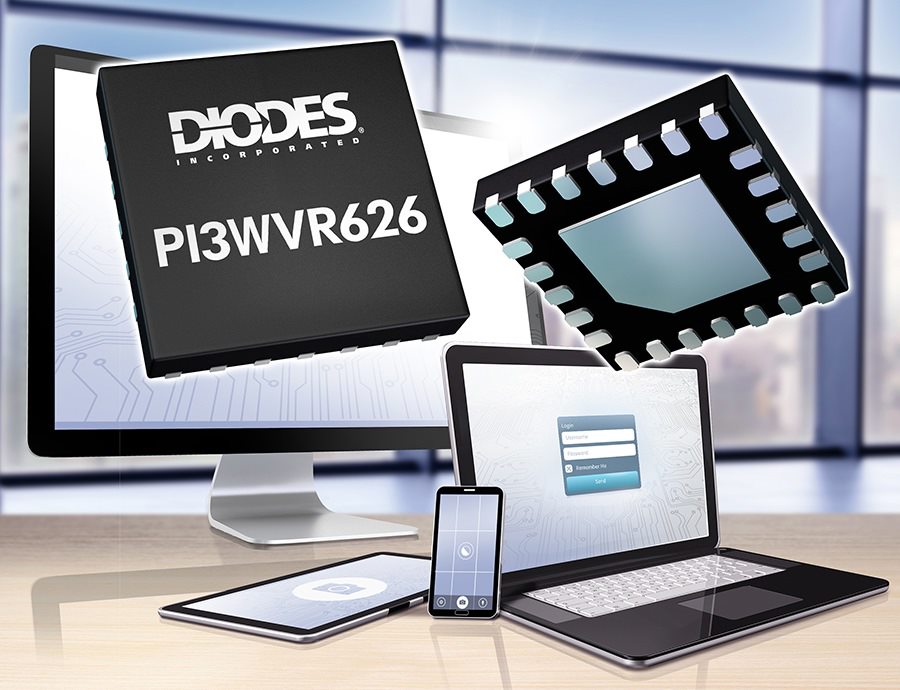
Diodes Incorporated announced the introduction of the PI3WVR626, a MIPI D-PHY/C-PHY 2:1 switch that enables a single host device to interface with two MIPI compliant modules, helping engineers optimize the design of multi-camera cell phones and other personal computing devices.
Many consumer devices now feature multiple cameras compliant with the MIPI interface. For product designs requiring a MIPI switch with only two data lanes, the PI3WVR626 offers a lower cost alternative, addressing the need for an improved solution.
The PI3WVR626 provides 2-to-1 multiplexing via three differential channels, each able to switch high speed (HS) and low power (LP) MIPI signals. The device supports D-PHY through two data lanes and a clock lane, along with two lanes for C-PHY.
Each channel is switched using low on-resistance single-pole double-throw (SPDT) switches, which ensures low insertion loss with a break-before-make operation. The high bandwidth of 4.5GHz, coupled with low channel-to-channel skew and minimal crosstalk, means that data rates of 2.5Gsps for C-PHY operation and 3Gbps for D-PHY data can be supported. The PI3WVR626 can operate from a supply voltage of between 1.5V and 3.6V.
The PI3WVR626 is offered in the X1-QFN2525-24 package and is available now, priced at $0.35 each in 3,500 piece quantities.
For more information visit Diodes Incorporated.