Modern display and control solutions in the field of micromobility require compact, graphics-capable controllers
Figure 1: A possible implementation case with the TRAVEO T2G Graphics shows the “speedometer” on the left-hand side with speed and virtual signal or control symbols, as well as the navigation displayed by a smartphone. On the right is the smartphone with a wireless connection
Digital display and control concepts are increasingly finding their way into vehicle classes that were traditionally equipped with mechanical or basic LCD instrument. Today, the requirements and capabilities of these applications extend far beyond simple speed or fuel indicators: Users expect clear, easy-to-read visualization of safety-related information, personalization options and smartphone integration interfaces.
In the context of software-defined vehicles (SDVs), functions are increasingly being implemented via software and can be adapted or expanded throughout the product life cycle. This applies, in particular, to display units that not only visualize driving data but also integrate safety and comfort functions and can be connected to smartphones or other devices.
The implementation of such systems requires microcontrollers that, in addition to conventional control functionality, can also handle graphics processing and safety functions. At the core of the control electronics are microcontrollers equipped with integrated graphics processing units (GPUs). This category includes Infineon’s new 32-bit microcontrollers from the TRAVEO T2G Graphics series.
Scalable Graphics Controllers for Embedded Display Applications
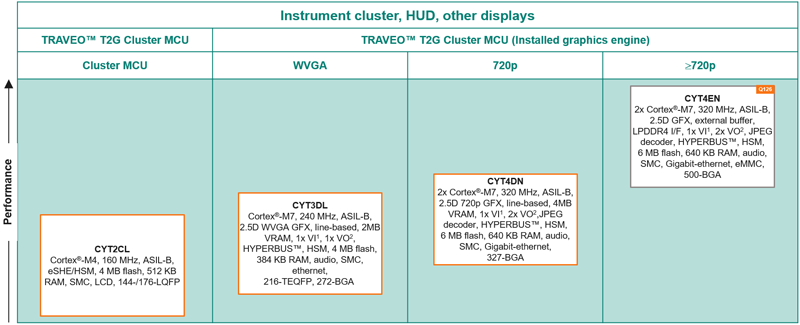
The microcontroller family is designed for various display and control solutions in small vehicles and boats. The product selection is based on the specific requirements of the respective application – from basic segment displays to graphics-intensive display units with video output (Figure 2).
Click image to enlarge
Figure 2: The portfolio of the TRAVEO T2G Graphics (source: Infineon)
The CYT2CL subfamily is ideal for applications with low graphics requirements, such as basic speedometers with LCD segments or pointer instruments with stepper motors. These modules deliver essential control logic and I/O functionality without requiring a full-fledged graphics engine. The focus is on low power consumption and cost-effective implementation.
Applications with freely configurable graphical user interfaces, such as digital cockpits, scooter displays with navigation overlays or rearview camera systems, can be implemented using the CYT3DL, CYT4DN and CYT4EN subfamilies. These microcontrollers integrate a 2D graphics engine and primarily differ in their RAM configuration and display support. The target is graphic displays with a WVGA resolution (800 × 480 pixels) or higher:
- CYT3DL: internal video RAM (up to 2 MB) for basic 2D graphics at medium resolution
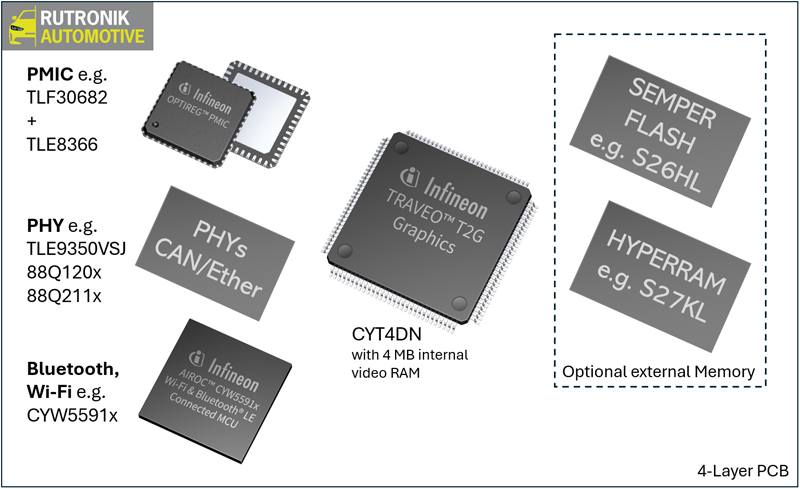
- CYT4DN: enhanced rendering with up to 4 MB internal video RAM, supports multiple display layers and warping (Figure. 3)
- CYT4EN: external LPDDR4 RAM up to 1 GB for high-resolution displays or larger image buffers
The CYT4EN subfamily is designed for complex systems such as head-up displays, digital rearview mirrors or multi-display concepts with projection or camera-based inputs. These derivatives combine high graphics performance with low energy consumption, featuring two independent video outputs (e.g., cockpit + HUD), warping for projection surface correction and optional external LPDDR4 memory. They offer the necessary flexibility for future display and assistance functions.
Click image to enlarge
Figure 3: Possible system components for CYT4DN with 4 MB internal video RAM (source: Rutronik)
All derivatives of the CYT3 and CYT4 families integrate a sound subsystem and numerous peripheral blocks alongside the graphics engine. The graphics subsystem offers a range of performance features, including the following:
· On-chip video RAM with CYT3DL and CYT4DN. The on-chip video RAM increases the integration of the overall system and eliminates the need for external memory modules. The internal bus connection enables fast access times. With CYT4EN, the up to 1 GB big video RAM is designed as external memory with LPDDR4.
· Graphics processing unit (GPU) for on-the-fly 2D rendering with block image transfer (BLIT), image scaling and rotation, perspective correction for 3D effects (2.5D) and command sequencer.
· Display and composition engine with five graphics layers supporting alpha blending, one of which includes a warping function, e.g. for lens or projection surface correction, and two independent video output signals, e.g. for the main display and head-up display.
· Capture engine for a video stream
· Video I/O interface
· JPEG decoder
The key function is the option to render videos and graphics directly (on-the-fly) to the display via a multi-line buffer, instead of first loading them into a large frame buffer in the RAM. This means that the internal video RAM is sufficient for 720p graphics and BOM costs can be reduced, as the system does not require external DDR RAM. This technique is common for basic sprite graphics but unique in the context of 2D GPUs and demanding operations such as image rotation and perspective correction (2.5D).
Safety Functions in Display Units
In many vehicle applications, display units not only perform a comfort function but also safety-related tasks. This includes displaying warning symbols. To ensure that this content is correct and always visible, specific functional safety measures are required.
A key element is the so-called Signature Driver. It calculates a checksum (CRC) for defined image areas on the microcontroller. This checksum is continuously compared with a reference value. This way, you can see whether safety-related display content is shown as required. These properties also qualify the microcontroller as a Safety Companion MCU for display units that are operated in conjunction with an SoC – such as those running Linux with Android Auto or Apple CarPlay support. In these systems, the microcontroller manages the display of safety-related symbols, while the main processor handles all other displays. This allows the overall system to secure safety-critical content in accordance with an ASIL classification without requiring the main SoC to meet functional safety requirements.
In addition to functional safety, an integrated hardware security module (HSM) is also available as an option for all modules. This meets the EVITA Full Specification (E-safety Vehicle InTrusion protected Applications) and enables, for instance, secure system startup and hardware-supported execution of cryptographic functions. Compliance with standard ISO/SAE 21434 for cybersecurity in vehicle development is underway, with certification planned by the end of 2025.
Developer tools and evaluation platforms
Drive Core Graphics is an integrated software solution specially tailored to the microcontroller family for developing graphics-capable applications. It comprises compilers, debuggers and middleware for hardware abstraction, as well as graphics libraries that utilize the acceleration capabilities of the hardware. Among other things, support is provided for connecting to IAR tools (compilers, debuggers) and using Qt-based graphics development. The evaluation license is available free of charge (limited to three months) and is tied to the hardware purchase.
Various licensing models are available for the AUTOSAR MCAL, Qt Runtime and Infineon graphics package software libraries. With the conventional model, users obtain licenses from the respective software providers and manage them themselves. It is especially suited for high-volume projects but requires upfront investment – typically by the start of series production. In the alternative licensing model, Infineon has already included the licensing costs in the component price. This eliminates the need for a separate advance payment or an additional license agreement with a third-party provider. Use is governed by a clickable end user license agreement (EULA). This model simplifies access to production-ready software for small and medium-sized projects with limited quantities, as are often found in the distribution environment.
To fully leverage the potential of graphics-capable microcontrollers, it is crucial that the graphics libraries of software partners actually use the hardware acceleration of the TRAVEO T2G. Infineon has tested and approved several libraries for this purpose. The approved libraries include: Altia Design, DeepScreen, Candera CGISTUDIO and Qt for MCUs.
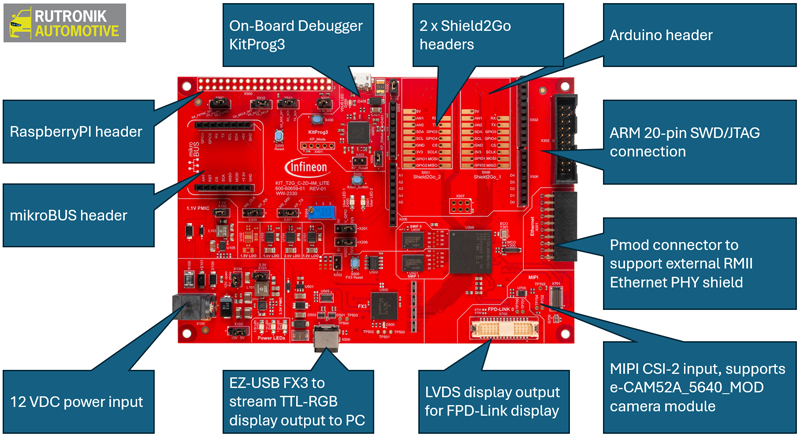
The supplier provides several evaluation platforms for a practical introduction. One example is the KIT_T2G_C-2D-4M_LITE board (Figure. 4), featuring a CYT3DL controller, internal video RAM, as well as external HYPERFLASH and HYPERRAM memory. It enables the development of basic to medium-sized graphical user interfaces and supports typical interfaces such as LVDS, MIPI-CSI-2, Ethernet and CAN.
Click image to enlarge
Figure 4: The KIT_T2G_C-2D-4M_LITE evaluation board based on CYT3DL with 2 MB internal VRAM, external HYPERFLASH (512 Mbit S26HL512T) and 64 Mbit HYPERRAM (S27KL0642) (source: Rutronik, with contents from Infineon)
The reference boards are designed for a wide range of applications – from stand-alone control elements to safety companion roles in more complex system architectures. Extensive connections and interfaces facilitate integration into existing development environments. Rutronik also offers hardware debuggers and flashers from Segger Microcontroller. The distributor also supports developers in identifying the right solution for their specific application from the available portfolio – from the initial idea to series-production readiness.