Modular battery concept for short-distance traffic presented at the IAA International Motor Show
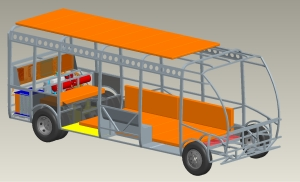
Electric mobility may be economically efficient, with battery-based electric drives applied efficiently in urban buses, for instance. Frequent acceleration and slow-down processes as well as a high utilization rate in short-distance traffic make their use profitable even when considering current battery costs. At the IAA International Motor Show in Frankfurt, Karlsruhe Institute of Technology (KIT) will present an e-city bus demonstrator to illustrate the concept (Hall 3.1, D13). The key modules of the demonstrator are a drive train with a high-torque electric motor, a high-voltage network, a battery management system, and a novel modular battery system with lithium-ion cells made in Germany. At the IAA, the demonstrator developed for drive tests will present options for the design of the electric drive train of buses. Using the demonstrator, the innovation potential of KIT's research results can be validated and interaction of the components can be analyzed experimentally under the simulated operating conditions. "In this way, the demonstrator contributes to the further development of electric mobility," Andreas Gutsch, coordinator of the Competence E project at KIT, explains. The battery system consists of flat modules that can be stacked to reach the dimensions and electric characteristics desired. Various spaces in the different types of vehicles can be used for accommodating the energy storage system. The battery management system and drive control developed for the KIT demonstrator allow for driving operation taking into account the current performance limits of the system and its components. "Energy efficiency of an electric bus can be increased by an adequate selection of components already," says Martin Gießler, Head of the demonstrator development project. "Of course, an anticipatory operation and recuperation strategy plays an important role." By means of recuperation, braking energy is converted into electrical energy again. The drive consists of a low-torque engine supplying a high driving torque for the vehicle. The engine is connected directly with the differential gear of the rear axle. It decreases the gear reduction to be implemented and, hence, ensures a high efficiency of torque transmission. The e-city bus demonstrator development project was funded by the Federal Ministry of Economics and Technology. Karlsruhe Institute of Technology