RB-IGBTs can find application in systems requiring the use of a bidirectional switch
Energy is an issue that affects every person on the planet. With the advancement of the Human Race, Energy Dependence has increased and this has strained the Earth’s natural resources. To make better use of the available resources, numerous efforts have been made to improve existing technology and change the way new products are made and used.
Fuji Electric has developed a century-long reputation for being on the forefront of Energy innovation. The manufacturer’s operating philosophy is centered on the creation of responsible and sustainable societies through innovation in Energy Technology, and they continue to lead the market with revolutionary, advanced solutions, which serve the global effort toward a brighter and healthier tomorrow.
The company recently introduced RB-IGBT’s (Reverse Blocking Insulated Gate Bipolar Transistor, developed for use in Matrix Converters, but the company has been expanding its target application areas which now include Current Source Inverter for Motor Drives (EV/ HEV) and 3 level inverters for PV, Wind and UPS.
Their use in the Advanced T-type NPC (Neutral Point Clamping) 3 level modules give energy efficiency a new meaning.
Device Structure
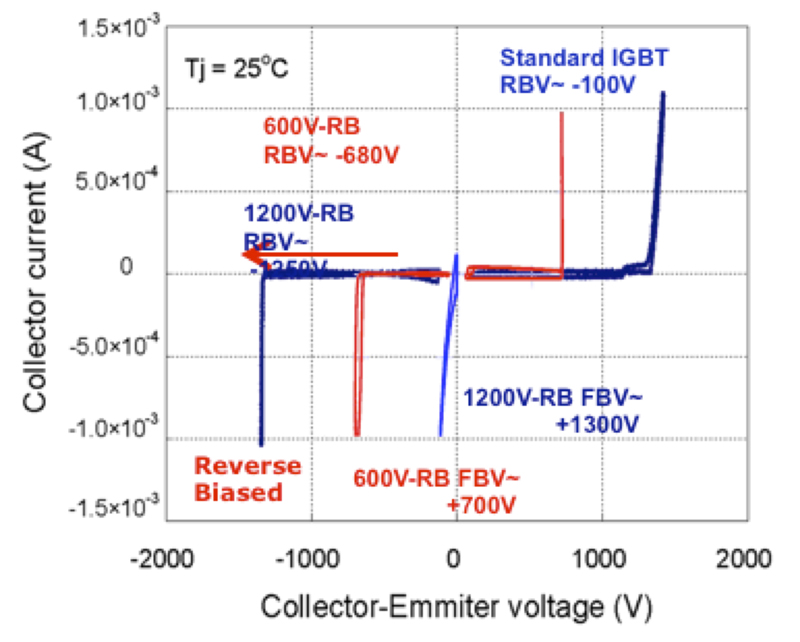
A conventional IGBT has forward and reverse blocking capability. So theoretically, we can use the IGBT to block reverse voltages equivalent to the IGBT forward voltage rating. However, practically, this is not true. Under reverse bias, there is a leakage current, the dependence of this current on reverse voltage is exponential.
The primary difference in structure between the Fuji RB-IGBT & a conventional IGBT is that the former has deep junction isolation structure that limits carrier generation thereby providing the needed (higher) reverse blocking capability.
Performance
The forward characteristics of the RB-IGBT are very similar to that of a standard IGBT. Therefore switching speed and trade-off curve of Von are similar. Figure 1 shows the reverse characteristics of a conventional IGBT as compared to a RB-IGBT.
Click image to enlarge
Figure 1: Advantage of using RB-IGBT’s reverse-blocking capability.
The Reverse Blocking IGBT has found a use in many applications, including but not limited to Inverters, Converters, battery charging systems, matrix converters, pfc circuits, etc.
RB-IGBT’s in Inverters
Multilevel Inverters have been in discussion from the early 1980’s, with an end goal to reduce inverter harmonics and thereby reduce use of magnetic components. An added advantage is reduced losses, with the introduction of NPC, TNPC & ATNPC (Advanced T-type Neutral Point Clamp) topologies.
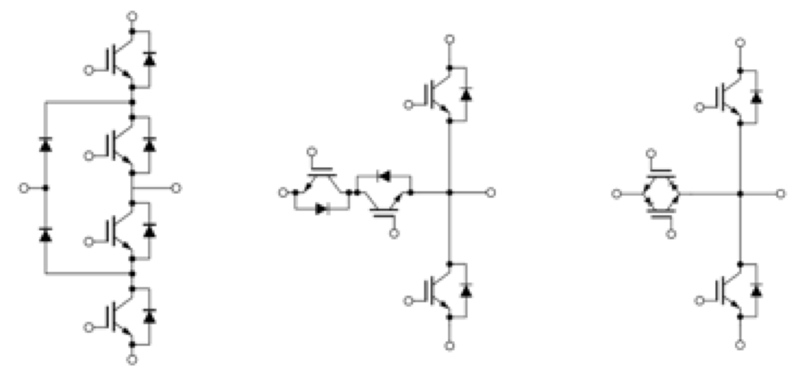
A direct application of the Fuji RB-IGBT is the Advanced T-type Neutral Point Clamped module. The T-type modules in existence/ those offered by our competitors use the conventional AC-Switch shown in 5(a). More components means more losses and more chances of failure. A loss comparison is presented in the next section that details the performance of the 2-level inverter, 3 level NPC inverter, Advanced NPC 3 level inverter and the Advanced T-type 3 level inverter.
There is a significant performance improvement with an efficiency increase of 2% from 95.1% to 97.1%. There is also an added benefit of a 33% volume reduction, weight reduction of 36%, due to the reduction in filter components & magnetics.
RB-IGBT’s in matrix converters
The largest consumers of power in the US today are Industrial Motors. A reduction of losses in this segment will greatly benefit our Energy Efficiency initiative.
A Matrix Converter is essentially an AC-AC Converter that does away with the rectification and filtration steps required when having the conventional AC-DC-AC conversion.
Conventionally, between the Source of power and consumer, we have a number of steps to condition the power to ensure smooth operability. In the example of driving an Industrial Motor, the Matrix converter assumes the role of a Rectifier/ Inverter block and does away with the Boost block (Required to suppress inrush current to DC Caps).
Internal Fuji Electric studies have shown that the using RB-IGBT’s in the design of a Matrix converter reduces losses 30% compared to system implemented in the traditional form with reactor and PWM rectifier.
Battery chargers
An internal Fuji study was conducted to verify benefit of using the RB-IGBT in place of the conventional IGBT in reverse series in battery charger systems.
For the internal tests, a battery voltage of 450V and charge current of 24A was simulated with the result that, using Fuji RB-IGBT has 35% reduced losses compared to conventional system (see Figure 2).
Click image to enlarge
Figure 2: Li-ion Battery System