Compact, Energy-saving, Universal
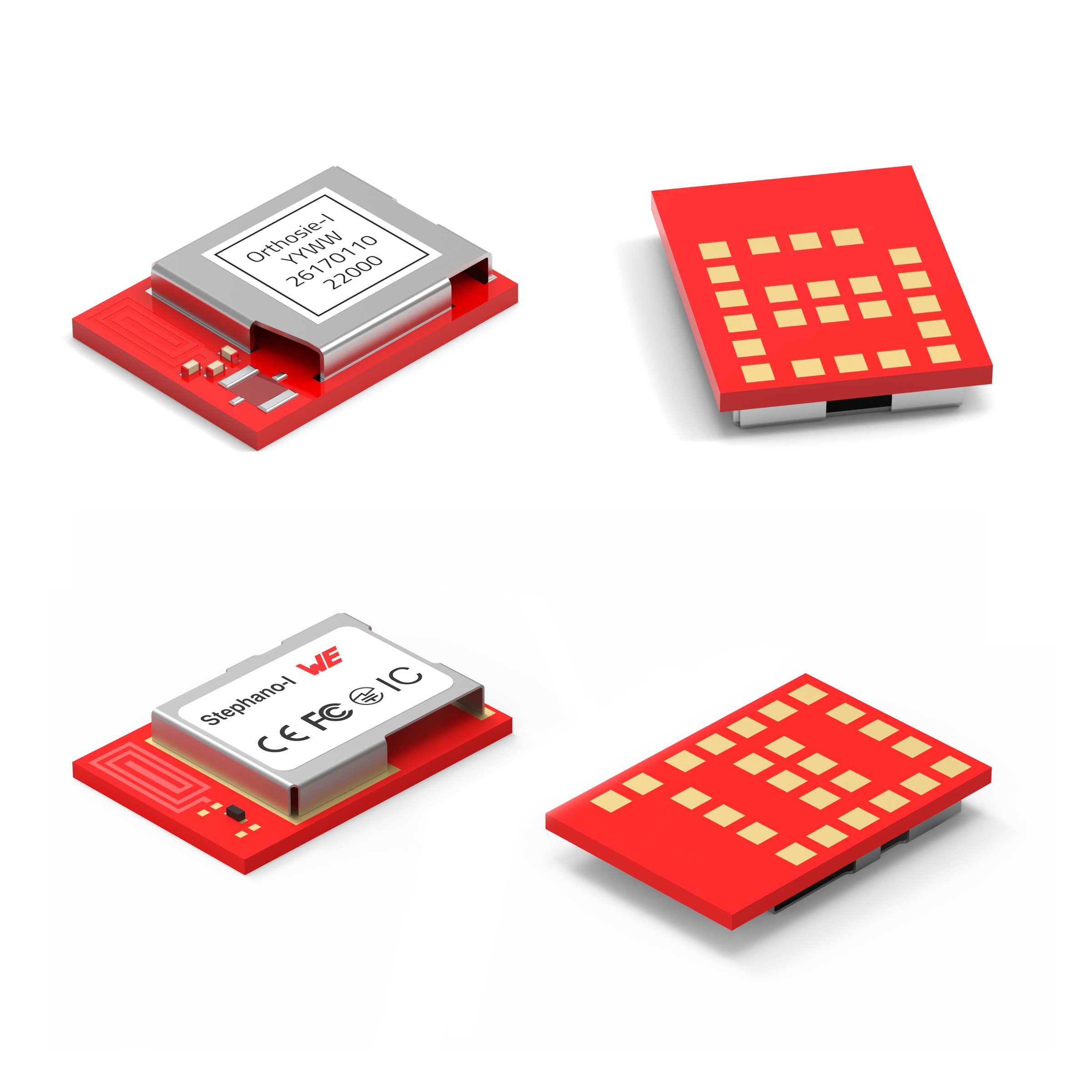
Würth Elektronik, manufacturer of electronic and electromechanical components for the electronics industry, presents its new wireless modules: the freely configurable Orthosie-I model and the Stephano-I variant with pre-installed firmware. Both are based on the ESP32-C3 chipset and communicate according to the IEEE 802.11 b/g/n and Bluetooth®LE 5.0 standards. The new components feature an integrated antenna and, thanks to their space-saving design, are very flexible to use.
Wireless communication is now used in many areas of our daily lives – in blood glucose meters that transmit results to a smartphone, thermostats or lawn-mowing robots with a visual interface app, or in cordless power tools that automatically activate a Bluetooth®-linked dust vacuum when they start up. Würth Elektronik now offers the suitable radio modules for these and many other applications.
Optimized to save energy and space
The modules feature an integrated antenna. They have been specially optimized for energy-saving operation without compromising wireless range. Updating via wireless connection is also possible (FOTA, Firmware Over The Air). The developers at Würth Elektronik have also managed to reduce the TX current consumption and form factor by 50 percent compared to the ESP32-C3-MINI-1 module. In power-off mode, the modules, which measure just 13 × 9.5 × 2 mm, consume only 1 µA.
The innovative communication components are based on a 32-bit RISC-V single-core processor from Espressif (ESP32-C3), which can operate at a clock frequency of up to 160 MHz. They have 4 MB of flash memory and 400 kB of RAM. In addition, 15 freely configurable GPIO pins (General Purpose Input/Output) are available.
Available with or without pre-installed firmware
The Orthosie-I module is supplied without pre-installed firmware and can be individually programmed for the specific application. Various interfaces can also be implemented, such as UART, SPI, I²C, and ADC.
Stephano-I comes with high-quality, pre-installed firmware, a complete TCP/IP-Stack, MQTT and HTTP. The versatile module can act both as a station and as a soft access point. In soft-access-point mode, the encryption modes WPAPSK, WPA2PSK, and WPA/WPA2PSK are available. Up to three Bluetooth® LE connections can be established simultaneously. The practical and time saving “WE Bluetooth® LE Terminal” app from Würth Elektronik offers a quick and easy testing option as well as the basis for your own apps (available free of charge from Google Play Store® and Apple App Store®, or as source code on GitHub).
For more information, go here.