Expanding portfolio adds certified USB 3.1 PD SmartHub IC with HostFlexing and PDBalancing plus standalone USB Type-C PD controller for simpler applications
CHANDLER, Ariz. — USB Type-C has become increasingly popular, and with the introduction of Power Delivery (PD), it is now possible to charge more types of devices – and charge faster – than ever before. To remove the traditional complexity and high costs associated with implementing USB Type-C, Microchip Technology Inc. announced two new solutions that simplify USB Type-C PD for a range of applications.
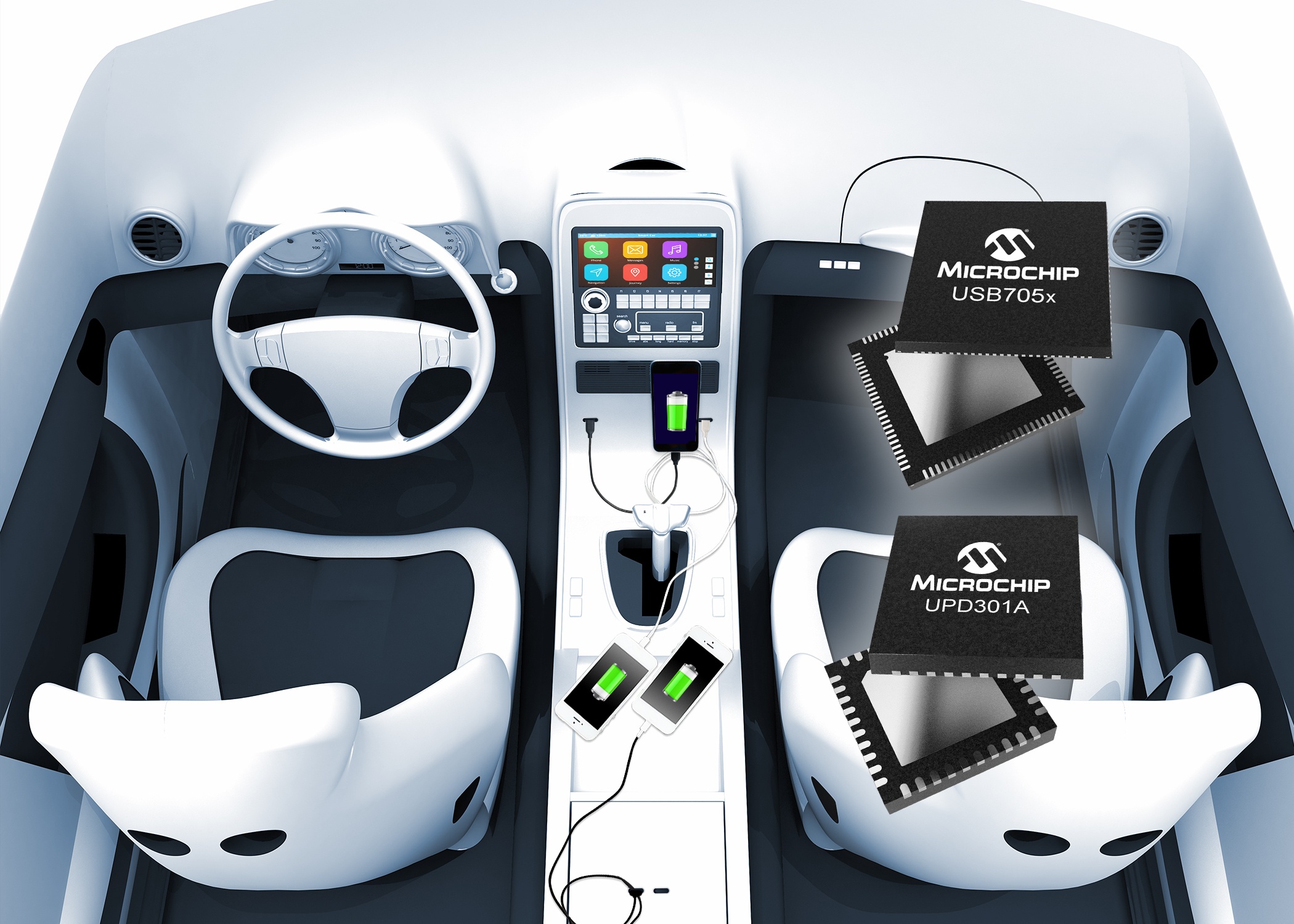
As one of the industry’s first USB-IF-certified USB 3.1 SmartHub devices with integrated support for Power Delivery (TID1212), the USB705x family enables fast device charging and introduces unique PD implementations called HostFlexing and PDBalancing. The UPD301A is a standalone USB Type-C PD controller that significantly simplifies the implementation of basic USB Type-C PD charging functionality, making it ideal for applications from rear seat charging in vehicles to portable equipment to public charging stations.
The USB705x family includes two unique features that simplify USB Type-C PD implementations – HostFlexing and PDBalancing. HostFlexing simplifies the user’s docking station experience by allowing all USB Type-C ports to function as the “notebook” port, eliminating the need for cryptic labels that try and explain overall functionality of each USB Type-C port. PDBalancing provides a methodology for manufacturers to manage overall system power through centralized control, ultimately saving money for consumers by being able to charge a number of PD enabled devices with less overall power.
To meet consumer demand for faster mobile device charging and data streaming, the USB705x family combines native support for USB Type-C PD with the 5 Gbps SuperSpeed data rates of USB 3.1. Ideal for docks, PC monitors and automotive infotainment, the family – consisting of the USB7050, USB7051, USB7052 and USB7056 – provides a range of USB configurations to meet varying PD and USB Type-C design needs. For example, the USB7050 supports three PD-enabled upstream and downstream USB Type-C ports, while the USB7056 provides only one upstream port alongside five traditional Type-A downstream ports. The new hubs also support driver assistance applications that are available on all mobile handsets, allowing the graphical user interface of a phone to be displayed on a vehicle’s screen while simultaneously charging the mobile device.
With smartphones increasingly requiring more than standard BC 1.2 power, designers of electronic systems need to be able to easily implement basic high-powered charging in systems. The UPD301A provides a simple, standalone solution for implementing USB Type-C PD charging in a variety of applications. The device supports both single- and dual-port operation and uses a pin-configurable implementation that focuses on ease of use. The UPD301 complements Microchip’s expansive family of USB hubs and enables solutions from charge-only to full data, video and power management.
Development Tools
The USB705x and UPD301 come with a complete solution including the MPLAB Connect Configurator hub configuration tool, evaluation boards with schematics and Gerber files to reduce development time.
Pricing and Availability
The UPD301A is available today starting at $1.50 in 10,000-unit quantities. The USB705x family is available today with options and pricing for 10,000-unit quantities as follows:
For more information, visit the Microchip website at www.microchip.com.