ON Semiconductor introduces world’s most compact Sigfox verified solution with its first RF system-in-package for low power IoT designs
Sigfox RC1 verified SiP provides turnkey RF solution with module-like
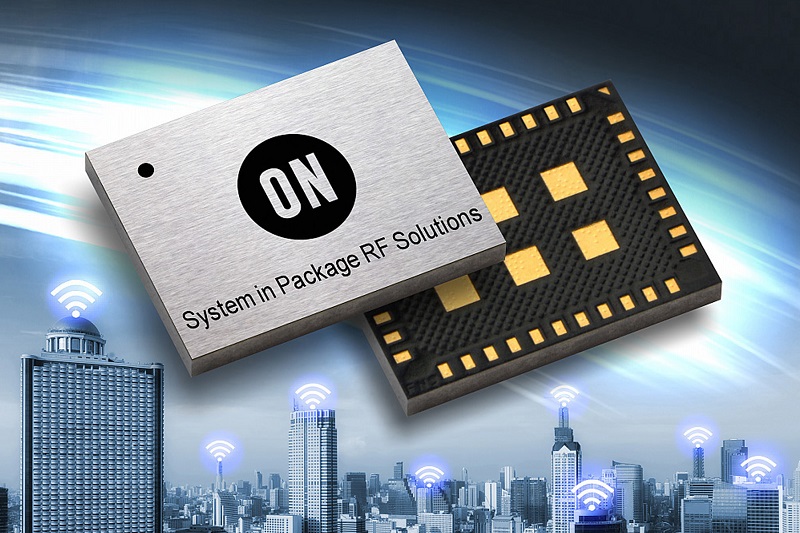
ON Semiconductor (Nasdaq: ON), driving energy efficient innovations, has announced a new programmable RF transceiver System in Package (SiP) integrating an advanced RF System-on-Chip (SoC) with all surrounding Bill of Material (including a TCXO). The AX-SIP-SFEU provides the most integrated Sigfox solution for both uplink (transmit) and downlink (receive) communications. The device is the first in a new family of SiPs that will be launched over the coming months, providing a comprehensive range of ready-to-use, turnkey radio frequency (RF) solutions to support applications requiring Internet of Things (IoT) connectivity.
With the challenging space constraints of many IoT applications – where, for example, connectivity is needed close to the sensor, ON Semiconductor’s 7 mm x 9 mm x 1 mm SiP transceiver has almost one-third the footprint and is one-tenth the overall size of a module-based solution; this gives engineers much greater design freedom. Building on the success of the AX-SFEU SoC family and thanks to the integration of all necessary functionality, the AX-SIP-SFEU positions ON Semiconductor with a market leading one-chip solution for Sigfox applications. Delivered with conformal shielding and pre-certified radio regulatory approvals, the ‘out of the box’ solution helps to simplify design, speed time to market, and reduce overall development cost by allowing customers to focus on their application and antenna design.
Due to the need for long-life from a battery powered solution, a further concern for design engineers working on wireless communications applications is power consumption. Sigfox’s predictable and claimed lowest energy consumption ‘device-to-cloud’, is complemented by ON Semiconductor’s own ultra-low power design to give the new SiP standby, sleep and deep sleep mode currents of just 0.5 milliamps (mA), 1.3 microamps (mA) and 100 nanoamps (nA) respectively.
The AX-SIP-SFEU connects to the customer product via a simple universal asynchronous receiver transmitter (UART) interface. AT commands are used to send frames and configure radio parameters, with an Application Programming Interface (API) variant available for customers wishing to write their own software. The new device is part of an ON Semiconductor ecosystem which also comprises a development kit and an integrated IDE for Software developers.
“ON Semiconductor’s new SiP transceivers, of which the AX-SIP-SFEU is the first provides all of the advantages, integration and convenience associated with a module, but with the form factor of an IC,” said Thomas Wolff, Vice President of Wireless & Connectivity Solutions at ON Semiconductor. “Sigfox certification and compliancy with local regulation, means that engineers working on exciting and innovative IoT solutions across many market sectors, can focus on other aspects of the design knowing that the connectivity and communications element is already taken care of.”
“Sigfox is delighted to have partners like ON Semiconductor that provide our ecosystems with innovative products and leading technologies,” said Tony Francesca, VP of Global Ecosystem Partners at Sigfox. “The new SIP from ON Semiconductor is opening a new generation of devices, demonstrating with its high level of integration that the IoT market is developing now and gaining in maturity.”
www.onsemi.com