Precision Op Amp Features Ultra-Low Input Offset Voltage
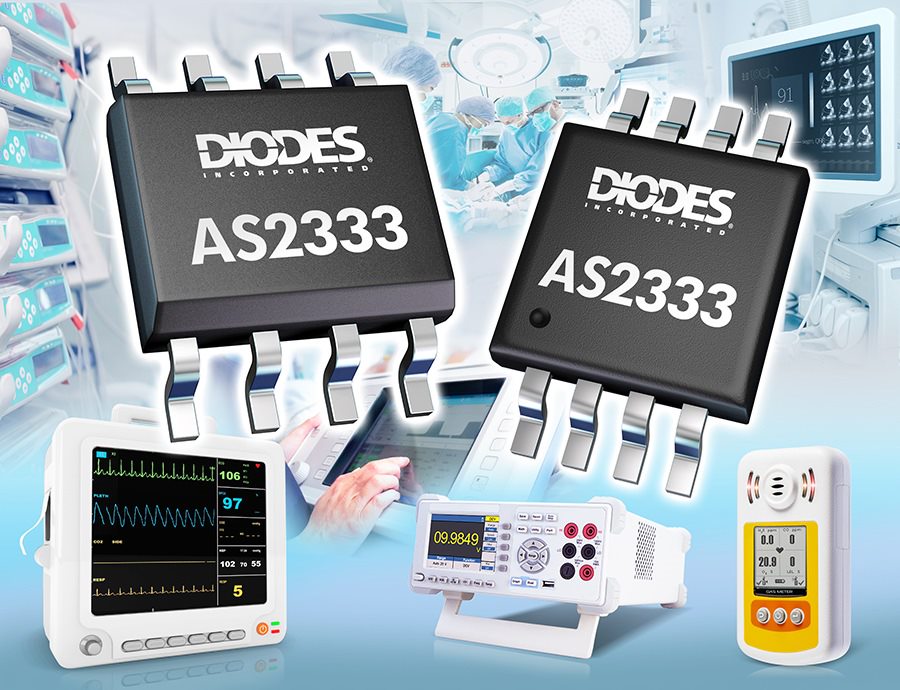
Diodes Incorporated announced its first precision operational amplifier. The AS2333 uses chopper stabilization to achieve ultra-low input offset voltage of 8µV (typical) and near-zero drift (0.02µV/degree C, typical) over time and temperature. The chopper stabilization also addresses low frequency 1/f noise and offset voltage crossover distortion. Typical applications for the AS2333 include transducers, medical equipment, chemical detectors, and handheld test instruments.
The AS2333 features a typical common-mode rejection ratio of 120dB and a typical open loop gain of 130dB useful for small signal sensors that measure parameters such as pressure, sound, light, temperature, voltage, and current. As many applications have very low output signals, they require precision amplification with low offset and low noise.
The high precision, dual channel amplifier also features high impedance inputs with a common-mode range 100mV beyond the supplies and an output swing that is within 50mV of the rails. Features for battery-operated applications include a typical quiescent current of 12μA and supplies as low as 1.8V (±0.9V).
The AS2333 is available in SO-8 and MSOP-8 packages priced at $0.38 in 2500 piece quantities.
For more information visit Diodes Incorporated.