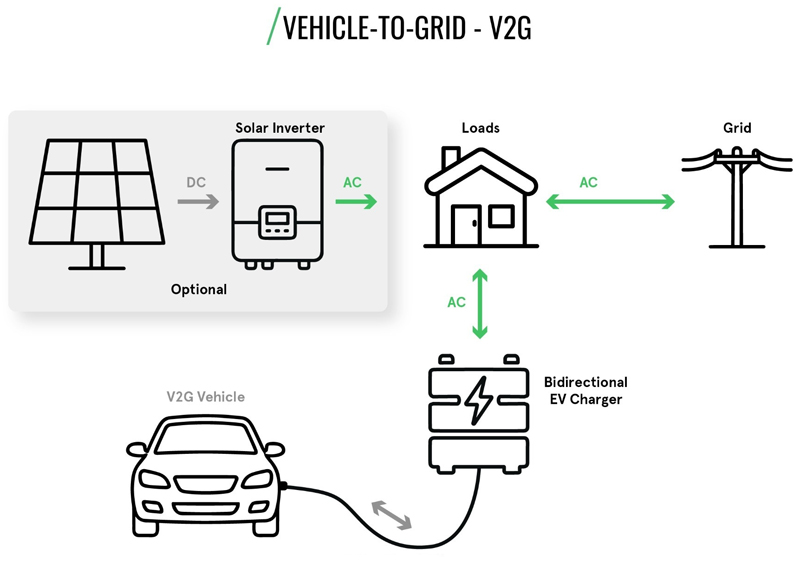
IC delivers 0.7% accuracy, supports ±1200V
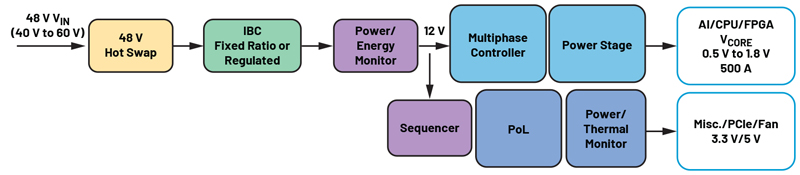
Figure 1: Block diagram of the 18SCT005, a 1200V high voltage monitor and HV-LV divider
As electrification continues to reshape the automotive industry, electric vehicles and hybrid powertrains increasingly depend on high voltage (HV) battery packs and power electronics that must be monitored continuously and accurately. In the case of battery electric vehicles (BEV), as voltages move from 400V to 800V and now 1,000V, the voltage rating of the surrounding power electronics shifts with them. Components rated at 650 to 750V are giving way to devices rated up to 1,200V, according to Yole Group's Automotive Powertrain and Electrification 2025 – Volume 2 report. Yole also predicts 800V and 1,000V platforms will power one out of every three BEVs by 2030.
This higher voltage shift means every battery management system, inverter, and onboard charger must now sense and react to voltages accurately across a wider and higher voltage range, especially during rapid changes in operating state such as acceleration, regenerative braking or charging. Resistor-divider networks, the long-standing default for high-voltage sensing, come with tradeoffs that become harder to ignore as voltages climb. They can drift with temperature and require tighter and costlier tolerance matching across units. They may require multiple resistors in series to handle higher voltages, adding board space and BOM count. Also, certain failure modes can go undetected, creating reliability or safety risks.
As OEMs push toward 800V+ platforms and charging infrastructure scales to match, the gap between what traditional sensing approaches can deliver and what modern EV systems require is widening. Closing that gap calls for an alternative approach to high voltage sensing: one built into silicon rather than assembled from discrete components.
A Monolithic Approach to High-Voltage Sensing
The 18SCT005 is a ±1200V high voltage monitor and HV-LV divider from SimpleChips that takes a single-chip, very accurate approach to high-voltage sensing. As shown in Figure 1, it integrates two high-precision resistors, a buffer, and a filter into a small TSSOP8 4.4mm package, with no external components needed. This monolithic IC enables conversion of high voltage signals into lower voltages readily compatible with standard low voltage electronics, while maintaining high accuracy of ±0.7% (23ppm), across a wide operating temperature range from -55° to 125°C.
Click image to enlarge
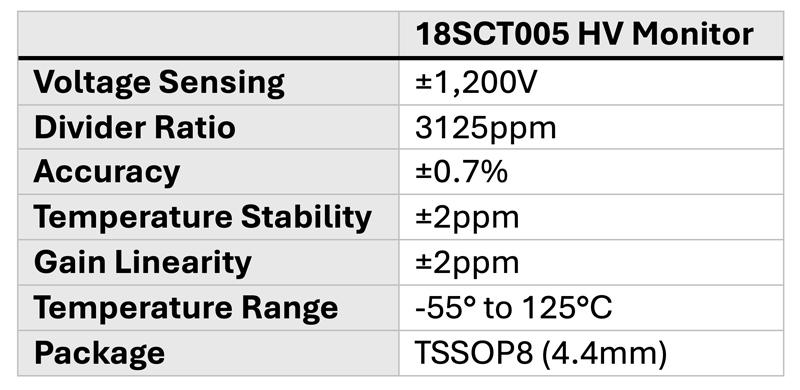
Figure 2: 18SCT005 key specifications
The IC senses voltages up to ±1,200V through a fixed-divider ratio of 3,125ppm, producing a 2.500V output at 800V input, gain temperature stability of ±2ppm/°C, and gain linearity of ±2ppm across the full voltage range.
A rail-to-rail output buffer with less than 2mV offset voltage drives the low-voltage signal, while a built-in 1kHz low-pass filter suppresses switching and charge-pump noise upstream. For transient and fault-detection applications, the 18SCT005 offers a rise/fall time to 1% of approximately 1mSec.
Packaged in a TSSOP8 that is 4.4mm wide and rated to 1,400V, it meets creepage and clearance requirements up to ±1,430V per UL 60950-1 for simple PCB system implementation without slot or conformal coating.
Designing with the 18SCT005
For DC battery and bus-voltage measurement in EV systems, the relationship between input and output voltage follows a simple linear transfer function:
VOut = VRef + Vos + AV × (VHV − VRef)
Where AV is the device's fixed divider ratio (3,125ppm) and Vos is the small offset voltage inherent to the buffer stage. In most DC applications, the reference input is tied to ground, and Vos becomes negligible relative to VRef, simplifying the design equation to:
VHV = VRef + (VOut − VRef) × 320
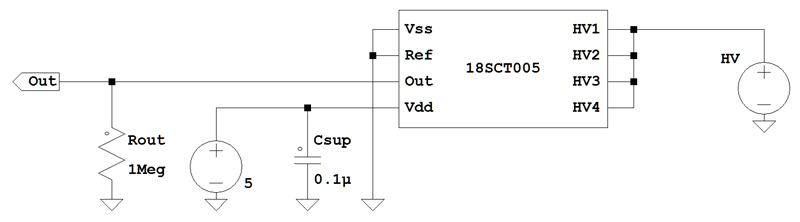
This configuration requires only the 18SCT005 itself, a supply bypass capacitor, and an optional output load resistor to represent the input impedance of the downstream measurement system. No external divider, buffer, or filter network is needed: the output can be connected directly to an ADC input, and the stability of the gain factor across temperature means the conversion from output voltage back to actual high voltage remains consistent without extensive calibration.
Click image to enlarge
Figure 3: Typical DC application schematic
This simplicity stands in sharp contrast to how high-voltage sensing is typically implemented today. To achieve a comparable divider ratio of roughly 1/320 with discrete resistors, engineers commonly resort to long resistor chains or networks, such as identical 200kΩ resistors in series, or combinations of series and parallel resistors tuned to the target ratio. Other designs pair a single high-value resistor (around 60MΩ) with a precision low-voltage resistor but require the two to be carefully temperature-matched to maintain accuracy. Each of these approaches still needs a separate buffer and filter stage added afterward, and none inherently solves for voltage coefficient, self-heating, or long-term drift the way a monolithic, same-die IC does.
Tracking Real-World Transients
Steady-state accuracy alone is insufficient for EV applications, where battery and bus voltages change rapidly. The 18SCT005 responds to a 200V step input by settling within 1% of its final value in roughly 1mSec, fast enough to track transitions on the order of 100uSec to 1mSec that occur during real driving events. The response is dominated by the device's internal RC filter, with a small overshoot and undershoot of approximately 1% of the signal amplitude. For battery management systems and inverter control loops that depend on fast, accurate voltage feedback during abrupt load or charging changes, this transient behavior ensures the sensed voltage closely tracks the actual high-voltage bus, without introducing the kind of lag or ringing that could delay a protection response.
Long-term stability under stress is critical for any device used in high-voltage automotive systems, where field life can span a decade or more under demanding thermal conditions. Figure 4 shows the 18SCT005's relative gain drift over 250 hours at a sustained 125°C and 800V bias. The data shows a drift of only about +0.05% (1.5ppm), with most of the shift occurring during the first 100 hours before the gain settles and remains essentially flat through the remainder of the test. This level of stability under combined thermal and voltage stress gives designers confidence that the device's accuracy will hold up over the operating life of the vehicle, without requiring recalibration or derating margin to compensate for long-term drift.
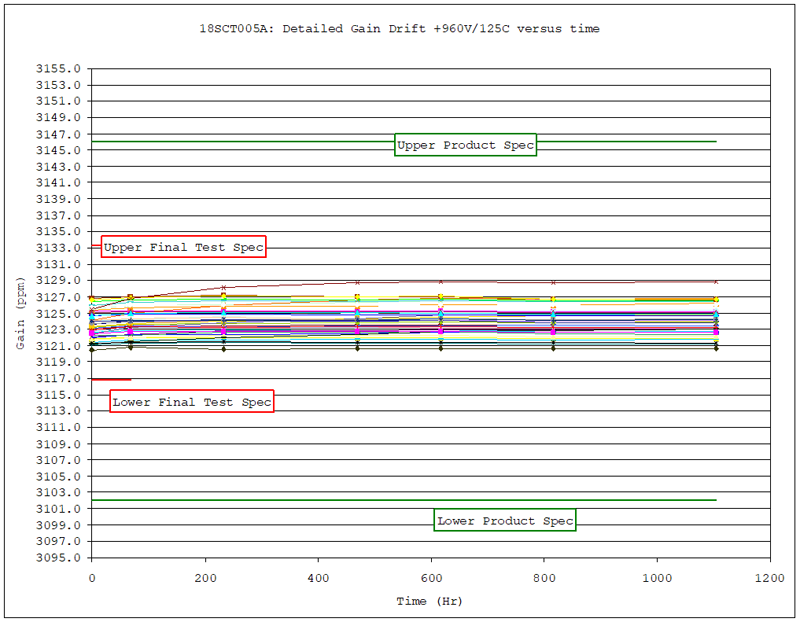
Click image to enlarge
Figure 4: Room temperature gain vs. time at 125°C and 960V
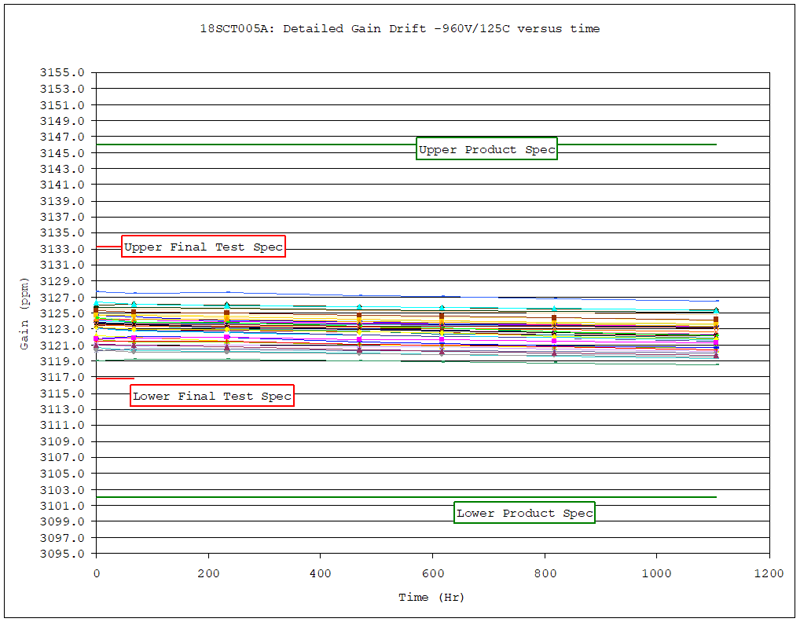
Click image to enlarge
Figure 5: Room temperature gain vs. time at 125°C and -960V
Beyond long-term stability, the divider gain must also stay tightly controlled across the automotive temperature range from unit to unit. Figure 6 plots the 800V DC gain ratio of multiple production samples from -55°C to 125°C, against the device's specified minimum and maximum gain limits of 3,102ppm and 3,146ppm. Across this entire temperature span, every sample tracks within roughly ±5ppm of the nominal 3,125ppm gain, with no unit approaching either spec limit even at the temperature extremes. This unit-to-unit consistency is a direct result of the matched resistor construction described earlier, and it gives designers a wide margin against the part-to-part variation and temperature drift that typically plague discrete resistor-divider implementations.
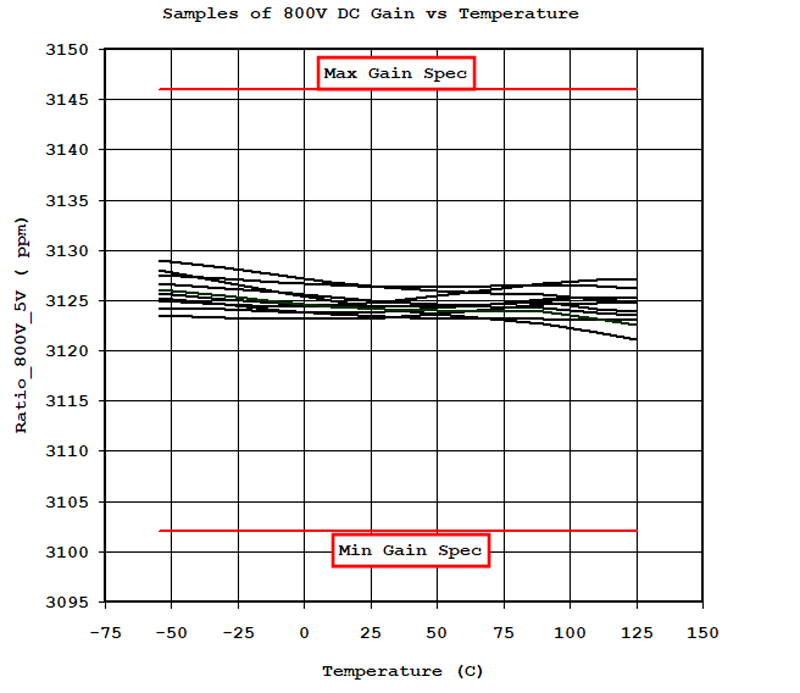
Click image to enlarge
Figure 6: 800V DC gain vs. temperature
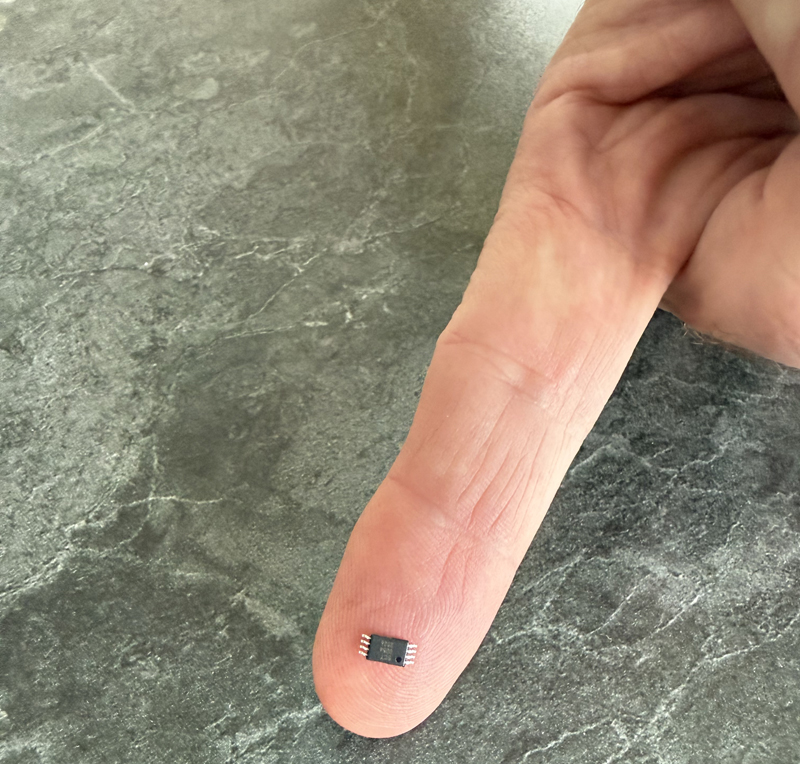
Click image to enlarge
Figure 7: The small size (4.4mm wide) of the 18SCT005
Conclusion
As EV battery voltages continue climbing to 800V, 1,000V, and beyond, the sensing function tasked with monitoring that voltage must scale alongside it, without inheriting the drift, bulk, and complexity of discrete resistors. The 18SCT005 demonstrates that high-voltage sensing can be condensed into a single, low-cost IC without compromising accuracy, temperature stability, or transient response. As OEMs and Tier 1 suppliers design the next generation of battery management systems, inverters, and onboard chargers, a monolithic approach like this offers a simple path to a smaller, more reliable, and easier-to-validate high-voltage measurement chain, exactly the kind of building block to support the next wave of EV platforms.