The Advantages of Migrating from Planar Rad Hard MOSFETs to Superjunction Topology
As aerospace, defense, and satellite industries continue to demand ever-higher power efficiency, reliability, and radiation tolerance, the evolution of power semiconductor devices has become a cornerstone of system design
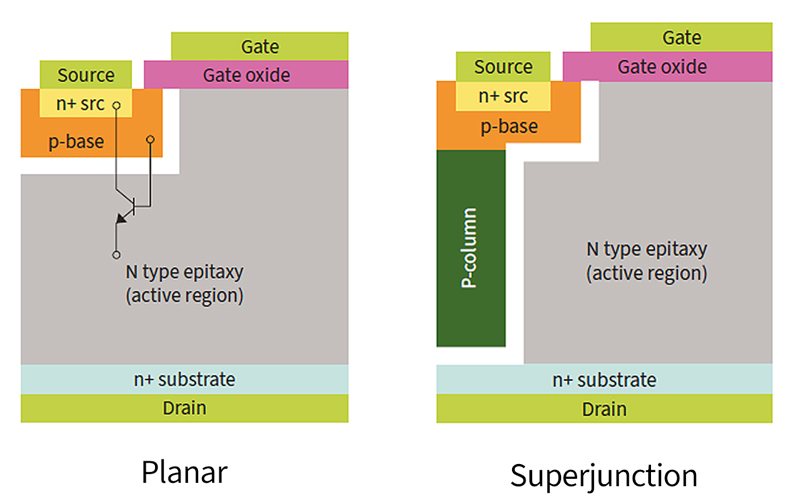
Figure 1: Illustrating the differences in power architectures
For decades, planar-topology MOSFETs have been the workhorse of radiation-hardened (rad-hard) applications, providing a foundation for robust power management in critically important systems that must perform flawlessly in the harshest of environments. These environments include outer space, high-altitude flight, and defense applications where exposure to radiation, vibration, and extreme temperature fluctuations is the norm, not the exception. In these scenarios, the reliability of every electronic component is paramount, and MOSFETs have long been trusted for their proven performance.
However, with the relentless pace of technological advancement and the ever-increasing performance requirements of next-generation aerospace and defense projects, the limitations of traditional planar MOSFETs have become increasingly apparent. The advent of superjunction (SJ) MOSFET technology is rapidly changing the landscape, offering tangible performance benefits and enhanced reliability for next-generation systems. Superjunction MOSFETs are engineered to address the core challenges found in advanced power systems, such as minimizing conduction and switching losses, maximizing energy efficiency, and withstanding the rigors of space and defense operating environments. This article explores the advantages of migrating from older planar rad-hard MOSFETs to more efficient and reliable superjunction topologies while providing insights into the design considerations and practical benefits that system architects should evaluate.
Fundamental Differences: Planar vs. Superjunction
Planar MOSFETs are built with a single, uniformly doped drift region, which limits their ability to simultaneously achieve low on-resistance (RDS(on)) and high voltage blocking capability. As a result, designers often face a trade-off between efficiency and voltage rating, particularly in applications exceeding 100V (see Figure 1).
Superjunction MOSFETs introduce a revolutionary vertical structure, utilizing alternating p- and n-type columns in the drift region. This architecture enables higher doping concentrations without sacrificing breakdown voltage, dramatically lowering RDS(on) and improving efficiency at high voltages (see Figure 1).
Superior Efficiency and Lower Power Losses
One of the pivotal factors driving rapid adoption of superjunction MOSFETs is their inherently lower on-resistance which results in improved efficiency gains over older planar devices. Efficiency is not just an abstract metric; it translates directly to reduced operating costs, lower thermal loads, and extended mission lifespans in aerospace and defense systems. The ability to minimize wasted energy is critical in satellite platforms where power budgets are tightly constrained.
In high-power satellite arrays, for example, even small increases in efficiency can result in substantial reductions in the size of solar panels or battery banks required to sustain operations. This not only saves weight and space but also lowers overall mission costs. The reduced power loss also means that less heat is generated, simplifying thermal management and allowing for more compact system designs. Ultimately, the superior efficiency of superjunction MOSFETs enables the deployment of more advanced payloads, sensors, and subsystems without compromising reliability or operational longevity.
Higher Power Density and Smaller Form Factor
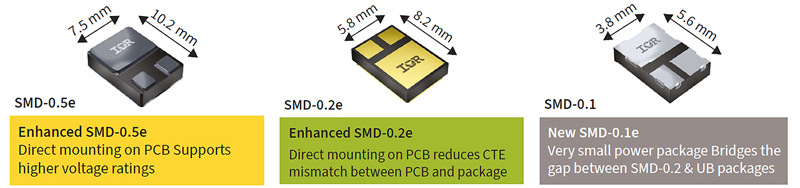
With their improved efficiency, superjunction MOSFETs deliver higher power density designs resulting in smaller packaging options (see Figure 2). System architects can pack more performance into a smaller footprint, a critical advantage in satellites and spacecraft where every gram and cubic centimeter matters. Migration to SJ technology often results in circuit boards with fewer or smaller devices, simplifying layouts and reducing size, weight, and power (SWaP) metrics.
Click image to enlarge
Figure 2: A variety of available hermetic packages
Enhanced Switching Performance
Superjunction MOSFETs offer faster switching speeds and lower gate charges (Qg) compared to planar MOSFETs. The result is lower switching losses and improved efficiency, particularly at high operating frequencies. For applications like DC-DC converters, satellite power supplies, and radar systems, this capability enables higher frequency operation, reducing the size of passive components (inductors and capacitors) and further shrinking system dimensions.
Lower gate charge also means simpler and more efficient drive circuitry, further reducing component count and system complexity.
Improved Reliability and Robustness
Reliability is non-negotiable in radiation-hardened applications. Superjunction MOSFETs, by virtue of their vertical structure and advanced fabrication techniques, offer improved ruggedness and better tolerance to transient overvoltages. Many modern SJ devices are designed with enhanced radiation hardness, meeting or exceeding the stringent requirements for total ionizing dose (TID) and single event effects (SEE) encountered in space and defense environments.
The lower thermal resistance and reduced self-heating of SJ MOSFETs also contribute to improved long-term reliability, mitigating the risk of hot-spot formation and device degradation over mission lifetimes.
Simplified Design and Qualification
Converting to superjunction technology can simplify system design. With lower on-resistance, faster switching, and improved ruggedness, designers can often meet their performance, efficiency, and reliability goals with fewer parallel devices or less derating. Many SJ MOSFETs come with comprehensive qualification data, including radiation test results, making it easier for engineers to integrate them into mission-critical designs.
Scalability and Futureproofing Next-Generation Systems
As space and defense missions continue to push for higher voltages, increased power levels, and more stringent SWaP targets, the limitations of planar MOSFETs become more pronounced. Superjunction MOSFETs are inherently scalable, with ongoing process improvements enabling even lower RDS(on) and higher voltage ratings. Investing in SJ technology today positions organizations to take advantage of these future enhancements with minimal redesign effort.
Real-World Examples and Applications
Superjunction MOSFETs have already demonstrated their value in a variety of demanding applications:
- Satellite Power Systems: Enhanced efficiency and reliability extend mission duration and reduce thermal stress.
- Defense Ground Vehicles: Higher power density allows for more compact and robust power converters.
- Radar and Communications: Fast switching and low losses enable higher frequency operation and improved signal integrity.
Migration Considerations and Best Practices
While the benefits of SJ MOSFETs are clear, successful migration requires careful planning and working with a qualified and trusted power supplier. Infineon IR HiRel is uniquely qualified to help you make this transition seamlessly. With over 50 years of MOSFET design and manufacturing, and the largest portfolio of rad-hard MOSFETs in the industry, IR HiRel can make your migration effortless.
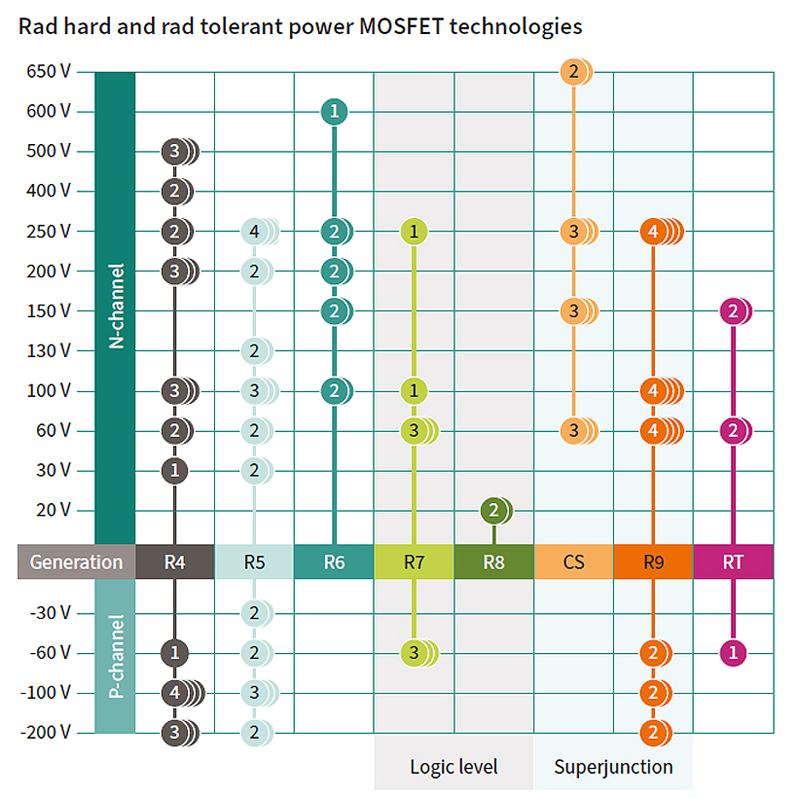
IR HiRel’s R9 series of MOSFETS represents the latest technology offering the best performance in terms of RDS(on), gate charge (QG), Safe Operating Area (SOA), and Single Event Effect (SEE) robustness (see Figure 3).
Click image to enlarge
Figure 3: Illustrating IR HiRel’s MOSFET portfolio range of voltages and topologies
In Summary
The migration from older planar rad-hard MOSFET technologies to superjunction topology offers a compelling array of advantages: superior efficiency, higher power density, enhanced reliability, and greater design flexibility. As the demands of space, defense, and high-reliability sectors continue to escalate, superjunction MOSFETs represent not just an incremental improvement but a transformative leap forward in power semiconductor technology. Organizations embracing this migration are well-positioned to deliver more capable, efficient, and robust systems for the critical missions of today and tomorrow.