The EV Battery Market – And the Electrification of Everything
Advanced EV battery technologies are spurring exponential growth in EV transportation and other markets transitioning to electrification. But challenges remain
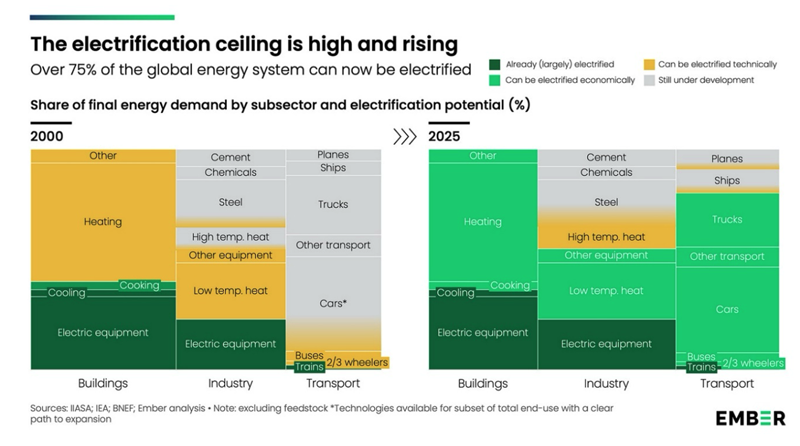
Figure 1. The chart illustrates the slow and steady growth toward electrification across applications and industries (Courtesy of Ember.)
With approximately 360 global battery industry events, annually, one could theoretically attend a battery show a day during the year. A key reason for this intense interest is the growth of the electric vehicle (EV) battery market. But batteries are no longer simply a component of EVs—they are the enabling technology that determines vehicle range, cost, performance and, ultimately, market adoption.
This article explores how the electrification of everything accelerates the rise of the EV battery market worldwide. It also discusses how technological innovation, costs and geopolitical and financial pressures surrounding EV batteries continue to shape this market.
Market Growth
Global battery demand for EVs and energy storage reached approximately 1 terawatt-hour (TWh) in 2024, marking a historic milestone; of this, electric vehicles account for over 85% of total battery demand, according to a recent report from The International Energy Agency (IEA).
The market is scaling just as rapidly in monetary terms. According to the IEA, EV battery demand is expected to more than triple to over 3 TWh by 2030. Although passenger cars dominate the market, growth in other electric vehicles – trucks, buses and two-wheelers – is accelerating. Demand for EV truck batteries alone grew more than 75% in 2024, albeit from a smaller base.
The Electrification of Everything
Macro-level forces propel the EV battery market. While the industry focuses on a single application, a bigger-picture viewpoint shows how the ongoing electrification of everything reflects the slow and steady progress of battery use in a multitude of applications.
The chart in Figure 1 is from a 2025 presentation by Ember, a global energy think tank, called “The Electrotech Revolution.” It shows the rise in electrification across various applications over the last 25 years. As the world converts to all things electric, other markets experience tangential transformations. The electrification of transportation, for instance, makes advanced battery technologies available for power tools, medical and computing devices, power walls, grid-connected systems, AI data center power backup, UPSs, and more.
Globally, the shift toward electrified mobility has other knock-on effects as markets convert to electric energy. Governments worldwide are implementing emissions regulations, incentives and mandates to accelerate overall electrification. Even in regions with fluctuating policy support, long-term electrification trends remain intact due to decarbonization goals and energy security concerns.
Market Growth Drivers
The EV battery market is characterized by intense competition and rapid innovation in a race to remove the main barriers to EV adoption. Performance advancements in battery technologies are improving energy density, enabling longer driving ranges, faster charging speeds and cycle life.
Technology innovation
In the technology landscape, lithium-Ion batteries maintain market dominance due to their high energy density, efficiency and maturity. Newer lithium-ion chemistries gaining traction are NMC (Nickel Manganese Cobalt), which offers high energy density and are widely used in premium EVs, and LFP (Lithium Iron Phosphate), which provides a lower-cost alternative and improves safety over a longer cycle life.
According to Adamas Intelligence, LFP batteries accounted for 40% of global EV battery capacity deployed in 2024 — a rapid rise that puts the chemistry close to half of all EV battery demand. Their lower cost and reduced reliance on critical minerals like cobalt make them attractive for mass-market vehicles. As an example of EV battery technology’s tangential effects, LFP batteries are used in UPSs and other energy storage systems.
Emerging technologies, such as solid-state batteries, offer higher energy density, improved safety and faster charging. However, they remain in early commercialization stages, with mass adoption expected later in the decade. Sodium-ion battery technology is gaining attention as a lower-cost alternative to lithium-ion. Although its energy density is lower, material abundance and cost advantages could make it viable for certain applications, particularly entry-level EVs and stationary storage systems.
Materials offering better performance are lithium anodes (including silicon anodes), advanced electrolytes and cathode materials. IDTechEX predictsthat several chemistries on the horizon may further reshape the battery landscape in the 2030s, assuming they can be viable as production solutions. A small part of the market could shift to lithium anodes, which increase energy density, but have the drawback of degrading the battery and cycle life.
Battery costs
Battery costs have declined significantly over the past decade and continue to fall. In 2024 alone, lithium-ion battery pack prices dropped by about 20%, one of the largest annual declines on record, according to the IEA. This cost reduction is driven by manufacturing scale, supply chain optimization and intense competition, particularly from China. After federal tax credits expired in the U.S., the market slowed for EVs and thus batteries, yet the projections are that the market demand for U.S. and Europe markets will catch up with that of China.
LFP battery technology has emerged as a “middle-ground” solution that balances its cost effectiveness with the high-performance of nickel-based chemistries, according to Automotive News Europe.
Challenges
Despite its exponential growth, the global EV battery market faces challenges that impact battery costs and therefore EV affordability. The primary roadblocks include: a dependence on a limited number of suppliers, geopolitical and logistical risks in certain regions, fluctuating raw material prices, and the lack of a sufficient charging infrastructure.
Supply chain and geopolitics
The EV battery supply chain is highly concentrated and increasingly geopolitical. For EV manufacturers, battery technology is becoming a key differentiator. Organizations are investing heavily in proprietary chemistries, battery management systems and fast-charging capabilities. (Some are investing more than others after several automotive OEMs experienced huge losses due to mismanaging the mix of IEC-HEV and EVs that consumers wished to buy.)
The IEA reports that China dominates the global EV battery market and supply chains, accounting for the largest share of global battery demand and the fastest EV battery growth. In response, the United States and Europe are investing heavily in domestic battery manufacturing capacity.
Procuring critical minerals for batteries, such as lithium, nickel, cobalt and graphite, also remains a key constraint. While short-term oversupply has reduced prices, long-term demand growth could lead to shortages, especially if investment in mining lags.
Automakers are increasingly moving upstream into battery production to secure supply and reduce costs. This includes partnerships, joint ventures and in-house battery manufacturing. Automotive OEMs are laser-focused on supply chain resiliency for batteries and semiconductors that enable this industry transformation.
Environmental factors and infrastructure
Full EV adoption means replacing the energy transfer capabilities of over 150,000 fueling stations in the U.S. alone with EV charging stations powered by sufficient grid energy (100% renewable and green) – all of which will take time and money, as well as an understanding of electricity, power, generation fuels, losses, Ohms law, current flow and more. Furthermore, recycling batteries is a dirty and labor-intensive proposition and is not as “green” as one might expect.
Conclusion
The EV battery is the pivotal foundation and imperative technology upon which the future of transportation – and the overall conversion of energy from fossil fuels to renewable electricity generation and consumption – is being built. This includes the power electronics required to properly manage the batteries’ power and energy transfer.
As demand for EVs continues to surge, advanced analytics and AI will optimize battery performance, lifecycle management and manufacturing processes. Success in the EV market will depend on balancing battery cost, performance and reliability while navigating an increasingly competitive and dynamic global landscape. Companies that innovate rapidly, scale production efficiently and secure their supply chains will define the next phase of the electric mobility revolution.