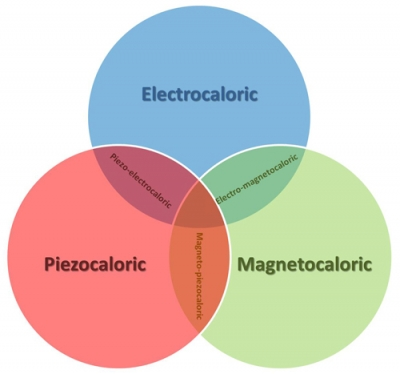
The Electrocaloric effect is one of three principle caloric effects that describe a temperature change in a material when an external field is applied
Scientists at the National Physical Laboratory (NPL) and Imperial College London are working to make the inefficient method of refrigeration and air conditioning - which has been relied on for over a hundred years - a thing of the past. The project sets out to provide a more economical, energy efficient and environmentally friendly cooling alternative. The project will utilise the electrocaloric effect to develop new methods of cooling.
The electrocaloric effect is a phenomenon in which a material changes temperature under an applied electric field. Current domestic refrigeration relies on a continuous cycle of compression and expansion of chemicals - known as 'vapour compression'. Freon gas, for example, can be cooled and condensed into a liquid. This liquid then absorbs heat from the refrigeration area, causing it to re-evaporate, where it begins the cycle again.
These chemicals can be harmful to the environment when disposed of or if they leak. They have a fairly low efficiency, requiring high energy input to create adequate cooling. They also require bulky apparatus, making them unsuitable for smaller applications, such as cooling electronics.
Thermoelectric and magnetic cooling technologies have been put forward as environmentally-friendly alternatives to vapour compression. However, these technologies struggle to compete with vapour-compression due to intrinsically low energy efficiency (maximum 10%), and the need for large and expensive magnets to generate the magnetic fields needed to run magnetic coolers.
Maciej Rokosz, a PhD student at NPL and Imperial College London, explains: "An electrocaloric cooler could potentially deliver higher efficiency than vapour compression - as the creation of an electric field requires less energy than the compression process to create the same level of cooling. It could also offer reduced size and weight, making it viable for applications like cooling electronics."
Tatiana Correia, a scientist at NPL who is leading the project, adds, "This project builds on considerable research and expertise that has been developed at NPL. Our experience in this area makes us confident that, over the next three years, we can develop the first electrocaloric refrigerator ever to operate close to room temperature."
To support electrocaloric cooling technology, NPL is also developing and leading a new multimillion pound project funded by the European Metrology Research Programme METCO (Metrology of Electro-Thermal Coupling), which brings together Europe's leading research centres and industry to develop unique capabilities for the traceable and accurate measurements of electrocaloric effect in materials.