Triaxial Vibration Sensor for Condition-Based Monitoring
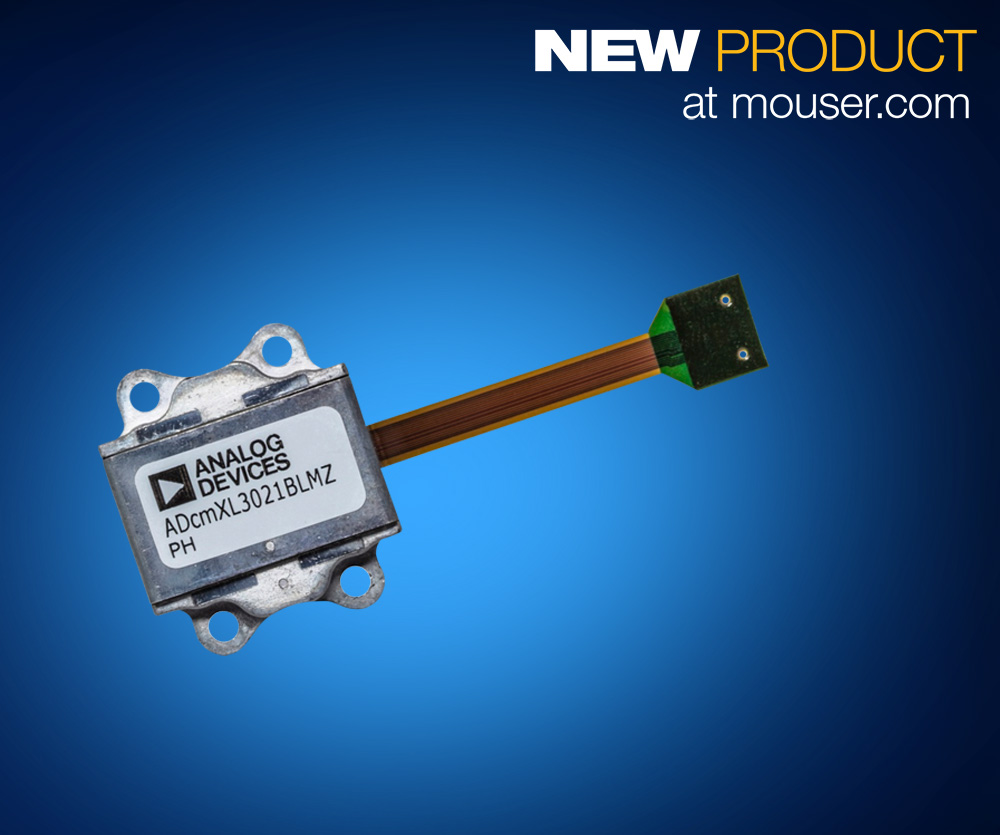
Mouser Electronics, Inc., is now stocking the ADcmXL3021 triaxial vibration sensor from Analog Devices. Based on Analog Devices’ award-winning micromechanical (MEMS) sensor technology, the ADcmXL3021 module is a complete sensing system that monitors for early indications of possible machine fatigue and failure specifically in industrial and transportation equipment to help reduce repair costs and maintain a high level of productivity.
Analog Devices’ ADcmXL3021, available from Mouser Electronics, is a triaxial (3-axis) vibration monitoring subsystem. The device incorporates Analog Devices’ high-performance MEMS sensors with an analog-to-digital converter (ADC), high-performance signal processing, data buffers, record storage, and a user interface that easily works with most embedded processors.
The ADcmXL3021 uses three ADXL1002 MEMS accelerometers with ultra-low noise density (25 µg/√Hz) to support excellent resolution. Designed with a wide bandwidth, the device enables tracking of key vibration signatures on many machine-based platforms. With a high operating input range of ±50 g, the ADcmXL3021 is suitable for vibration measurements in high-bandwidth applications such as vibration analysis systems that monitor and diagnose machine or system health.
The module helps simplify the development of condition-based monitoring (CBM) systems for Industrial Internet of Things (IIoT) and Industry 4.0 applications, including instrumentation, diagnostics, and safety shutoff sensing.
To learn more, visit www.mouser.com/adi-adcmxl3021.