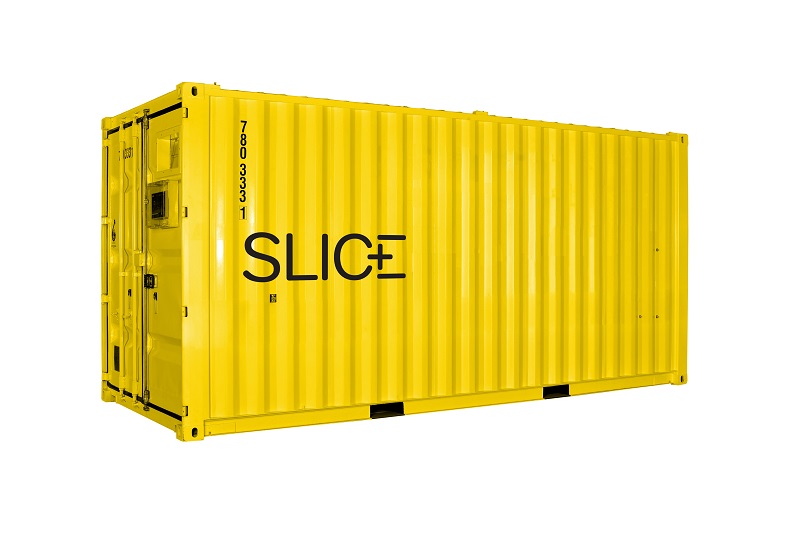
Denchi Group has announced the commercial availability of SLICE, which is based on the company’s reliable Li-Ion battery technology.
Slice also benefits from its engineers' expertise in developing rugged military-grade hardware, Denchi's SLICE is a highly scalable and adaptable energy storage solution that is designed to deliver maximum return on investment. Through its deployment, the operational costs associated with electricity usage can be significantly reduced. Large enterprise and university campuses, industrial plants, sports stadia and residential complexes can all execute grid balancing, peak shaving, plus TRIAD and Red Zone charge avoidance activities via this new solution. Likewise, smaller agricultural or community microgeneration sites will be able to draw on electricity from renewable resources as needed (regardless of the time of day), or use it to generate revenue by selling electricity surpluses back to the grid when demand levels are high.
Delivering a safe, secure and prolonged working lifespan, SLICE employs an innovative modular architecture. Implementations comprise an array of 3.5kWh battery units, using cells of a high-performance, extremely durable and ultra-safe Lithium Iron Phosphate (LFP) chemistry. Up to 13 of these can be placed in each cabinet. The cabinets are then combined together to meet the specific storage capacity criteria defined by the customer, with no excess needing to be paid for (which is often a major drawback of solutions from other vendors).
The batteries in the SLICE cabinets are all connected to a sophisticated management subsystem (which relies on Modbus TCP/IP connectivity). In addition to allowing remote control, this subsystem facilitates the monitoring of ongoing operational performance and can assist with other real-time diagnostic tasks - thanks to a cloud interface (which is accessible using either desktop or mobile devices). Among these tasks are analysis of charge/discharge profiles, as well as in-depth assessment of cells' cycling lifespans. Further key functions for the subsystem include regulating ambient temperature and humidity, so that the highest degrees of efficiency are always maintained. Fault detection mechanisms (over-current, over-voltage, over-temperature and Earth-leak) protect against potential damage during power outages, while fire suppression systems can be activated if situations arise that put safety under threat.
"Suitable for both grid-connected and off-grid implementations, SLICE represents a simple and convenient way through which our customers can take full control of the energy usage, and gain significant financial rewards as a result," states Nick Simmons, Sales Director at Denchi Group. "It means charging can be undertaken at off-peak times, when utilities' pricing is low, then the electricity subsequently consumed as demands dictate. Likewise, energy from renewable resources can be brought online as and when they are needed."
The SLICE platform has been purposely designed to be easy to integrate into existing infrastructure. It can be installed directly inside customers' premises, or housed externally within shipping containers placed on site. Underlining its operational robustness, all elements of this solution come with a 10-year warranty. T