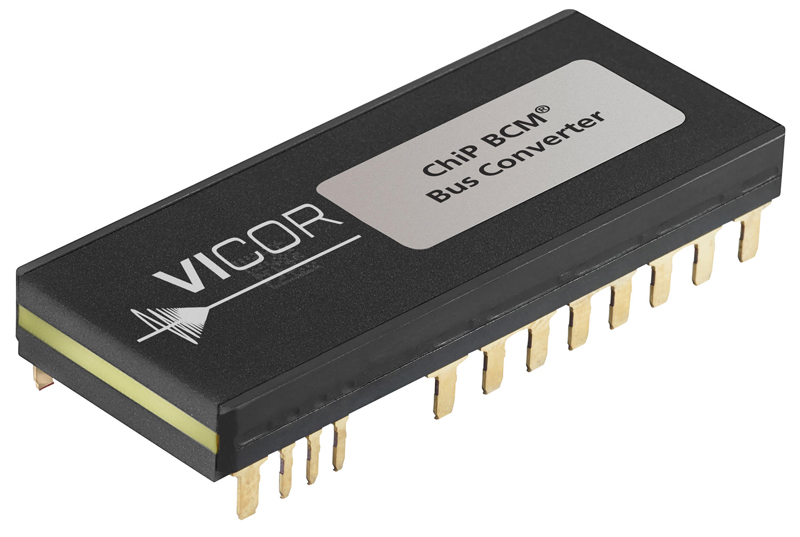
Vicor Expands High Voltage Bus Converter Family with New K=1/16, 384 VDC - 24VDC Module in a ChiP Package
Vicor Corporation has announced the expansion of its BCM series of DC-DC converters utilizing the Converter housed in Package™ (ChiP) power component format.
Click image to enlarge
BCM series of DC-DC converters utilizing the Converter

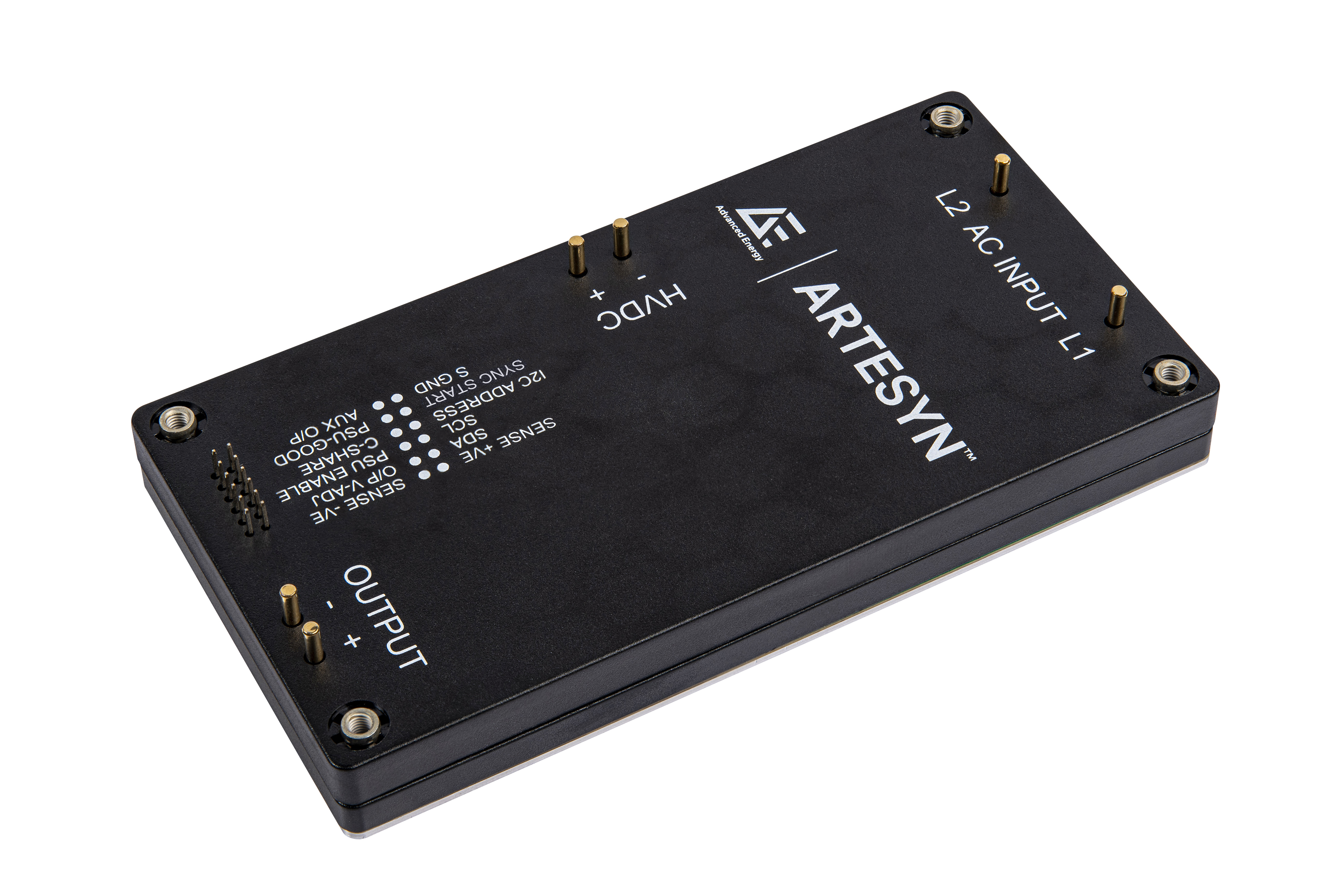
The new BCM6123TD1E2663Txx is a high-density, high-efficiency, fixed ratio DC-DC converter module in a ChiP package, which operates from a 384 VDC nominal input and delivers an isolated and Safety Extra Low Voltage (SELV) 24V secondary output. The new BCM 6123 ChiP is offered in a through-hole form factor measuring 61mm x 23mm x 7.26mm.
The introduction of the new BCM6123TD1E2663Txx expands Vicor’s family of high voltage bus converters to include K=1/8 (384 - 48VNOM), K=1/32 (384 - 12VNOM), and the new K=1/16 (384 - 24VNOM) modules. Targeting industrial, telecom, and lighting applications, Vicor’s family of high voltage bus converters give system designers a simple and cost effective means to create common bus voltages of 12V, 24V, and 48V directly from 384 VDC.
Based on the patented Sine-Amplitude Converter topology, high voltage BCM ChiPs are able to reach peak efficiencies of 98% and achieve power densities up to 2400W/in³. These flexible modules can be easily paralleled into high power arrays and outputs can be put in series to achieve higher VOUT. In addition, the high voltage BCMs are offered with either analog or digital signal interface and all have an operating temperature range of -40˚ to 100˚C.
High voltage BCMs allow designers to reduce the amount of bulk capacitance needed at the load by utilizing the Sine-Amplitude Converter’s low AC impedance relative to the down-stream regulator, effectively ‘reflecting’ the capacitance across the module. With the new K=1/16 module, 500 µF of 24V point-of-load capacitance can be effectively provided by 2 µF on the module’s primary side.