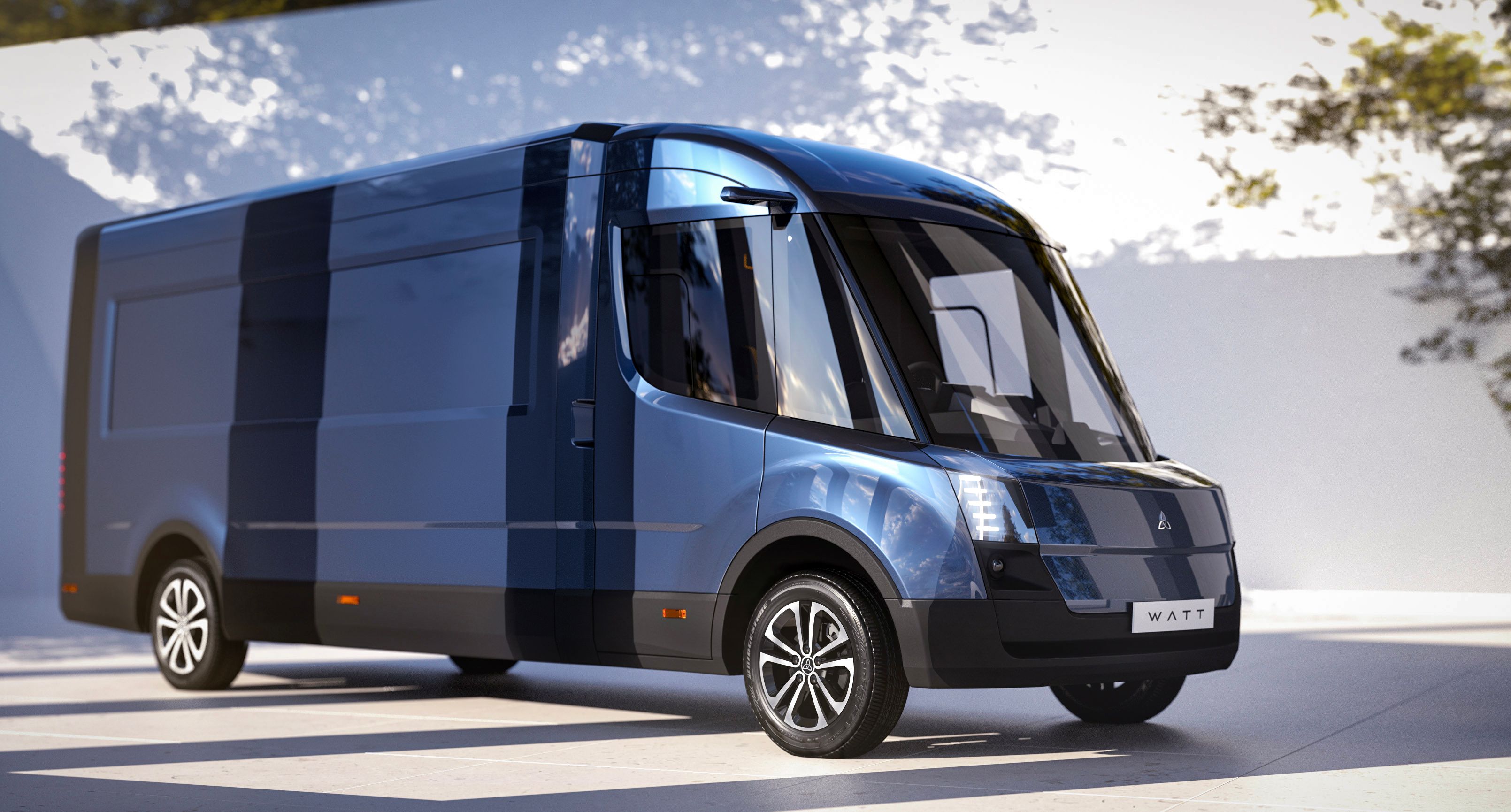
Revised design gives Luton-esque capacity with integrated body and low access height
WEVC Reveals Production-Ready eCV1 Electric Light Commercial Vehicle with New Luton-Style Wide Body
Watt Electric Vehicle Company (WEVC), a pioneer in the design, engineering, and manufacture of low-to-medium volume EVs, both under its own brand and for third parties, today reveals its production-ready eCV1 electric light commercial vehicle, now with a revised body style for even greater carrying capacity.
Following extensive testing and feedback from a host of blue chip companies, WEVC has further developed its cutting-edge eCV1 – initially revealed in prototype form at the 2023 CV Show – as the vehicle accelerates towards volume production.
Featuring an innovative new wide-body, ultra-low low access height configuration, the subtly refined commercial vehicle is set to give fleets the attributes of a Luton conversion – the largest type of van which can be driven in the UK with a standard licence – but with the low access height of an air suspension vehicle, in a more aerodynamic and efficient integrated body.
Carried over from initial concept to production vehicle will be the unique feature of a central driving position, allowing a safer kerbside exit for the operator, whichever side of the road the vehicle is driving or parked on. Production-intent revisions have resulted in unrivalled visibility for the driver, with a class-leading viewing angle in front of the vehicle – vital for safe operation in towns and cities.
The unique cabin can be configured as a walk-through two-seater or without a sliding bulkhead door and offset three abreast seating, with the large glass house providing superb visibility making the vehicle safer to drive and easier to manoeuvre and park. Further feedback from fleet buyers and operators has resulted in a flexible cabin layout with an elevated roof height, allowing drivers easy ingress and egress to either side of the vehicle, improving safety and reducing lost time waiting for a gap in traffic in urban operations, making the vehicle even more optimized for urban delivery duty cycles.
CEO of WEVC, Neil Yates, commented: “We live and breathe customer-centric engineering and have listened carefully to the fleet buyers of many large organisations regarding their electric van requirements, incorporating crucial feedback into this revised, production-ready version of the original eCV1 prototype. This isn’t an either/or vehicle, it is an and/and electric LCV, offering the operator and driver more. We can give our customers the low access height of an air suspension vehicle, with the load capacity of a Luton conversion and class leading payload at 3.5t.
“This means many of our customers can operate the vehicle without having to go to a 4.25t plated vehicle and the tachograph and 56 mph speed limiter that brings with it. If they do have heavy payload requirements, we can offer them a 4.25t version, which can carry up to a 1750kg payload. No other electric van on the UK market today can offer this combination of range, payload, flexibility, visibility and ease of operation.”
The first of multiple commercial vehicle offerings to come from WEVC, the eCV1 uses the company’s breakthrough, proprietary PACES architecture, a sophisticated yet cost-effective modular electric vehicle platform. Developed to support commercial vehicle manufacturers, specialist vehicle converters and fleet operators in the transition to an electric future, PACES complies with ISO regulations and exceeds stringent European Small Series Type Approval safety standards.
It’s ‘module-to-chassis’ system means batteries are integrated to the primary structure (rather than having a separate battery pack), optimising stiffness, minimising weight, and maximising payload. As a result, the clean sheet design means the eCV1 has none of the structural, weight and packaging compromises inherent in most electric LCV designs, many of which having been converted from diesel drivetrains and which are further constrained by traditional high volume manufacturing processes.
The WEVC eCV1 delivers class leading payload and range in the 3.5t and 4.25t segments. The WEVC eCV1 is continuing through its durability testing programme and will start production in 2026.