Superior characteristics of eGaN FETs and integrated circuits, such as low output capacitance, low input capacitance, low parasitic inductances, and small size make them ideal for increasing efficiency in highly resonant, AirFuel wireless power transfer
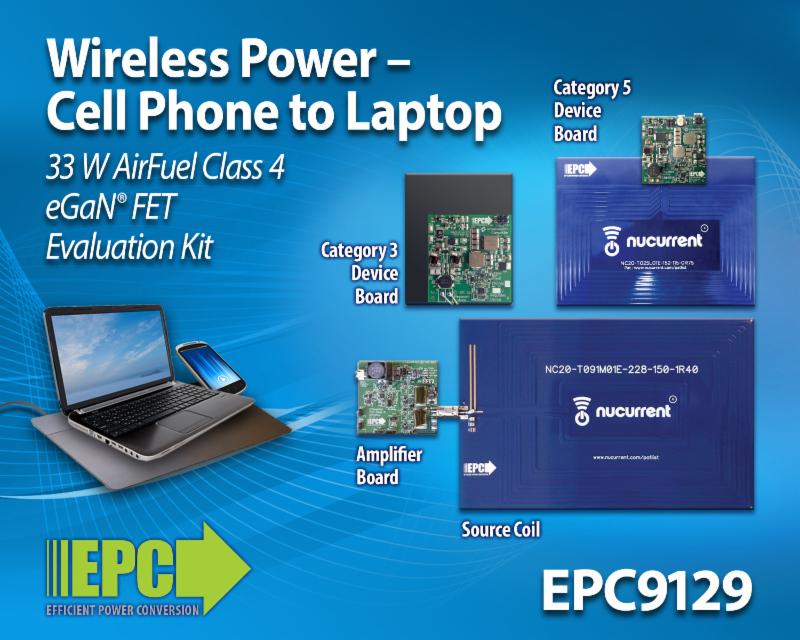
EL SEGUNDO, Calif.— Efficient Power Conversion Corporation (EPC) announces the availability of a complete class 4 wireless power kit, the EPC9129. The system can transmit up to 33 W while operating at 6.78 MHz (the lowest ISM band). The kit comes complete with two receivers, each with a regulated output - one capable of 5 W capable and a second capable of delivering 27 W at 19 V.
The purpose of this demonstration kit is to simplify the evaluation process of using eGaN FETs for highly efficient wireless power transfer. The EPC9129 utilizes the high frequency switching capability of EPC gallium-nitride transistors to facilitate wireless power systems with full power efficiency
between 80% and 90% under various operating conditions.
The EPC9129 wireless power system consists of four boards:
* Source Board (Transmitter or Power Amplifier) EPC9512 featuring the EPC 8010, EPC2038 and EPC2019
* Class 4 Air Fuel compliant Source Coil (Transmit Coil)
* Category 5 AirFuel compatible Receive Device EPC9514 featuring the EPC2016C
* Category 3 AirFuel compatible Receive Device EPC9513 featuring the EPC2019
The popularity of highly resonant wireless power transfer is increasing rapidly, particularly for
applications targeting large power transmitting surface areas, with the capability to place receiving
devices anywhere on the surface, and the ability to simultaneously power (or charge) multiple devices placed on the surface. The end applications are varied and evolving quickly from cell phone charging to powering handheld tablets and laptop computers. Delivering up to 33 W supports all of these applications.
Source (Amplifier) Board
The source board is a highly efficient Zero Voltage Switching (ZVS), Class-D amplifier configured in an optional half-bridge topology (for single-ended configuration) or default full-bridge topology (for differential configuration), and includes the gate driver(s), oscillator, and feedback controller for the pre-regulator. This allows for compliance testing operating to the AirFuel class 4 standard over a wide load range. The amplifier board is available separately as EPC9512 for evaluation in existing customer systems.
Device (Receiving) Boards
The Category 5 EPC9514 (19 V, 27 W) and Category 3 EPC9513 (5 V, 5 W) device or receiving boards included in the wireless power demonstration kits are also available separately for those that
have their own source boards or who want to work with multiple receiving devices simultaneously. The efficiency of these first-generation systems is about 87% from input to the transmitter to the output of the receiver (end-to-end), and with future improvements in architecture and GaN IC technology this number can reach into the 95% range.
As with the demonstration kits, these boards operate to the Airfuel standard, excluding Bluetooth Low Energy (BLE) communications. With the wide range of efficient receivers that can be used to power anything from lamps to laptops to tablets, while remaining compatible with cell phone charging, the system designer now has all the tools needed to create an entire wireless power, large area, efficient system.
For more, visit www.epc-co.com