Current Editor Blogs
    Airbus Solar-Powered Drone Delivers Internet to Remote Areas
    Airbus Solar-Powered Drone Delivers Internet to Remote Areas

    07/18/2018
    Jason Lomberg, North American Editor, PSD
    Tag: @airbus @facebook #internetbeaming #solardrone #drones #psd

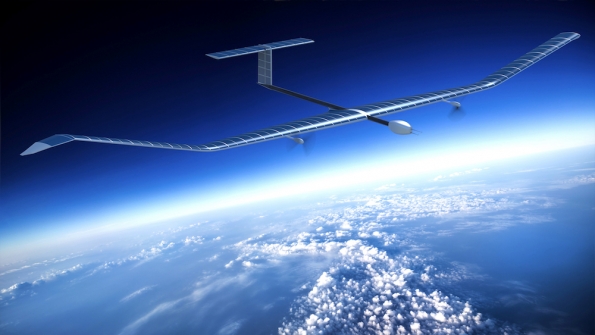
    Airbus has begun production on its High Altitude Pseudo-Satellite (HAPS), a solar-powered drone the company wants to keep aloft for 100 days.

    The European aerospace giant is pushing the Zephyr for defense applications, but the “Psuedo-Satellite” also has the ability to deliver internet access to remote areas – similar to Facebook’s internet “beaming” technology. And that’s where it gets really interesting.

    The Zephyr S would operate in the stratosphere at an altitude of 21 kilometers (13 miles), and its solar power generation and relatively light frame (< 75 kg) should allow it to stay airborne for 100 days without landing (so far, they’ve hit a max of 14 days).

    The “High Altitude Pseudo Satellite” is able to fly for months at a time, “combining the persistence of a satellite with the flexibility of a UAV” and offering “voice and data communications, both line of sight and beyond the line of sight.”

    And the Zephyr S will have plenty of competition – namely, the world’s largest social media website. Facebook has already tinkered with a solar-powered internet “beaming” drone, and the global clout of Mark Zuckerberg’s baby should make it a bit harder for competitors to carve their own piece of the HAPS pie.

    But the promise of truly connecting the entire world should make room for a host of different solutions. And this goes without saying, but Airbus is no slouch in the aerospace department.

    Read more about the Zephyr S here: www.airbus.com/defence/uav/zephyr.html

    Recent
    Battery Life: How Can We Get More from Each Charge?

    Battery Life: How Can We Get More from Each Charge?

    04/12/2017
    Meng He, Executive Business Manager, Core Product Group, Maxim Integrated
     Creating Smaller, More Efficient Isolated Power Supplies with Iso-Buck Converters

    Creating Smaller, More Efficient Isolated Power Supplies with Iso-Buck Converters

    04/17/2017
    Reno Rossetti, Principal Technical Writer, Maxim Integrated
    Accelerating Isolated Power Supply Design

    Accelerating Isolated Power Supply Design

    05/10/2017
    Reno Rossetti, PhD, EE, Maxim Integrated
    The Pope Receives his First Electric Car

    The Pope Receives his First Electric Car

    06/02/2017
    Jason Lomberg, Editor, North America, PSD

    Power Systems Design

    146 Charles Street
    Annapolis, Maryland 21401 USA

    Power Systems Design

    Power Systems Design is a leading global media platform serving the power electronics design engineering community. It delivers in-depth technical content, industry news, and product insights to engineers and decision-makers developing advanced power systems and technologies.

    Published 12× per year across North America and Europe, Power Systems Design is distributed through online and fully digital editions, complemented by eNewsletters, webinars, and multimedia content. The platform covers key areas including power conversion, semiconductors, renewable energy, automotive electrification, AI power systems, and industrial applications—supporting innovation across the global electronics industry.