Magnet-Free Electric Motor
Electrical motors are used in a multitude of applications. They are so widely used that research estimates that they are the main energy consumer globally and use almost half of all electricity generated in the world. Almost all motors depend on magnets to operate, and those magnets contain rare-earth minerals, which may not be as rare as the name suggests, but extraction today is mainly situated in China, and the country has threaten to stop exports of the materials more than once. Rare-earth minerals are also expensive and environmentally unfriendly. If magnets could be eliminated from motor designs, it would make industry far more sustainable. But replacing magnets is if the alternative doesn’t provide the same benefits. Magnet-free designs would need to be compact, efficient, be built with easily available materials, and offer similar performance, which is a difficult task.
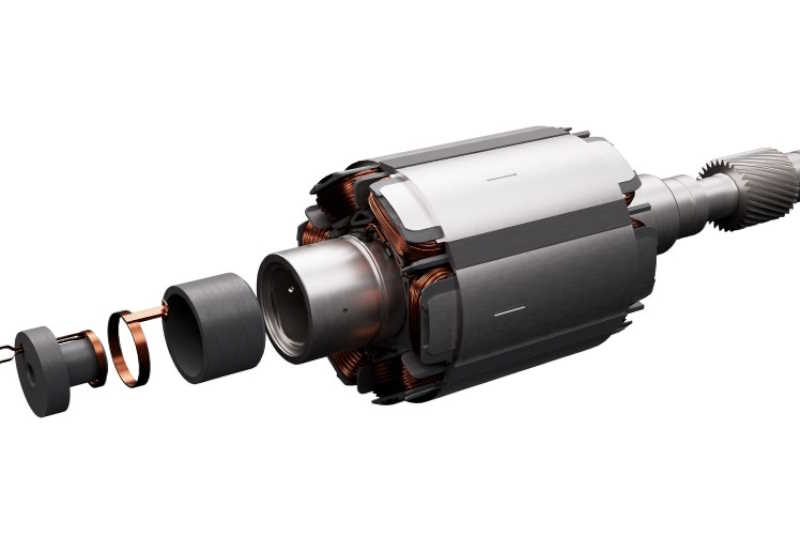
German company ZF is now claiming it has solved those issues and made an electric motor which does not require magnets. To get around the drawbacks, the company has developed its own I2SM (In-Rotor Inductive-Excited Synchronous Motor) technology, as opposed to the separately excited synchronous motors (SESM) design traditionally found in magnetless motor designs. I2SM has been designed to transmit the energy for the magnetic field through an inductive exciter inside the rotor shaft, making the motor smaller, while offering more power and torque density.
The new motor is an alternative to permanent-magnet synchronous machines (PSM), which are currently most frequently used in electric vehicles. Compared to SESM systems, the I2SM inductive exciter can reduce losses for the energy transmission into the rotor by 15%. The new motor’s CO2 footprint in production is around 50% lower than PSM motors due to not using magnets and the rare earth materials found in them. In addition to eliminating rare earth materials, the I2SM can also eliminate the drag losses created in traditional PSM e-motors, providing higher efficiency at certain operating points such as long highway trips at high speed.
To build the magnetic field up without magnets, the I2SM rotor uses current instead, as opposed to SESM motors which normally require sliding or brush elements. These elements force compromises in the design, such as the motor requiring a dry installation space and additional seals needed for access to oil cooling. These compromises add up to 90 mm extra axial space to the design, stopping manufacturers easily swapping PSM and SESM designs. ZF’s new design compensates for the disadvantages of SESMs, particularly by increasing the torque density without increasing the axial space requirements through its rotor design. Additionally, an increase in power density in the rotor leads to an improvement in performance.
I2SM works by transferring energy inductively into the rotor by generating a magnetic field through coils. There is no need to keep this area dry with seals. As with PSM machines, the rotor is efficiently cooled by circulating oil. In terms of power and torque density, the ZF motor operates at the level of a PSM.
ZF will develop the I2SM technology to production maturity and offer it as an option within its own e-drive platform. The company plans 400-volt and 800-volt variants for their respective applications.