Toothpaste Ingredient Could Increase EV Range
Although lithium-ion batteries are the most commonly used batteries globally, it is not the chemistry with the highest energy density - other chemistries can get much higher. The secret of lithium-ion’s success is that batteries are great all rounders. They have decent specifications for both their electrical and mechanical properties and few weaknesses. While they don’t have the highest density, they do have good longevity and the amount of charge they can hold drops slowly over time. They don’t have the fastest charging rate, but can charge relatively quickly. They are relatively small and light compared to some other batteries. The other chemistries that have higher densities and can charge faster than Li-ion do not have the same ability to hold charge after a few charge/discharge cycles. For example, lithium metal batteries can hold up to double the charge, and charge in half the time, however their performance degrades quickly, and their advantage disappears in well under a hundred charge-discharge cycles. If that performance could be improved, then lithium metal batteries would offer a much more compelling case to provide energy storage in many applications. For example, lithium metal batteries would extend the range of electric vehicles quite considerably. Additionally, they could also be capable of the heavy duty tasks where Li-ion batteries struggle, such as for aircraft or heavy industrial equipment.
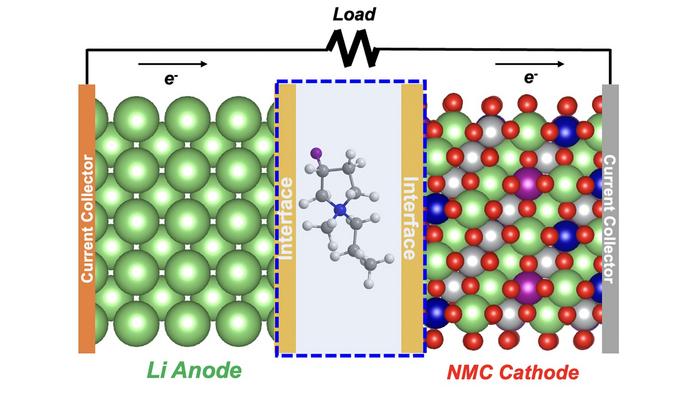
The key to extending the lifetime of lithium metal batteries could be a compound containing fluoride, much like the one found in toothpaste to protect teeth from decay. Scientists at the U.S. Department of Energy’s (DOE) Argonne National Laboratory have developed a fluoride electrolyte that could protect next generation battery chemistries, such as lithium metal chemistry, from performance decline.
The researchers focussed on the battery electrolyte. In lithium metal batteries, the electrolyte normally consists of a lithium-containing salt dissolved in a solvent. That electrolyte does not form an adequate solid-electrolyte-interphase (SEI) layer on the anode surface during the first few cycles. The SEI allows lithium ions to freely pass in and out of the anode to charge and discharge the battery. The ionic fluoride solvent electrolyte discovered by the researchers maintains a protective layer for hundreds of cycles.
To gain a better insight of what was happening inside the battery, the researchers used the high performance computing resources of the Argonne Leadership Computing Facility (ALCF), a DOE Office of Science facility. Simulations on the ALCF’s Theta supercomputer revealed that fluorine cations stick to and accumulate on the anode and cathode surfaces before any charge-discharge cycling. In the early cycling stages, a resilient SEI layer forms that is superior to what is possible with previous electrolytes. High-resolution electron microscopy showed that the SEI layer on the anode and cathode led to the stable cycling. The team then tuned the proportion of fluoride solvent to lithium salt to create a layer with optimal properties, and SEI thickness. This layer allowed lithium ions to efficiently flow in and out of the electrodes during charge and discharge for hundreds of cycles.
The new electrolyte also offers other advantages - it cost effective as it can be manufactured with high purity and yield in one step. It is environmentally friendlier as it uses less solvent, which is volatile and can release contaminants into the environment, and it is safer because it is not flammable.
The work was supported by the DOE Office of Energy Efficiency and Renewable Energy, Vehicle Technologies Office.