JT Sheehan talks to PSD about how Mersen has developed a new series of fuses specifically for solar parks with an output power of up to 2,000VDC
Photovoltaics play a central role in the climate-neutral energy mix. To ensure that PV systems deliver reliable power, they must be optimally protected against overcurrents and short circuits. This protection is becoming more challenging, as the average output power of solar parks has risen 600VDC in 2009 to 1,500VDC today, and it is trending towards 2,000 VDC. The reason for the rise in voltage is that PV module manufacturers wish to increase the efficiency of their systems by using longer cable runs with higher voltages. The higher voltage enables a reduction in current, and thus heat loss, without reducing the amount of electrical energy transported. It also helps to minimise the number of components in the system, reducing costs. Currently, many PV module manufacturers are certifying their products for use in 2,000VDC systems.
Mersen is supporting these new designs with the launch of the HP20Pxx series of high-performance PV fuses. JT Sheehan, Senior Product Manager UL/CSA Fuse Products at Mersen explains, “the fuses were developed for solar fields with a large number of PV modules connected in series and offer engineers great flexibility in system design and integration. The HP20Pxx fuses have rated currents from 20 A to 60 A and feature a low minimum breaking capacity of 1.35 times the rated current value. These characteristics enable safe interruption of the circuit under typical conditions with low fault currents. By using these fuses, solar park operators can ensure the operational safety of their generator connection boxes, inverters and solar charge controllers, even at high voltages. The HP20Pxx series PV fuses are also the smallest of their kind on the market for 2,000 VDC PV systems, measuring just 22 mm x 85 mm”.
The HP20Pxx PV fuses have been certified according to UL248-19 (USA) and UKCA (UK) – approvals according to the European standard IEC 60269-6 and the Canadian standard CSA C22.2 will follow shortly. JT Sheehan was instrumental in developing the UL standard for the new fuses, acting as a member of NEMA Fuse Section 5FU and IEC TC 32 Fuse Committee.
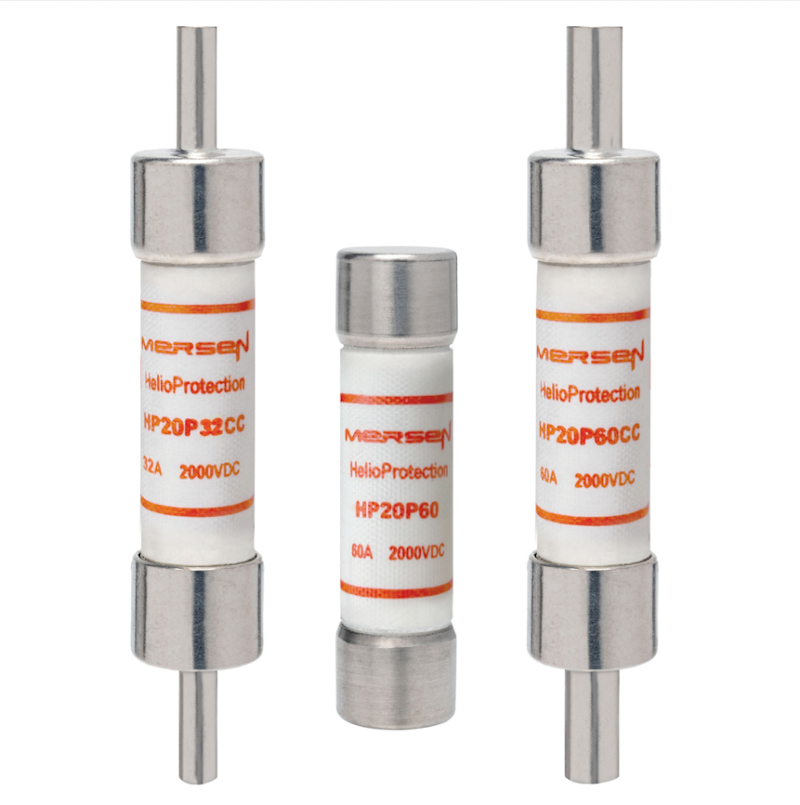
Image - Mersen fuse links are available in a standard version and a crimp-cap version
Sheehan finishes by saying, “the potential for these fuses is huge, as there is still plenty of free capacity for the construction of photovoltaic systems in Germany alone. For example, on agricultural land, electricity can be generated using elevated PV modules, while crops are grown underneath the systems. This type of solar power generation – known as agri-PV – offers many other advantages in addition to the dual use of land. The modules protect the plants from extreme weather conditions and maintain soil moisture. This significantly reduces both the need for irrigation and the use of pesticides”.
https://us.mersen.com/en/products/helioprotection-hp20pxx-2000vdc-solar-fuses-22x85mm