Compact Filter Saves Space in Three-Phase Power Applications
They are not easy to design and often require specialist help
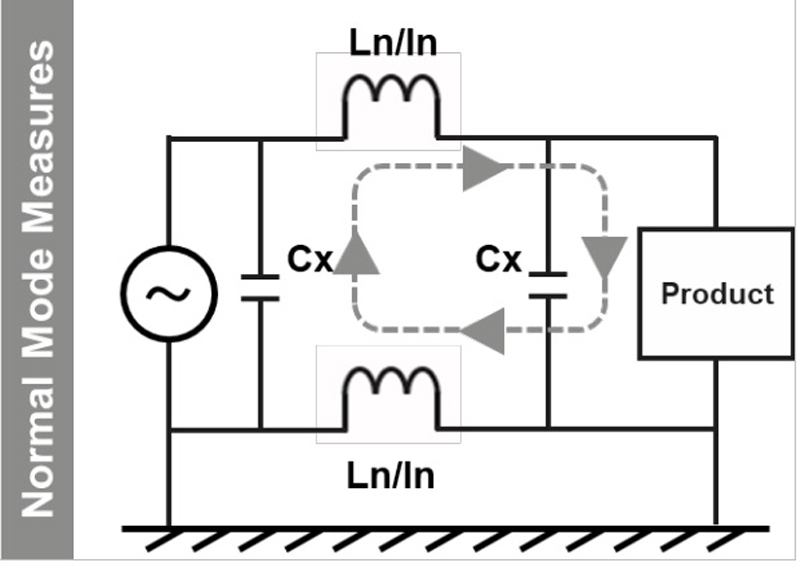
Figures 1a: Filtering normal-mode
EMI-RFI filters are needed to attenuate common-mode and differential-mode EMI (or noise). Although simple in principle, they are not easy to design and often require specialist help. Moreover, in three-phase power applications, adequate filtering can occupy a large volume. An integrated three-phase filter can alleviate the problem, although space constraints can still conspire to force designers towards a custom filter to get the size, power rating, and frequency response they need. Combining an integrated three-phase design with space-saving nanocrystalline core technology in inductive components gives extra freedom to achieve an off-the-shelf solution.
EMI Sources and Regulations
More and more electrical and electronic equipment is pervading every aspect of our personal and professional lives; to enable people to work, provide and consume services, manage essential infrastructures, monitor and care for the environment, protect our safety, and enable our social lives. As the world becomes increasingly densely inhabited by these devices, and given the critical nature of many of their roles, ensuring coexistence is essential. Each can be a source of EMI that may – if unaddressed – cause other equipment in the vicinity to malfunction. Minimizing emitted EMI and ensuring immunity to external EMI are both essential aspects of engineering these devices for electromagnetic compatibility (EMC).
Regulations aim to ensure that all products placed on the local market are capable of coexisting with others. The European Union’s EMC directive (2014/30/EU) references test specifications and standards set by various technical bodies, including the International Electrotechnical Commission (IEC), CISPR (Comité International Spécial des Perturbations Radioélectriques), and International Standards Organization (ISO).
Any item of electrical equipment can create EMI of various types. This is totally unwanted, such as switching high frequency emissions from a power converter or signal energy from one piece of equipment that becomes coupled into another where it is unwanted – hence perceived as EMI.
EMI can be conducted along transmission lines or radiated through the air between subsystems or different items of equipment. When electronic devices are connected via an offline AC power supply, EMI generated from each unit can reach other line-powered equipment through the power supply line.
Conducted emission is divided into two categories, depending on the path through which it propagates. Normal (differential) mode noise refers to asynchronous emissions that occur between power supply and signal lines. In this case, the emission current direction is opposite on each line. On the other hand, common mode noise occurs between power or signal lines and ground. In this case called synchronous emissions, the current direction is the same for each line.
EMI-RFI Filters
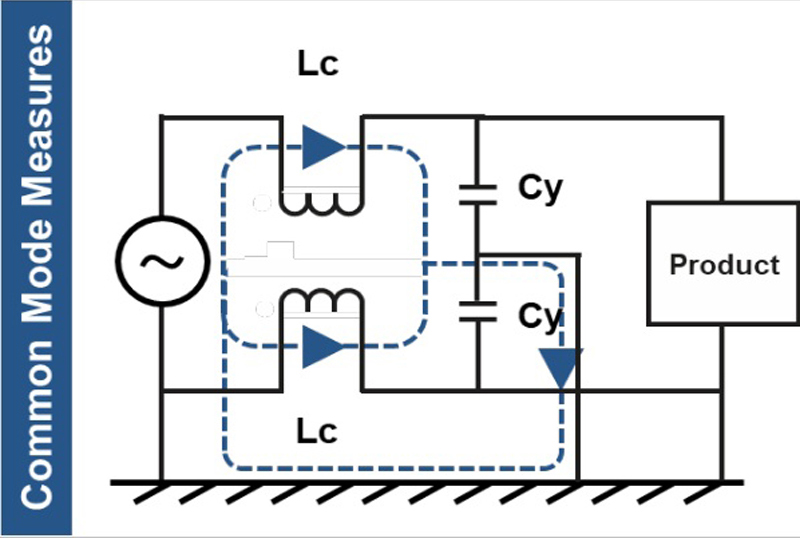
Filters are applied to attenuate these unwanted differential and common mode emissions. Normal (differential mode) noise is attenuated using a combination of in-line inductors and X-capacitors connected across the power lines, as shown in Figure 1a. Figure 1b shows how Y-capacitors between the power lines and ground are needed to deal with common-mode emissions.
Click image to enlarge
Figures 1b: Filtering common-mode EMI
Figure 2 shows how the two are combined to create a complete EMI-RFI filter. Any item of mains-powered equipment that contains switching devices such as AC/DC converters must contain this type of filter to comply with minimum targets for emission, immunity and susceptibility, such as the European EMC directive (2014/30/EU).

Click image to enlarge
Figure 2: EMI-RFI filter comprising differential-mode and common-mode filters
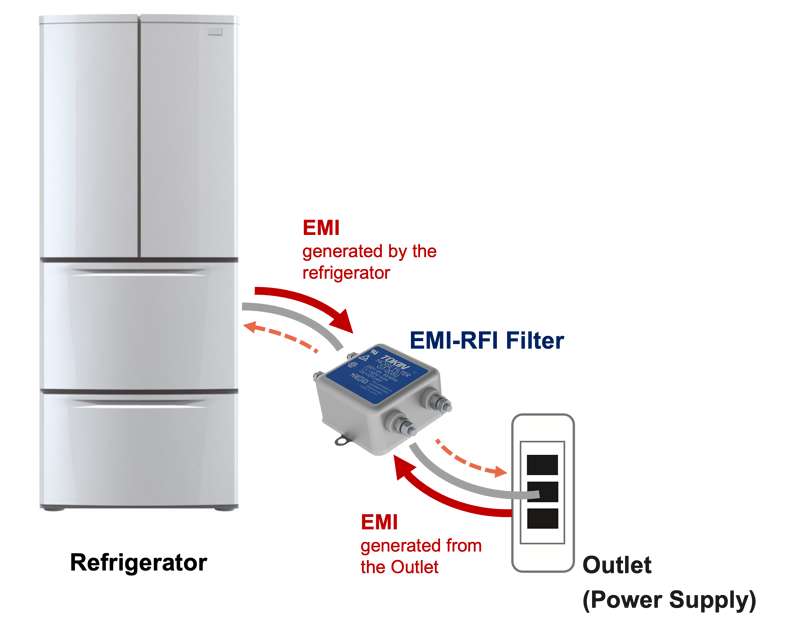
In the case of a home appliance like a refrigerator designed to operate from a single-phase AC supply, the filter is inserted between the power outlet and the load as shown in Figure 3, as many home appliances today use switching devices. This is compared to the past, where only a compressor and a light source was present.
Click image to enlarge
Figure 3. EMI-RFI filter in a single-phase application
Three-Phase – 3x the Challenge
High-power industrial equipment that demands more power than a single-phase AC supply can deliver, is typically powered from a three-phase supply. Examples include large industrial robots, motor drives, and large medical devices like MRI scanners. Three-phase equipment naturally requires three channels of EMI-RFI filtering: one on each line. It is common for filter suppliers to provide units that integrate three individual line filters in a single enclosure as a three phase filter, to deliver a space-efficient solution.
Filter Selection Criteria
However, getting the desired blend of frequency response and power rating within a form factor suitable for the prevailing size constraints, is not always easy and can push the project towards a custom filter. There can be several problems with this. Product teams often find that their chosen vendor cannot help within a suitable timeframe. If the expected production volume is low, some vendors may not be prepared to discuss a custom filter project at all.
Assuming a willing supplier can be found, developing the custom filter inevitably adds time and cost to the project. Engineers must first wait for samples to be produced. Subsequently, if trials show that the filter design needs to be changed, further delays are likely before production examples can be delivered. In addition, applications have to comply with different EMC rules depending on the place of installation. In pure industrial applications, the lowest requirements are present, but in residential areas the requirements are more stringent. In medical surroundings like hospitals, a current to ground is not allowed or must be limited and filters without Y-capacitors are the only solution.
Saving More Space
Nanocrystalline materials enable inductive components, or chokes, in EMI-RFI filters to be made significantly smaller than is possible using conventional ferrite cores. Leveraging these space savings can deliver a filter of suitable frequency response that meets the applicable space constraints. In addition, the nanocrystalline core material enables attenuation at a higher frequency range due to the material capability and less turns of copper windings being needed to achieve the same inductance. Windings cause a parasitic capacity that reduces the high frequency attenuation. Specifically with modern wide band-gap technology that operates at higher switching speeds, these upper frequency ranges need more attenuation than in the past.
KEMET has used its nanocrystalline technology to create a family of 24 off-the-shelf compact three-phase filters. These filters can be specified with any of six Y-capacitance values, from 0pF to 470,000pF, which provides a choice of common-mode attenuation characteristics suitable for various equipment topologies. Figure 4 shows the effect on common-mode attenuation of each of the six different capacitance values.

Click image to enlarge
Figure 4: Frequency response of 3-phase filters with various values of Y capacitance
In addition, each configuration is available with one of four current ratings from 30A to 60A. The spread of current ratings and attenuation characteristic helps ensure engineers can find an off-the-shelf model to meet their project requirements, avoiding the overheads associated with a custom project. In addition to benefiting from faster access to samples and easier ordering of production quantities, only minimal technical engagement with the vendor is needed, and engineers can quickly and easily evaluate one or several alternatives from the family.
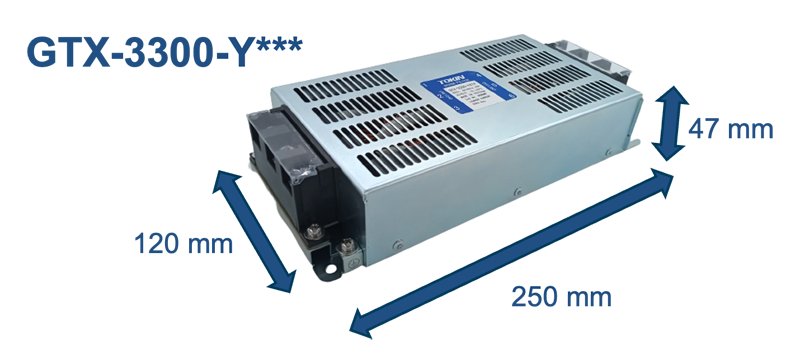
Compared with a similar conventional 3-phase EMI-RFI filter, the GTX series occupies less than 30% of the volume and realizes a similar reduction in the overall mass of the filter (Figure 5).
Click image to enlarge
Figure 5. Nanocrystalline core technology reduces 3-phase filter size and weight to less than 30%
Conclusion
Electrical equipment powered from the AC line must have a line filter for each supply phase, to meet mandatory EMC regulations. If space constraints are tight, engineers can be forced to find a specialist to design a custom filter to provide the desired attenuation in a filter of suitable dimensions. Nanocrystalline inductor cores allow high common-mode attenuation with a wide frequency range in a small and lightweight unit, permitting off-the-shelf filters to address demanding applications in industrial automation, renewable energy, and medical scanners that require deep attenuation with high current capability.