SMD PIR Sensor Enables the Next Generation of Smarter Living

An accurate PIR sensor that doesn’t analog design expertise and extensive calibration
Figure 1: The IRS-D200ST00R1 sensor, developed to address the limitations of traditional PIR sensors
As homes, offices, and cities grow more connected, engineers are expected to deliver designs that are not only intelligent and secure but also energy-efficient and scalable. From remote health monitoring to adaptive lighting and automated security, passive infrared (PIR) sensors remain a core component in enabling responsive environments.
PIR sensors are increasingly being used in non-intrusive wellness applications. For example, they can help monitor elderly family members or individuals living alone by providing presence detection without relying on cameras or microphones. This allows designers to build solutions that enhance peace of mind and safety, while still respecting personal privacy.
The demand for these sensors is surging. In the consumer electronics sector alone, motion sensing is projected to become an $8.5 billion market, growing at a 19% CAGR. However, engineers working to meet this demand often encounter friction when integrating conventional PIR technology into today’s compact, battery-powered, and wireless designs.
Integration Pain Points of Conventional PIR Sensors
While PIR sensors have long been used in motion detection applications, the mechanical structure and analog circuit requirements of conventional models often introduce constraints that hinder their use in modern, miniaturized, and wireless device designs.
One of the primary challenges that designers face with PIRs is the required Bill-of-Materials (BOM). Conventional PIRs require discrete analog circuits, including amplifiers, band-pass filters, and comparators. These components not only increase the bill of materials count but also necessitate analog design expertise and extensive calibration for precise detection. Furthermore, the design complexities extend beyond the PIR itself, as most legacy PIRs are dual-in-line package (DIP) type through-hole components. This packaging introduces complexities to assembly, demanding specialized mounting and consuming considerable space on both sides of a PCB, thereby hindering high-density configurations.
The rationale behind DIP packaging stems from the degradation of pyroelectric ceramics in traditional PIR sensors when subjected to reflow temperatures above their Curie point. As a result, DIP packaging has remained dominant, limiting compatibility with automated SMT production lines. Ultimately, these factors all combine to create sensors that typically require significant board space and additional circuitry, limiting design flexibility in applications with strict space constraints.
Finally, alongside the BOM and packaging considerations, conventional PIRs are sensitive to electromagnetic interference (EMI) from wireless signals, especially in the 2.4 GHz and 5 GHz bands used by Wi-Fi and Bluetooth. Mitigating this often requires time-consuming shielding strategies and layout adjustments, which further impact the BOM component count as well as costs and ease of assembly.
Murata’s Solution
Addressing the limitations of traditional PIR sensors, Murata has developed the IRS-D200ST00R1, a sensor that is engineered for high-performance sensing, ease of integration, and sustainability. This sensor is a targeted advancement in PIR technology, designed to meet the nuanced requirements of contemporary intelligent environments.
The IRS-D200ST00R1 features a surface-mount package that integrates smoothly into automated SMT lines, enhancing the manufacturing process. This Surface-Mount Technology (SMT) compatible form factor not only reduces labour costs but also increases production throughput and eliminates the manual handling typically associated with DIP components.
At the heart of the sensor is a Murata-developed application-specific integrated circuit (ASIC) that consolidates signal amplification, analog-to-digital conversion, and filtering into a single component. This allows engineers to interface with the sensor via I²C, configuring detection thresholds and timing through firmware, which simplifies the design process and shortens the time-to-market. The sensor also includes an interrupt output for power management, signalling the host microcontroller (MCU) only when motion is detected. This innovative feature supports deep sleep modes and ultra-low power operation, which is particularly beneficial for battery-powered smart devices, where energy efficiency is a priority.
Characterized by its compact and low-profile design, the IRS-D200ST00R1 offers flexible placement options in space-constrained environments, thus contributing to the miniaturization of smart devices. Addressing the shortcomings of traditional PIR sensors, the Murata IRS-D200ST00R1 SMD PIR sensor provides an advanced solution for creating safer, more efficient, and sustainable environments. Its compact design is well-suited for diverse applications, including smart thermostats, IP cameras, doorbells, and wearable technology.
Reliable Detection, Even in Noisy Environments
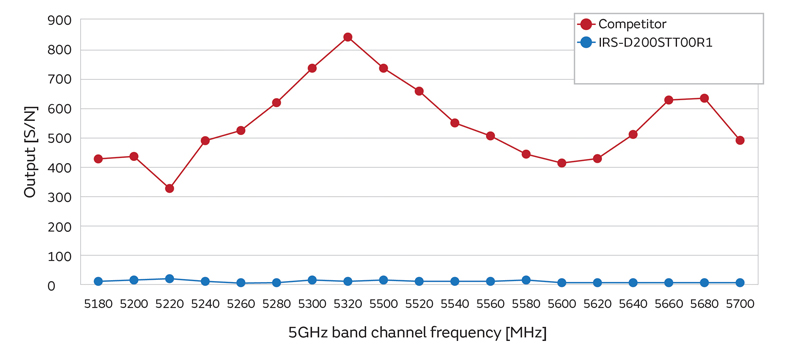
The IRS-D200ST00R1 was engineered to deliver a stable, high-SNR output even in the presence of environmental noise. Leveraging Murata's proprietary pyroelectric ceramic technology, the sensor ensures strong signal amplitude during human detection events, which enhances detection accuracy and reduces the likelihood of false triggers.
In practical applications, it is essential for sensors to perform reliably under varying ambient conditions. The IRS-D200ST00R1 is engineered to sustain consistent performance despite temperature fluctuations, changes in lighting, vibration, and static discharge. It also exhibits a notable resistance to EMI, particularly across the congested 2.4 GHz and 5 GHz wireless bands – a critical advantage in IoT-rich environments. By reducing the incidence of false positives and negating the necessity for extensive signal filtering or shielding, the sensor helps engineers to streamline their design process and reinforces the confidence of end-users in the sensor's reliability.
Click image to enlarge
Figure 2: Murata’s IRS-D200ST00R1 is engineered to deliver a stable, high-SNR output even in the presence of environmental noise
Built for a Sustainable Future
As the proliferation of IoT devices continues, the imperative for intelligent and sustainable design becomes ever more pressing. According to the American Council for an Energy-Efficient Economy (ACEEE), homes could save 7–27% on lighting energy use with smart lighting, like those triggered by PIR sensors. However, a truly sustainable solution is not just about saving energy in the end use case; it should also consider the energy used to create the device.
Murata's IRS-D200ST00R1 sensor is crafted with this in mind, addressing environmental considerations throughout its lifecycle, encompassing production efficiency, power consumption, and the reduction of component waste. The sensor's architecture, which consolidates signal processing and supports SMT compatibility, leads to a decrease in the total number of components required. This approach not only minimizes production waste but also reduces failure rates and streamlines material handling, thereby promoting more sustainable manufacturing principles.
Once deployed, the sensor's low-power profile, underpinned by its interrupt-based operation, plays a pivotal role in conserving energy. This feature allows devices to remain in a state of low power consumption until motion is detected, thereby extending battery life and reducing the frequency of battery replacements. This is particularly beneficial in consumer environments where prolonged operation of smart devices without maintenance is highly valued.
Finally, the compact design and energy efficiency of the IRS-D200ST00R1 sensor facilitate the creation of products that are mindful of environmental impact. This allows engineers to design IoT devices that are not only innovative but also eco-friendly. The sensor's compact size and low power draw are key to creating energy- and space-efficient smart devices, a crucial balance for the next generation that must integrate seamlessly into our lives while minimizing environmental impact.
Conclusion
Murata’s IRS-D200ST00R1 offers a motion detection solution that fits seamlessly into next-generation designs. By surpassing the restrictions found in conventional PIR systems, this innovation makes significant strides in safety, scalability, and sustainability.
Featuring high detection accuracy coupled with low power consumption and simple integration capabilities, for engineers, this sensor represents a significant advancement beyond incremental improvements; it is instead a foundational upgrade for the next generation of smarter living systems.