From Rising Loads to Rugged Switching: The Case for SiC JFETs in SSCBs
Fast, efficient, and robust protection for 750 V to 1200 V applications with CoolSiC™
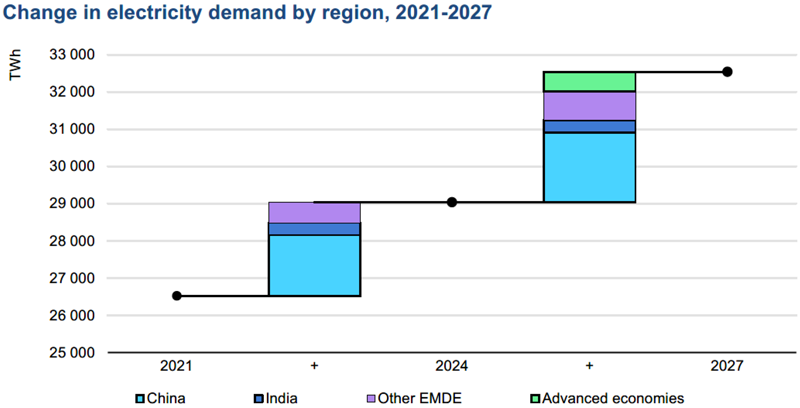
Figure 1: Change in electricity demand by region, 2021–2027. Note: EMDE = Emerging Markets and Developing Economies [1]
Global electricity demand surged 4.3% in 2024, nearly double the average pace of the previous decade, driven by data centers, electrification, and severe climate change causing temperature fluctuations that pushed heating and cooling loads to record levels [1]. Projections for 2026 to 2030 indicate that demand will continue rising at roughly 3.6% per year, fueled by electric vehicles, air conditioning, and the rapid acceleration of industrial and AI‑driven workloads [2].
Data centers alone show the magnitude of this shift. U.S. facilities consumed 176 TWh of electricity in 2023 (a jump from 76 TWh in 2018) and may reach 325 TWh to 580 TWh by 2028 depending on server mix and AI adoption rates[1]. Globally, data centers consumed ~460 TWh in 2022 and are projected to reach 650 TWh to 1050 TWh by 2026, outpacing many national grids [1]. Even conservative estimates suggest data centers could account for 3% to 4% of global electricity usage within the decade [3].
Meanwhile, renewable energy, although expanding faster than ever, introduces variability that stresses grid protection infrastructure. Integrating wind and solar energy requires tighter control, faster fault response, and more flexible protection schemes to handle intermittency, rapid ramps, and reverse power flow scenarios[4].
For reliable protection in this environment, breakers must be faster, more precise, and more rugged. This is exactly where solid-state circuit breakers (SSCBs) play a significant role. Beyond their superior switching characteristics, SSCBs enable a higher degree of intelligence that traditional mechanical breakers simply cannot match. These smart capabilities include real-time power consumption monitoring, predictive maintenance algorithms, remote diagnostics and control, and advanced fault analysis; transforming circuit protection from a purely reactive safety measure into a proactive system management tool. And to make SSCBs future-ready, wide-bandgap devices are important, more specifically, silicon carbide junction field‑effect transistors (SiC JFETs).
More load, more variability, more stress on protection devices
Rising loads amplify fault current magnitudes, reduce thermal margins, and stress protection systems during both normal and abnormal operation. With highly distributed generation and applications such as EV fast‑charging, the electrical environment grows more unpredictable. Traditional mechanical circuit breakers, designed for earlier eras of grid stability, struggle where:
· Fault currents rise too rapidly
· Arc suppression becomes difficult
· Long‑term wear compromises reliability
· Protection must integrate digitally with meters, controllers, and analytics
Mechanical contacts and breaking methods, where arcing is a byproduct, simply cannot match the microsecond‑level responsiveness modern power systems now demand.
SSCBs, in contrast, use semiconductor devices to interrupt current electronically; eliminating arcing, accelerating reaction times by orders of magnitude, and enabling programmable protection curves. But the semiconductor at the heart of the breaker must withstand extreme electrical stress. That is where SiC JFETs distinguish themselves.
The wide-bandgap shift and the role of the SiC JFET
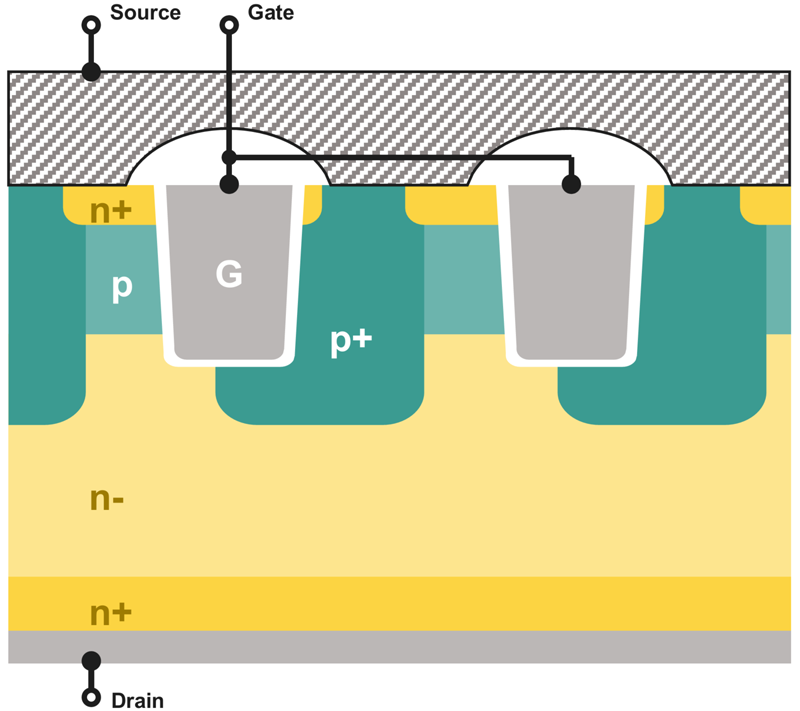
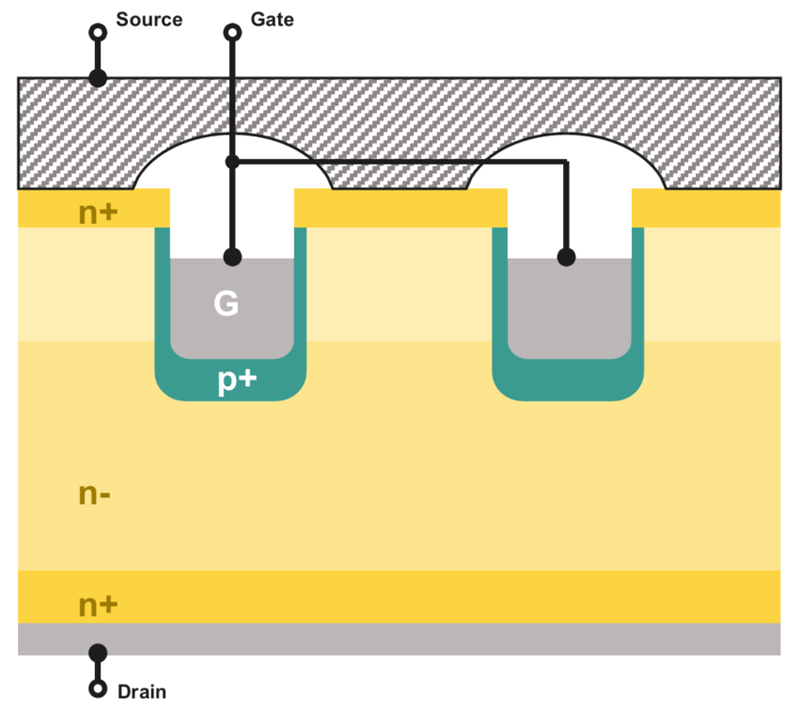
Wide‑bandgap materials like SiC have become essential for modern power electronics due to their higher critical electric field, higher temperature tolerance, and faster switching capability. While SiC MOSFETs often dominate the conversation, the SiC JFET brings unique structural and switching advantages particularly suited to protection devices.
Instead of forming a thin inversion channel at an oxide interface like a MOSFET, the JFET uses a doped volume channel. This architecture enables:
· Extremely low RDS(on) per unit area
· High surge current capability
· Improved dV/dt ruggedness
· Very rugged avalanche behavior
· Strong thermal stability
Although a JFET is naturally normally‑on, pairing it with a low‑voltage MOSFET in a cascode configuration creates a functionally normally‑off device; preserving the JFET’s benefits while offering plug‑and‑play compatibility with standard gate drivers.
Click image to enlarge
Figures 2a & 2b: Cross‑section diagrams comparing SiC MOSFET (2a) vs. SiC JFET (2b) channel structures
Why the SiC JFET is ideal for SSCBs
Protection applications, and SSCBs specifically, place unusually demanding stress on semiconductor switches:
· Interrupting hundreds of amps under highly inductive conditions
· Handling avalanche events repeatedly
· Commutating energy into metal oxide varistors (MOVs), transient voltage suppressors (TVSs), or clamping networks
· Operating with minimal conduction loss
· Withstanding high dV/dt transients without unwanted turn‑on
· Blocking and conducting bidirectionally for AC grids, when used in a back-to-back configuration
SiC JFETs excel because their intrinsic physics address these conditions holistically. Their volume channel delivers industry‑leading conduction efficiency (as low as 1.6 mΩ at 750 V and 2.5 mΩ at 1200 V), while their avalanche behavior supports safe energy transfer to an MOV during fault interruption.
Their gate‑drain diode enhances ruggedness during fast voltage transients, making them particularly well‑suited for circuits where the line or load inductance cannot be tightly controlled.
The result is a device whose characteristics naturally align with the needs of high‑performance SSCBs.
Click image to enlarge
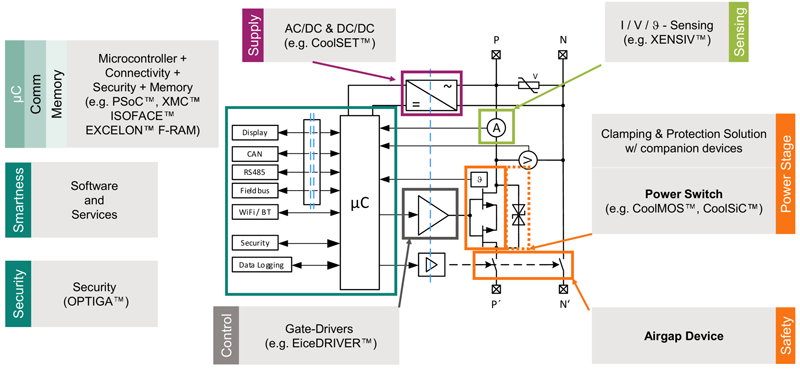
Figure 3: SSCB block diagram highlighting JFET cascode switches
Device advantages and their system-level implications
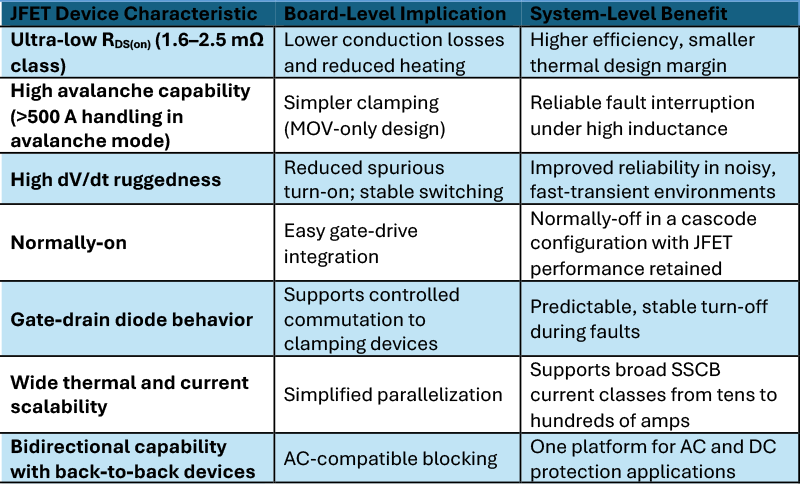
The table below replaces the earlier descriptive section and concisely links JFET characteristics to board‑level and system‑level benefits for SSCBs.
Mapping SiC JFET characteristics to SSCB system benefits
Click image to enlarge
Convergence of trends that favors the SiC JFET
Across industries, the macro forces shaping the next decade of electrical infrastructure align strikingly with the strengths of the SiC JFET:
· Electricity demand is accelerating, driven by industrial growth, EV charging, and extreme temperatures; requiring ultra‑efficient conduction in protection devices
· Data‑center loads are exploding, and hyperscale operators need protection that is fast, wear‑free, and software‑definable
· Renewable variability introduces frequent, dynamic transients, making dV/dt robustness essential
In all three domains efficiency, speed, and ruggedness the JFET is uniquely well matched.
Conclusion
As global electricity consumption continues its steep climb and power systems become more distributed, dynamic, and digital, the demands placed on protection infrastructure change correspondingly, mandating devices and technologies to keep up with the times. Devices must switch faster, withstand higher fault currents, tolerate greater variability, support bidirectional operation, and integrate cleanly with software‑defined grid architectures.
Silicon carbide, and the SiC JFET specifically, provides a semiconductor foundation capable of meeting these elevated expectations. Its ultralow on‑state resistance directly supports efficient, thermally stable operation. Its avalanche and dV/dt ruggedness enable reliable, repeatable fault interruption even in highly inductive networks. Its cascode‑enabled normally‑off behavior ensures compatibility with existing control ecosystems. And its scalability and bidirectional capability align naturally with the needs of modern SSCBs across industrial, automotive, data‑center, and microgrid applications.
The convergence of rising loads, more variable generation, and increasing demand for digital, wear‑free protection makes the SiC JFET not just a component choice, but a technology decision that shapes the resilience of the entire power distribution system. Executives evaluating future‑ready protection architectures will find that the JFET’s device‑level advantages translate directly into system‑level performance, robustness, and long‑term operational value.
References
1. International Energy Agency (IEA); Electricity 2025: Analysis and forecast to 2027; Paris: IEA; February 2025; https://www.iea.org/reports/electricity-2025
2. Renew Economy: IEA calls peak coal, even as “Age of Electricity” takes hold to boost global power demand; February 2026; https://reneweconomy.com.au/iea-calls-peak-coal-even-as-age-of-electricity-takes-hold-to-boost-global-power-demand/
3. Infineon Technologies AG: CoolSiC™ JFET Cascode Evaluation Board for Solid-State Circuit Breaker Applications; May 2025; https://www.infineon.com/document-promo/infineon-coolsic-jfet-cascode-evaluation-board-for-solid-state-circuit_1777900d-0520-4c8f-bb15-9b5703916c70
4. EE Power: How Do Renewables Affect Grid Reliability?; December 2024; https://eepower.com/tech-insights/how-do-renewables-affect-grid-reliability