Creating the Next Generation of Braking Systems with Magnetic Sensors
While stopping might seem like a simple action, every time we press the brake, we initiate a complex and highly coordinated process in our vehicles.
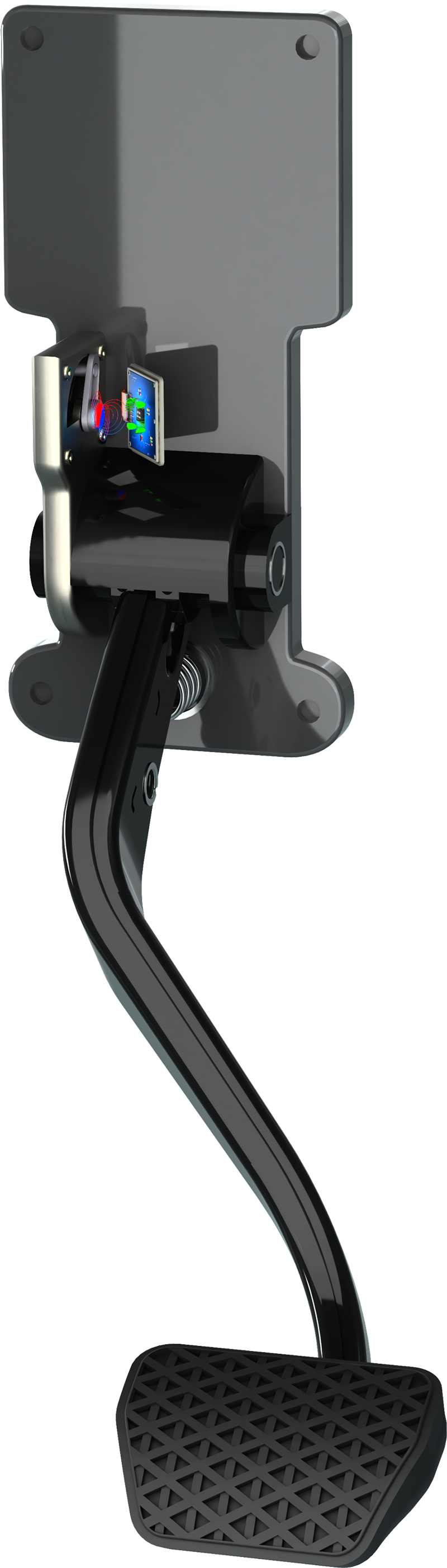
Figure 1: Brake pedal assembly with sensor and actuator module. The sensor detects drivers’ intent
To ensure safety at every stop, today’s braking systems require a sophisticated process that converts motion into control — a process that must function seamlessly in every situation from parallel parking to stopping an SUV on the highway. To do so, braking architectures need accurate, real-time information about mechanical position, motion, and force to achieve responsive intelligence. Magnetic sensors are a critical component in making this possible. And as vehicles become more software-defined, these sensors are becoming increasingly essential.
Every Stop is Actually a Complex Process
A high-powered SUV can accelerate from 0 to 100 kilometers per hour in five seconds, traveling over 140 meters in that short span. Because of the speed they can reach in a handful of heartbeats, modern vehicles must be able to stop safely and quickly under enormous loads. The braking system must dissipate a large amount of kinetic energy, often at power levels approaching or exceeding hundreds of kilowatts during hard braking, while maintaining stability and steerability to stop safely in less than a quarter of that 140-meter distance. No small feat.
And that’s just one job of a braking system. It also must be able to keep a vehicle steady on a hill or be able to gradually slow to a halt at a stop sign. Braking systems require high-performance mechanical hardware supported by smart electronic control to achieve power and precision needed for both emergency braking and daily traffic. Determining component positions like pedal angle, piston movement, and brake pad engagement to facilitate this versatility requires accurate sensor input.
The Rise of Electromechanical Braking
Braking systems relied on hydraulic circuits to transmit force from the pedal to the wheels for decades, but the increasing adoption of electrification is reshaping this. Electromechanical solutions are augmenting and, in some architectures, replacing traditional systems. Electro-hydraulic boosters and electric parking brakes began this shift by reducing the complexity of vacuum components and mechanical cables by adding compact, electronically controlled motors.
There are hybrid configurations on the road today, where the front wheels retain hydraulics for higher braking loads while the rear wheels use electronic actuators. Brake-by-wire systems that eliminate hydraulic fluid altogether and replace it with electrical signaling and motor-driven actuation are increasingly more common. This leads to cleaner, lighter, more controllable systems that are critical for electric vehicles and autonomous platforms.
The Magnetic Sensors Difference in Braking Control
Reliable sensing is essential to transition from hydraulic to electronic braking. Magnetic sensors operate without physical contact. This makes them particularly apt for automotive environments as they have a higher resistance to vibration, temperature extremes, and contamination.
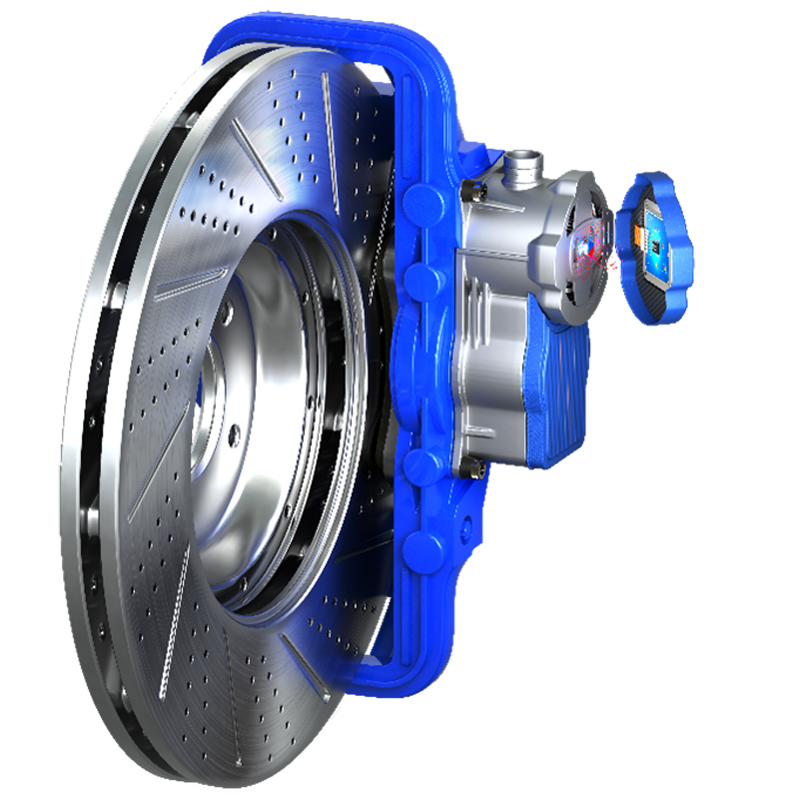
Magnetic sensors have many uses in the braking system. They can confirm if the parking brake is set, integrating with wheel speed data to support hill-hold assist features. They monitor how far the driver presses the brake pedal, which enables the ECU to understand intent and apply braking force accordingly. They confirm whether braking mechanisms are fully engaged or retracted by tracking the position of pistons and calipers. Sensors in systems where hydraulic fluid is still used can also help detect low fluid levels in the reservoir and trigger warnings or adaptive responses.
Click image to enlarge
Figure 2. Brake caliper with actuator modulet. The sensor detects brake piston travel, ensuring drivers’ intent is applied
Specialized Roles Need Specialized Sensors
As the old saying goes, “It takes a village.” The same goes for braking systems, which rely on a variety of sensor types engineered for specific tasks. For example, linear sensors track horizontal shifts in how much a pedal moves. Rotational sensors are used to detect angular position changes — key for controlling brake calipers or boosters in electric motors. Multi-axis or 3D sensors are used to capture compound motion in some applications, like when a switch is pressed and rotated simultaneously. Even simple magnetic switches that detect whether a component is open or closed remain relevant for end-position detection.
No single sensor type can handle every role. The variety of sensor functions is an indication of exactly how complex braking systems can be, and the precision required in their design. Engineers must select a combination of specialized sensors to ensure both performance and environmental tolerance.
Additional Sensor Issues That Must Be Addressed
Electromagnetic compatibilityis a new challenge as more vehicles become electric. Electric motors, inverters, and other high-current components generate magnetic fields. Sensors must be able to distinguish meaningful signals from background interference. Differential signal processing, advanced sensor geometries, and embedded shielding can be used to isolate the target magnetic field from environmental noise.
Braking systems must function even in the event of a component failure to comply with safety standards such as ISO 26262. Sensor redundancy is essential to meet these requirements. To ensure that a single mode of failure cannot affect multiple sensors, this redundancy must use two different sensing principles or technologies — enhancing fault tolerance and supporting the overall safety architecture of the vehicle.
Click image to enlarge
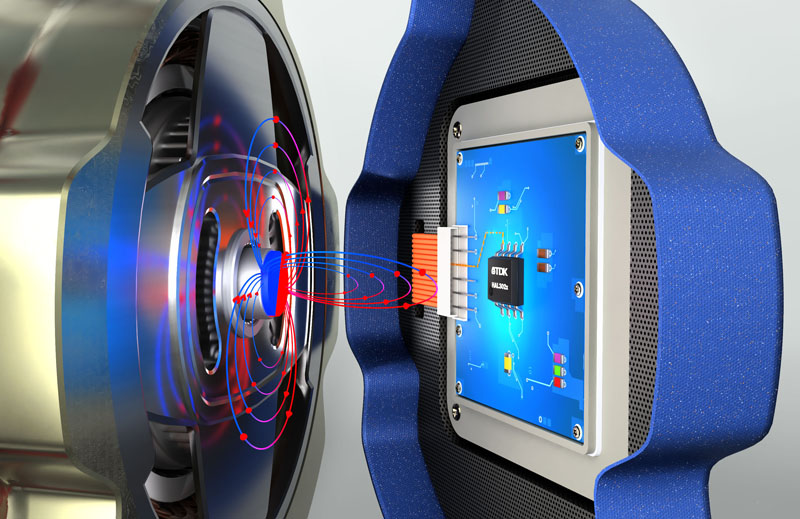
Figure 3. Detailed view of the actuator module. The sensor controls the turns of the shaft of the electric motor by sensing the poles of the magnet at the end of the shaft, translating into the travel of the piston
Sensor Integration in the Real World
Magnetic sensors can be found at every critical control point in a modern braking system, for example:
· Near the brake pedal: Angle or multi-axis sensors capture the driver’s input with high resolution, allowing the system to apply braking force proportionally and precisely.
· Monitoring shaft and gear position:Within motorized actuators used in electromechanical brake systems, sensors monitor shaft or gear position to confirm accurate application and release of braking force. This provides real-time feedback to the control unit and allows for quick adjustments and consistent braking behavior.
· Across the vehicle to ensure system reliability:A Hall-effect sensor may be paired with a tunnel magnetoresistance (TMR) sensor to create a redundant, fail-safe arrangement is one example of multiple sensors deployed in parallel using a different measurement principle.
· In high-EMC electric or hybrid vehicles:Sensors with differential signal architectures can maintain accuracy without heavy shielding to avoid electromagnetic field issues. Advanced designs reject common-mode noise to focus solely on changes in the target field.
Software-Defined Braking Systems Continue to Pave the Way
Steering systems transitioned from hydraulic to fully electronic control, and now braking systems are evolving similarly. This means the number of magnetic sensors used in each vehicle will continue to increase. In some cases, more than 20 different sensors — each fulfilling a specific function in the braking control chain — may be used. While it requires understanding new challenges, this increased sensing capability can greatly enhance vehicle performance. Braking systems will be able to adapt to road conditions, predict wear on components, and integrate more deeply with autonomous driving features. With the right sensor infrastructure, software-defined braking can deliver both safety and adaptability. And with their ability to deliver precise, resilient, and real-time data, magnetic sensors will continue to grow as central pillars in the architecture of modern braking systems — critical for pedal feel, caliper control, system diagnostics, predictive maintenance, and more. Magnetic sensing will continue to underpin safe, intelligent, and responsive braking as electrification and automation reshape the automotive landscape to ensure every stop is both smart and secure.