Electric motors are responsible for using a huge portion of the electricity we generate. Some estimates put that figure almost half of global energy consumption.
Electric motors are responsible for using a huge portion of the electricity we generate. Some estimates put that figure almost half of global energy consumption. As such, it makes sense to have the motors driven as efficiently as possible, for the user to save costs, for the supplier who won’t face so large demands on capacity, and for governments who have commitments to international agreements to save energy.
This need for efficiency has seen BDLC motors growing in popularity. Some other types of electric motor have a similar peak efficiency, but the BLDC can provide more efficiency across a number of different load types, and especially where there are low or no loads. As well as using less power, BLDC motors use fewer components in construction, which in turn makes them smaller and more reliable, requiring less maintenance. They also have a higher torque output per Watt. However, to realize these efficiencies, BLDC motors require more complex hardware and software to constantly adjust the signals sent to the motor. The motor works by using electromagnetic fields generated in pairs of coils to control the permanent magnet rotor. An inverter supplies the power to the coils. The inverter often requires a heatsink because of the large, fast switching currents it generates. However, using heatsinks takes away one of the big advantages of BLDC motors by making the overall design bulkier.
In 2018, Power Integrations launched its BridgeSwitch family of Integrated Half-Bridge (IHB) motor drivers to provide a method of generating the currents required by BLDC motors without the need for a heatsink. The ICs feature high- and low-side advanced FREDFETs (Fast Recovery Diode Field Effect Transistors) with integrated lossless current sensing, resulting in inverter conversion efficiency of up to 98.5% in BLDC motor drive applications up to 400 W. The 600 V FREDFETs use fast, ultra-soft-recovery body-diodes to reduce losses during switching. The self-powered, half-bridge motor driver ICs also provide a robust single-wire status update interface to allow communication between the MCU and up to three BridgeSwitch devices.
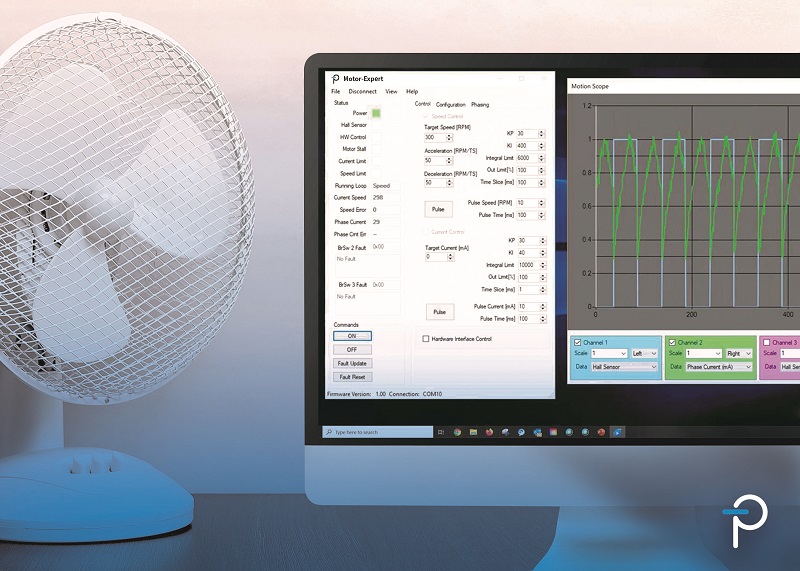
Now, to make the integration of BridgeSwitch designs easier, Power Integrations has launched software that can provide precise control and tuning of the BridgeSwitch ICs in single-phase BLDC motor drive designs. Motor-Expert software is an embedded “C” code application, library and control GUI for single-phase motor architecture. It supports both sensor and sensorless operation for additional system cost-reduction options and the code can be used with many common embedded MCUs.
Cristian Ionescu-Catrina senior marketing manager at Power Integrations said of the software: “The BridgeSwitch Motor-Expert software reduces the cost and complexity of BLDC drives. The new software comes with ready-to-use application examples for constant-speed and constant-torque operation, all of which are IEC6730 Class A-ready.”
Motor tuning is performed through the Motor-Expert user interface with new control loop coefficients being updated in real time without having to recompile code. The interface also enables users to visualize system operation, displaying the status of data including current, speed, status, current error, and speed error. A diagnostics field within the software interface provides insight into inverter and motor operation.
The Motor-Expert software features accurate speed and current control loop functions. The modularity and flexibility of the API-based software architecture allows new functions to be added. T also facilitates porting of the software to different microcontrollers or for it to be combined with other code in a system CPU. The software meets static (MISRA) and dynamic performance profiling covering latency, jitter and execution time. It requires only 14 kB code memory and 5 kB SRAM.