We’ve come a long way since Motorola’s Martin Cooper made the first cell phone call back in 1973
The phone Martin Cooper used was the prototype Motorola DynaTAC, and it could only be used for 20 minutes before the battery died. Battery life has continued to cause concern for manufacturers. Bluetooth introduced its low-energy feature in 2010 with Bluetooth 4.0 with energy efficiency as the prime goal, achieved in part via an asymmetric design. Bluetooth intelligently divides responsibilities between the two connected devices, making decisions about which work goes to which device. Thelow-energy feature creates a master/slave relationship in which the one is given more responsibilities than the other, which typically has a very small battery.
The master manages complex procedures, while advertiser devices only use a maximum of three radio channels. The challenge of radio chips heating up is addressed by efficiently encoding short packets of data so that the radio is only used in short bursts. That and the use of a single Attribute Protocol for data exchange also means that memory requirements are kept relatively small.
Bluetooth’s high data-throughput also plays a role in overall energy efficiency, as it translates into a lower duty cycle and latency as well as an increase in responsiveness, critically important in numerous IoT applications.
Looking ahead
Goldman Sachs forecasts that there will be 28 billion internet connected devices in the world by 2020, and many of those devices will be battery operated, including wearables and smart home devices. Efficiencies, capabilities, and sophisticated services depend upon the collection, analysis and exploitation of data from lots of sensors. In every application, sensors have a large impact.
Sensors benefit greatly from Bluetooth’s support for low-power modes, so they can spend most of their time with the radio in a powered down state, and wake up only to quickly perform their task, then go back to “sleep”. This is a major reason for why they can operate for many years on nothing more than a single coin cell battery.
The low energy feature of Bluetooth makes it ideal for power efficiency within the smart home as well.
Gaining efficiencies in the smart home
According to research commissioned by the Bluetooth Special Interest Group, almost half (46%) of consumers expect smart home devices to become mainstream by 2020. While consumer demand is strong there are still a number of technical obstacles that need to be overcome before these systems become common place.
The sensors required in a smart home may be located in areas that are hard to reach, so changing a battery will be inconvenient at best, not cost effective in many cases and, at worst, impossible or unsafe. Bluetooth solves this problem and has led to the introduction of low energy sensors that can run for a long period of time and, with the enhanced low energy usage, can also gather rich data from the environment and use this data to improve HVAC (heating, ventilation and air-conditioning) settings.
To ensure wireless technology can cover the entire home efficiently, mesh networks will be needed. Standardised mesh networking for Bluetooth, planned for 2016, will allow for the development of Bluetooth solutions that connect in networks that can cover an entire building or home. It will make it possible for devices to talk to each other with little required human interaction – a necessity in seeing the IoT reach its potential.
Growth of wearables
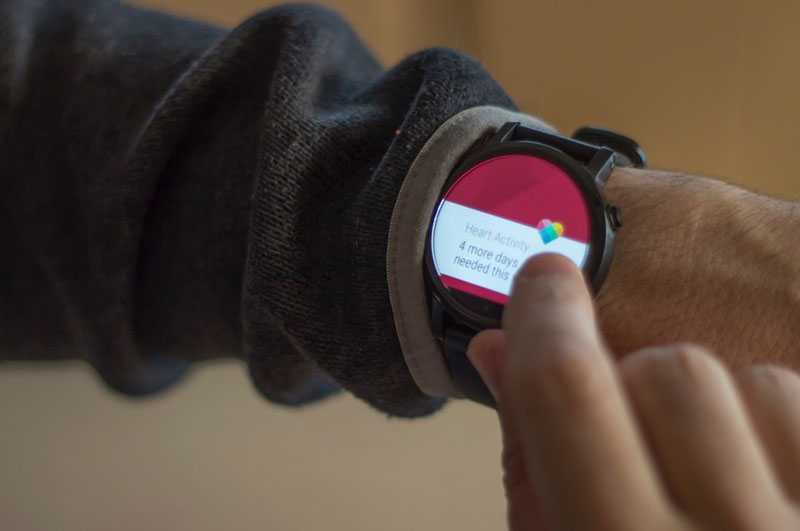
Wearables have gained rapid adoption in a matter of two years; people wearing fitness trackers (and increasingly smart watches) are not an unusual sight anymore (see Figure 1). Bluetooth’s low energy function is enabling this industry by providing a core component that allows product designers to create devices that are more energy efficient. In truth, many wearables have a way to go before they can truly be called energy efficient, due to various battery-draining elements such as LCD and OLED screens, but thanks to Bluetooth the sector is already at a stage where the wireless transmission aspects of wearable devices have little impact on the overall battery life.
Click image to enlarge
Figure 1: People wearing fitness trackers (and increasingly smart watches) are not an unusual sight anymore (Credit: Will Shanklin/Gizmag)
The power efficiency aspect of Bluetooth is not its only advantage for use in IoT applications. Given the extensive mobile platform support for Bluetooth, developers and OEMs can work on wireless wearable and other IoT devices that are interoperable with almost every smartphone on the market.
In conclusion, ultra-low energy wireless communications are a critical ingredient bringing the IoT to life. Devices need to be able to run off batteries for very long periods of time or better still, use energy harvesting techniques to generate power. Bluetooth makes it easy for developers and OEMs to create innovative new products that communicate with the billions of Bluetooth enabled devices already in the market. Bluetooth’s low energy feature is inexpensive and developer-friendly, with a flexible development architecture, so products can be created for any number of sectors. All this makes it a prime enabler of IoT and we expect to see its accelerating rate of adoption across many sectors continuing.