System solutions for battery-powered applications: Part 1 of 4 Editorial Series sponsored by Infineon; System solutions for robots and cordless power tool applications A move towards the future
Achieving more compact, efficient, and higher-performing motor drives
Introduction
Very often we hear that today’s world is moving faster. Let’s take a moment to think about what this really means. We see things changing around us, no doubt about it. New apps, solutions, behaviors, habits, discoveries, implementations – there are plenty of innovative ideas that one could think about. But how about the very same movement itself?
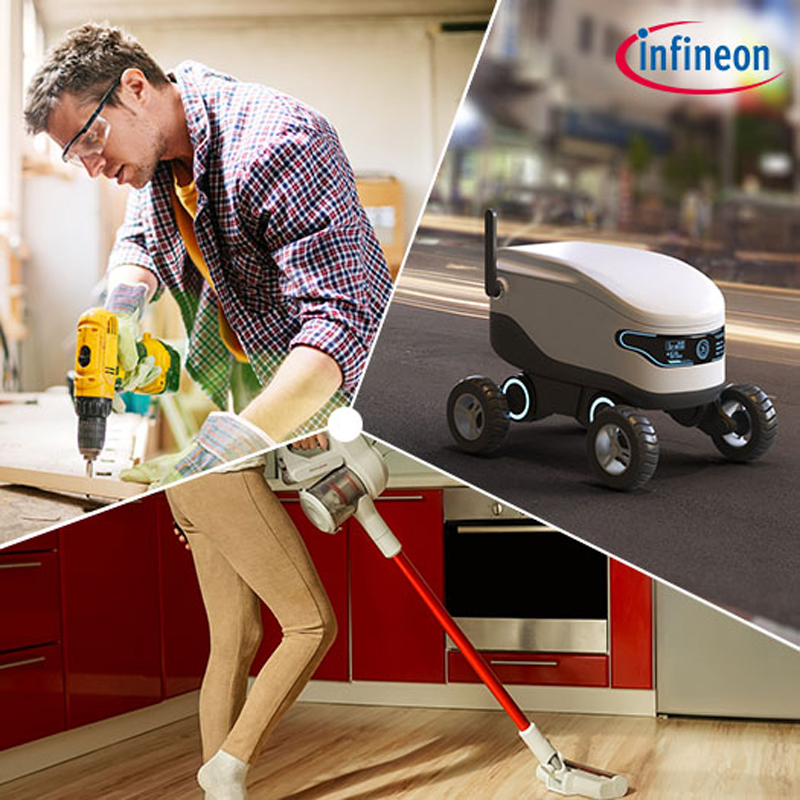
We are surrounded by an infinite number of devices making all kinds of movements. And their parts are also making movements. From an opened car window, an air conditioning blast, a drilled hole, removed dust up to robotic face grimace – it’s all done thanks to electrical power changing into motion. And the more precise, efficient, and controlled that move can be, the more we all benefit: in user experience and safety, resources optimization, and environmental friendliness.
Technology advancement in motor drives design has opened many doors. Especially, the introduction of brushless motor technology was a major step towards overall greater efficiency. The transition from brushed to brushless has started some time ago and continues to evolve, as more new technologies and system components make them the best and most suitable solution for the increasing number of demanding applications. Step by step, the new developments in electrical components technology enable better thermal management, higher power density, and miniaturization while allowing more complex tasks at a competitive cost.
Click image to enlarge
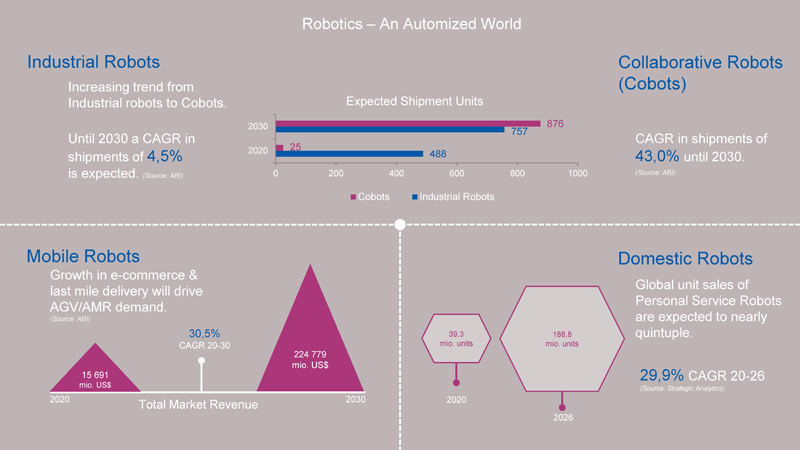
Figure 1.Increasing robot market demanding various motor drive solutions
In this series of articles, we will take a closer look at how Infineon addresses today’s and tomorrow’s challenges at electrical motor design for low and medium voltage classes and how it is possible to achieve designs that are more efficient by using the best in class semiconductor technology.
Technical innovations for improved motor drives solutions
Engineers choose from varying semiconductor solutions to fine-tune their motor drive designs. The technical parameters such as switching frequency and thermal resistance of end products set the requirements for drives. To build a well-optimized system that preferably improves power density and reduces size, designers have to minimize the losses – both conduction and switching losses – and optimize the thermal management.
In the upcoming three parts of this article series, we will dive deeper into three technical innovations contributing to improved motor drive solutions and enabling easier and faster system designs. The following topics will be covered.
Innovation in package technology – TOLx family
Following the trend of increasing battery voltages in robots and power tools, the power of the motor drive is also increasing. This subsequently translates into increasing requirements for power semiconductors in terms of high current rating, ruggedness, and extended lifetime. A profound solution to tackle these needs is Infineon’s new packaging technology which comes in three different variations, depending on each specific need (see Figure 2).
- TO-Leadless (TOLL) is optimized to handle currents of up to 300 A while increasing power density with a substantial reduction in footprint. A footprint reduction of 30 percent compared to D2PAK, together with a height reduction of 50 percent, results in an overall space saving of 60 percent enabling much more compact designs.
- TO-Leaded with Gullwing (TOLG) package offers a compatible footprint to the TO-Leadless package. The additional feature of gullwing leads results in 2x higher thermal cycling on-board (TCoB) performances compared to TO-Leadless. This package is excellent in performance on aluminum insulated metal substrate boards (Al-IMS)
- TOLT is the TO-Leaded top-side cooling package within the TOLx family. With top-side cooling, the drain is exposed at the surface of the package allowing for 95 percent of the heat to be dissipated directly to the heatsink, achieving 20 percent better RthJA and 50 percent improved RthJC compared to the TOLL package

Click image to enlarge
Figure 2. TOLx family (TOLL, TOLG, and TOLT) overview
Wide range of possibilities with MOTIX™ 3-phase smart gate drive controller ICs
The latest 3-phase smart motor driver ICs of Infineon’s MOTIX™ family enable the development of high-performance motor drives using brushless DC (BLDC) or permanent magnet synchronous (PMSM) motors, especially suited for mobile robots and power tool applications.
For example, with over 50 programmable parameters using a built-in digital SPI interface, MOTIX™ 6EDL7141 is highly configurable to drive a broad range of MOSFETs, thus yielding the best possible system efficiency. Besides many other benefits, which are summarized below, the main gain can be seen in the reduced external components and PCB area, as well as optimized efficiency and electromagnetic interference (EMI).
In a nutshell, the benefits of Infineon’s MOTIX™ 6EDL7141 and the upcoming MOTIX™ IMD700A[1] (Figure 3) product solutions include:
- Reduced external components and PCB area
- Optimized efficiency and EMI
- Maximum flexibility to use different inverter FET’s
- Highly accurate current sense while saving external components
- Higher dynamic range to increase signal resolution
Designers can choose between the latest variants of the MOTIX™ family.
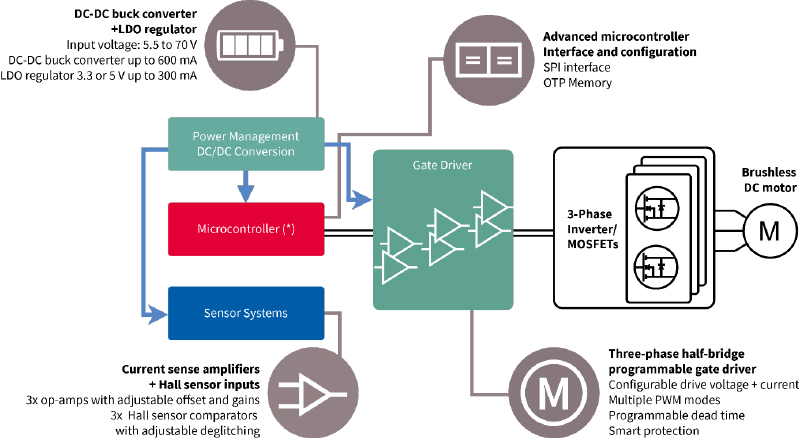
Click image to enlarge
Figure 3. High integration and functionality of Infineon’s MOTIX™ 6EDL7141 and IMD700A smart three-phase motor gate driver ICs. (*) MOTIX™ IMD700A additionally integrates the microcontroller
Boost efficiency and power density with CoolGaN™ e-mode HEMTs and GaN-optimized drivers
In some cases, an important design goal is the integration of power electronics close to the motor or within the same housing. Potential benefits include the increased power density, reduced bill-of-material (BoM) costs as both motor and electronics can be placed in smaller housing, and cost savings due to the higher system efficiency.
Commonly, heat dissipation and bulk capacitance have been limiting factors in integrated motor drives (IMDs). The move to GaN-based designs provides the necessary foundation to overcome the challenging trade-off between switching speed and maximum output power. Higher switching frequency that can be implemented by using field-oriented control (FOC) [1] enables numerous system benefits: reduced bulk capacitance, lower motor ripple current, lower torque ripple, and less acoustic noise. The higher frequency also enables lower motor temperature. This all together leads to higher end-to-end system efficiency improvements.
In drones, the above-mentioned benefits in system efficiency not only make the system more efficient due to lower losses but also smaller, which is a key benefit to make drones lighter and thus fly longer.

Click image to enlarge
Figure 4. End-to-end system efficiency and total system loss at 3000 RPM, for 20 and 60 kHz switching frequencies [1]
Outlook
Higher product integration makes it simpler for engineers to implement ready-to-go solutions to reduce the time to market. Combining high integration with broad programmability features as in Infineon’s new MOTIX™ 6EDL7141 or the upcoming MOTIX™ IMD700 products results in competitive advantages and system flexibility.
Engineers can also take advantage of new package designs that offer optimized thermal management as switching losses are always accompanied by heat in the power switches. New wide bandgap devices will establish the foundation of higher switching frequency drives, helping both accuracy and footprint.
Stay tuned and learn more on those three topics in the following articles coming in this series. To find out more information on Infineon’s motor control and drives offerings, make sure to browse our broad product and solutions portfolio here.
References:
[1] M. Wattenberg, E. A. Jones and J. Sanchez, “A Low-Profile GaN-Based Integrated Motor Drive for 48V FOC Applications,” PCIM Europe digital days 2021; International Exhibition and Conference for Power Electronics, Intelligent Motion, Renewable Energy and Energy Management, 2021, pp. 1-8.
[1]Coming soon! To be released in Q3, CY 2022