Honda Pushing Inductive Road Charging for EVs
Of all the EV power ideas, inductive road charging is certainly…one of them. And Honda is giving it the ‘ol college try.
In conjunction with its partners, Honda has been tinkering with dynamic wireless power transfer since 2021, with the tech’s promise of supplying “power to vehicles while they are in motion, thereby reducing the frequency of charging needed at home or at charging stations.”
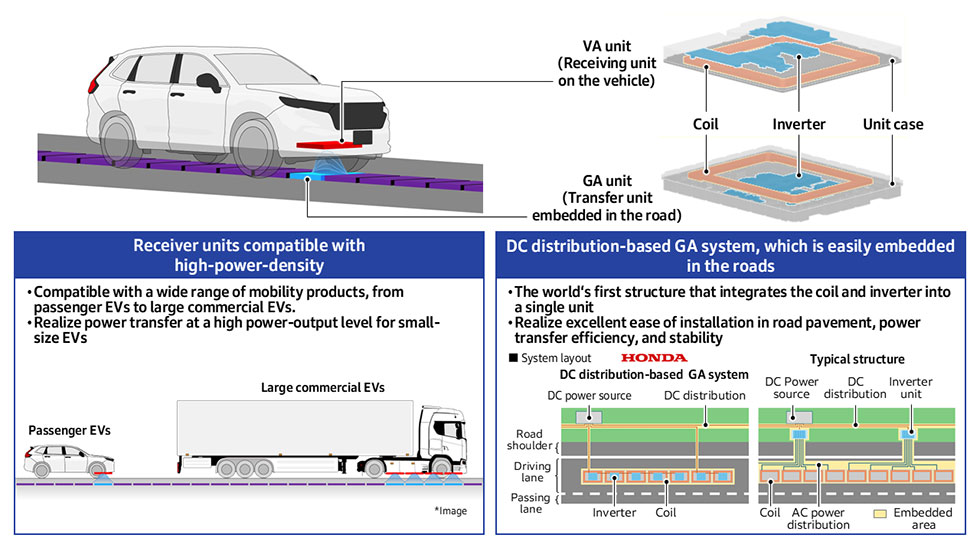
According to the company, it accomplishes that with three components:
1) A DC power supply system on the ground, 2) A DC distribution-based ground assembly (GA) system that connects multiple GA units (power transmitter units) embedded in the road using a DC connection, and 3) A vehicle assembly (VA) unit (power receiver unit) installed on the vehicle.
Once a receiver makes contact with a coil, the process apparently starts within milliseconds, transferring up to up to 200 kilowatts (kW) on highway-scale setups at high efficiencies (85-92%).
With the tech, Honda – and many other interested parties – are specifically targeting logistics and heavy-duty commercial vehicles, as one of their main requirements specifically calls for the DC distribution-based ground assembly (GA) system and pavement structures able to handle gross vehicle weight of approximately 20 tons.
Of course, the main downside is a healthy infrastructure investment – to the tune of millions of dollars per kilometer. That might partially be offset by the convenience of not having to stop to charge in an industry where every minute is valuable, but it’s still a big (and expensive) ask.
At the end of the year, Honda plans to conduct trials on a test drive roadway at the Future Technology Field for Taisei Group/Tamura, and the partners also plan to participate in the “Tateyama Project,” a showcase for DWPT technology to be conducted by East Nippon Expressway Company Limited.