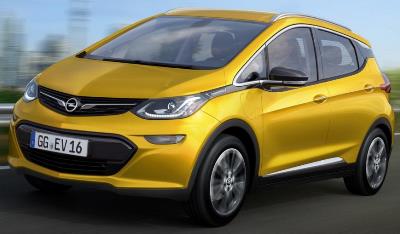
Hyundai and Kia Create New EV Wheel Drive System
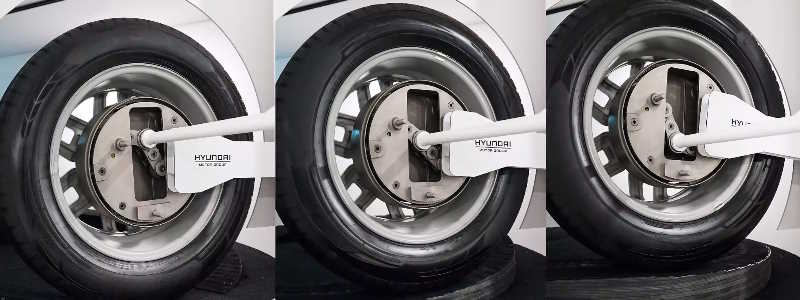
In my opinion, one of the most disappointing things about the current range of EVs on offer is a lack of innovation in how vehicles are designed. From the outside, it is often hard to tell the difference between an EV and its corresponding ICE variant. The way the vehicles work is usually similar too. The engine may be replaced by a motor, and the fuel tank by batteries, but power is transferred to the wheels in the same way it has always been done. That is, until now. Hyundai and Kia have worked together to develop the Universal Wheel Drive System ‘Uni Wheel’, which was recently unveiled in Seoul, Korea. Uni Wheel is a new structure for the drive system that integrates many of the wheel drive system components into the wheel hub itself.
Currently, an ICE and an EV transfer power to the vehicle’s wheels in a pretty similar manner, only using different technology to generate the power. In an ICE vehicle, power is transmitted from the engine through the transmission and to the wheels using drive shafts and constant velocity (CV) joints. EVs replace the engine and transmission with a motor and reduction gear, but still use CV joints and drive shafts. The new Uni Wheel design moves the EV’s reduction gear into the wheel hub and situates a small individual motor near to each wheel, reducing the length of the drive shafts. This technique saves on space, which can be used for additional batteries or extra passenger room.
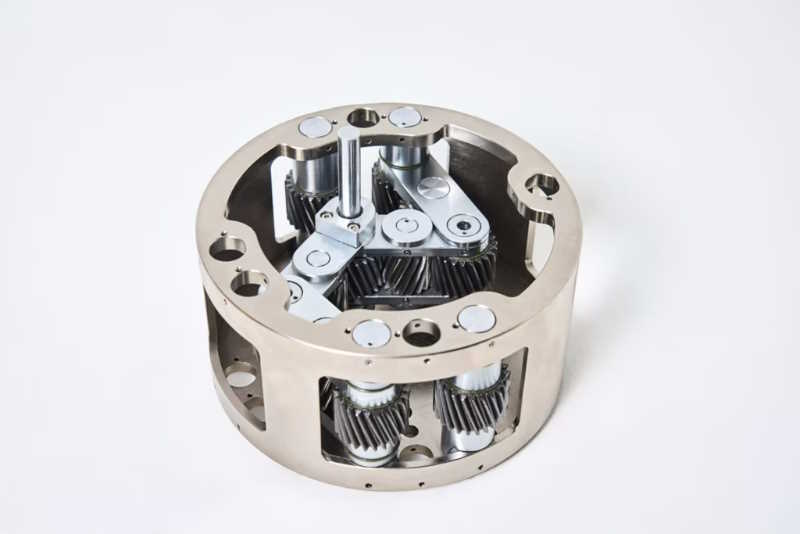
To operate, Uni Wheel uses a planetary gear configuration that consists of a sun gear in the centre, four pinion gears on each side and a ring gear on the outside. Power generated by the electric motor is transmitted to the sun gear, which engages the pinion gears to rotate the ring gear. The ring gear is connected to the wheel and drives the vehicle. Uni Wheel’s pinion gears are connected to each other to form two linkages, and the multi-link mechanism allows Uni Wheel’s multi-axis movement a wide range of suspension articulation.
Drive systems using CV joints lose efficiency and durability as the angle of drive shaft deflection increases when travelling over uneven surfaces. The Uni Wheel mechanism is able to transmit power with almost no change to efficiency regardless of the road surface. When the Uni Wheel construction is combined with an electronic air suspension that can adjust ride height, that ride height can be increased to stabilize the vehicle on rough roads, or decreased for high-speed driving. Uni Wheel’s high reduction ratio also provides a high torque output, which, in turn, requires a smaller electric motor. Having independent control of up to four electric drive units, allows torque vectoring to be used to boost dynamic ability and provide high levels of steering and driving stability.
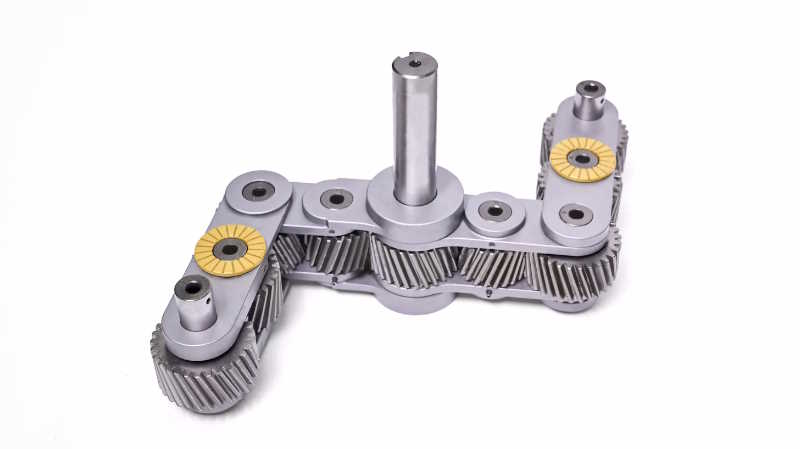
The Uni Wheel design can be easily adaptable to all types of EVs, as the system can implement the same powertrain and reduction gear functions. It can also be used in other types of mobility devices, such as wheelchairs, bicycles and delivery robots. Uni Wheel can be scaled to work with wheel sizes from 4 inches to over 25 inches. Additionally, the Uni Wheel’s ability to move the rotation axis of the wheel makes it possible to create forms of personal mobility that can climb stairs as smoothly as an escalator.
.jpg)
Accelerating Isolated Power Supply Design
05/10/2017