You Take the High Road and I'll Go By Plane
The Highlands of Scotland must be one of the few places in the world that are almost are universally loved. The area draws tourists from all over to visit its dramatic scenery. However, the north of Scotland is remote, mountainous and prone to some extreme changes of weather. The lack of population, as well as few towns and cities is a large part of the attraction, but it also means that infrastructure is lacking in many places. The main means of getting around in the area is by road, and there are few good roads outside the main population centres. Transport is a small annoyance for most tourists who are only there for a few weeks at most and normally in the summer, when the weather is at its best. The residents of the Highlands have to live with it all year long, and throughout some cold spells in winter when roads are completely blocked with snow and accessibility can be a matter of life and death. It’s not just a few square miles in the far north either, you don’t have to travel very far from Glasgow, Scotland’s biggest city, before there is a noticeable drop in both the quality and the width of the roads. It can be even worse on the islands off the coast, where the population has to face both restricted local infrastructure and the possibility that the ships that bring their food and other necessities in can’t make the crossing because of rough seas. The remoteness of these types of area also puts a drag on local economies.
For a while, it has been a priority of the Scottish government to improve the infrastructure up north and on the islands, but making the improvements is expensive at a time when budgets are being cut by London. Logistically, working on narrow roads that can be the lifeline to local communities is also difficult to plan and expensive. Instead, the government, along with other parties, have looked in another direction – up in the air. In July, £9 million of funding was announced to investigate low- carbon aviation project to provide a service to remote communities. The initiative has been using drones and a hybrid electric plane in trials on the Orkney Islands. The project is led by regional airports operator Highlands and Islands Airports Limited (HIAL).
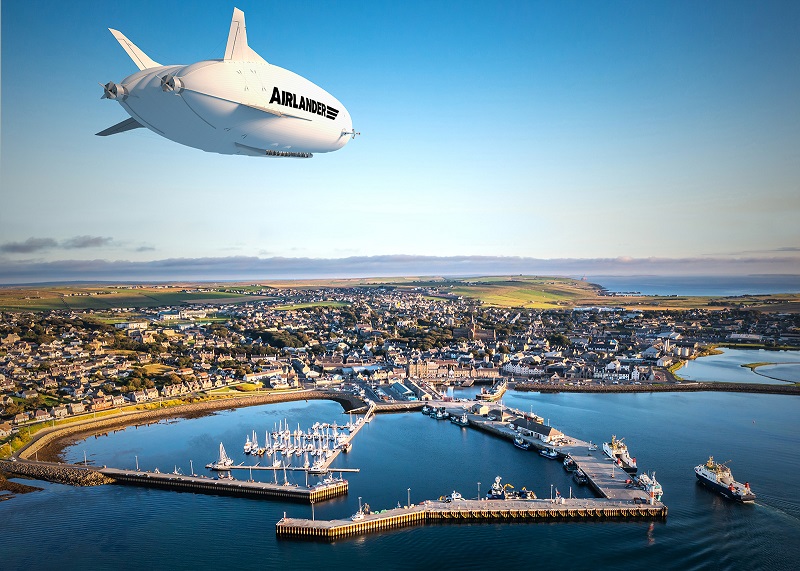
In the latest stage of the project, the group, which consists of HIAL, Highlands and Islands Transport Partnership, Highlands and Islands Enterprise, Orkney Island Council and Loganair, will test a new type of electric aircraft – one that is part aeroplane and part airship. The Airlander 10, produced by Bedford-based company Hybrid Air Vehicles, will be trialled on its ability to use its 10-tonne payload to move passengers and freight around the Highlands and Islands area, and if the rial is a success, the aircraft could be in operation before the decade is over. The three month study will test how Airlander 10 could support sustainable mobility and diversify and boost connectivity for communities. A comparison will be made on emission reductions between Airlander 10 and existing transport options. The trial will also look at the viability of using non-airport locations and taking advantage of the aircraft’s water operation capability.