Power density describes the amount of usable power per unit volume or mass. Reliability is the likelihood that a system continues to perform its intended function over time without failure
Figure 1: High Power Density vs. High Reliability. An isometric view showing how compact designs increase thermal stress, while spaced layouts enhance cooling and reliability
Manufacturers want smaller cabinets, lighter machines, and higher throughput, but they also expect equipment to operate for years in harsh environments, including heat, dust, vibration, and electrical noise. As automation spreads and switching frequencies rise, margins shrink. A few degrees of temperature or millimeters of spacing can decide whether a product lasts a decade or fails early.
This guide explains how power density and reliability are defined, why they conflict, where engineers draw the line, and how to push compact performance without sacrificing long-term stability.
What Does Power Density Mean in Industrial Design?
Power density measures delivered power per unit volume or mass, typically expressed in watts per liter or watts per kilogram. It directly affects enclosure size, cooling strategy, cable routing, and machine footprint.
In practice, several forms matter. Volumetric power density defines how tightly converters, drives, and magnetics are packaged. Gravimetric power density matters when weight affects motion, such as in robotics or gantries. System-level power density is equally important because a compact module that requires larger filters, fans, or spacing may not improve the overall machine.
Why Power Density Matters More Today
Demand for higher performance in smaller spaces continues to grow. Compact cabinets reduce material cost, free floor space, and simplify integration. Shorter cable runs can reduce resistive losses and improve efficiency.
At the same time, higher axis counts, faster acceleration, and smarter sensing raise current levels and switching activity. Without a clear reliability strategy, compactness often trades visible gains for hidden losses, such as reduced thermal headroom and accelerated wear-out.
What Does Reliability Mean in Industrial Systems?
Reliability is the probability that a system performs its intended function for a specified time under defined conditions. It differs from quality, which reflects how well something is built today rather than how well it will survive tomorrow.
In industrial environments, reliability directly affects downtime cost, safety risk, and service logistics. A failure that is acceptable in a lab may be unacceptable on a continuously running production line. Duty cycle, thermal cycling, vibration, and electrical conditions all shape real-world lifetime.
How Reliability Is Measured
Common metrics include failure rate, MTBF, duty cycle assumptions, and survival under defined stresses. MTBF is only meaningful if temperature, load, and operating hours are realistic. Engineers also rely on derating curves, thermal rise data, and accelerated life testing.
A practical reliability question is simple: what fails first, why, and under what conditions?
Why Power Density and Reliability Conflict
Higher power density concentrates heat, increases electrical stress, and reduces physical margin. Shrinking designs raise thermal resistance, tighten creepage and clearance, and push components closer to their limits.
Heat is the primary driver. Higher current density increases conduction loss, and higher switching frequency raises switching loss. Elevated temperature accelerates aging in capacitors, insulation, and solder joints. Electrical stress also rises as tighter layouts amplify ringing, EMI sensitivity, and transient stress.
Mechanical stress increases as well. Dense assemblies transmit vibration more directly and limit strain relief. This is why compact motion solutions often treat power stages and control electronics as a single, tightly coupled system.
Power Density vs Reliability in Practice
Power density favors compact, tightly integrated hardware. Reliability favors lower temperatures, generous margins, and serviceable layouts. Both can coexist only when tradeoffs are explicit.
Engineers typically balance thermal headroom, electrical margin, mechanical robustness, serviceability, and realistic mission profiles. A small drive running near junction limits may perform well initially but drift as components age. A larger design may last longer, but lose competitiveness due to size or cost.
This balance is visible when selecting motion hardware. Choosing between a higher continuous current in a smaller frame or a larger frame that runs cooler often defines long-term stability.

Click image to enlarge
Technical Limits on Power Density
Power density is constrained by thermal physics, insulation limits, switching behavior, and environmental exposure. These limits appear as hot spots, EMI failures, or early component wear.
The limiting factor varies by design. In some cases, magnetics dominates, in others, switching losses or connector heating. Treating power density as a single number often hides the real constraint.
Thermal Management
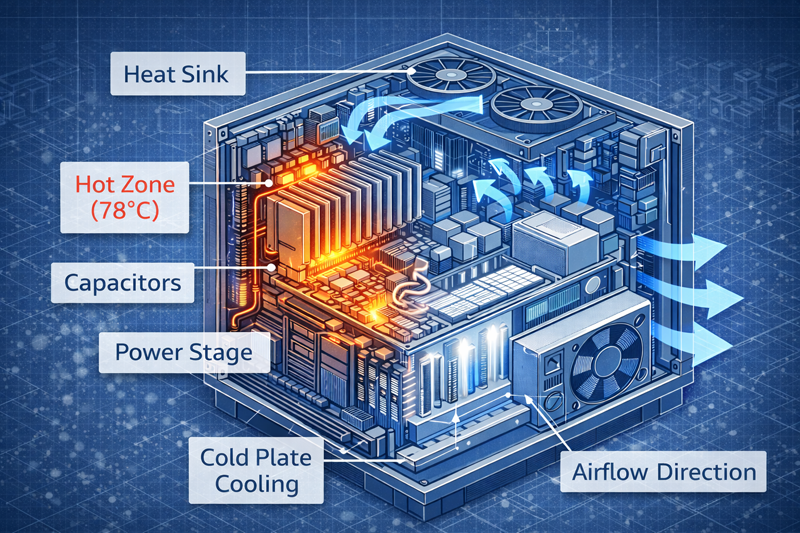
Thermal management controls how heat moves from components to the environment. In dense designs, every watt must exit through a limited surface area and airflow. Heat sinks, cold plates, interface materials, and airflow paths form the hidden architecture of high-density systems.
Poor thermal paths force compromises: reduced current, slower switching, or higher operating temperature. Thermal cycling also matters, as repeated heating and cooling accelerate fatigue.
Click image to enlarge
Figure 2: Thermal Management in Compact Industrial Drives. A blueprint-style cutaway with labeled airflow, heat zones, and cooling components used to train engineers on effective heat dissipation
Electrical Stress and Insulation
Higher density often reduces creepage and clearance while increasing edge rates. Small layout changes can cause significant overshoot and ringing. Rising temperature further shortens insulation life, multiplying electrical and thermal stress.
Mechanical and Environmental Stress
Dense assemblies transmit vibration more directly, thereby limiting isolation. Tight cable routing stresses connectors. Restricted airflow exacerbates dust accumulation, accelerating hot-spot formation.
Benefits of High-Power Density
When engineered correctly, high power density delivers real advantages.
1. Smaller cabinet footprints and easier machine layouts
2. Modular designs that scale across machine variants
3. Higher performance per axis without increased volume
4. Shorter cable runs and reduced resistive loss
5. Lower shipping weight and simpler installation
6. Space for added safety, filtering, and communications
These benefits persist only if thermal and electrical stress are managed intentionally.
Reliability Risks of Excessive Density
Pushing density too far creates overheating, accelerated aging, and unpredictable failures. Reduced margin makes small variations in airflow, ambient temperature, or load far more costly.
Common risks include:
1. Concentrated heat that accelerates capacitor and semiconductor wear
2. Increased EMI sensitivity and intermittent faults
3. Reduced insulation margin under transients
4. Amplified thermal cycling fatigue
5. Difficult service access and longer downtime
Early validation with realistic assumptions is critical, which is why many teams collaborate closely with drive manufacturers during design.
Click image to enlarge
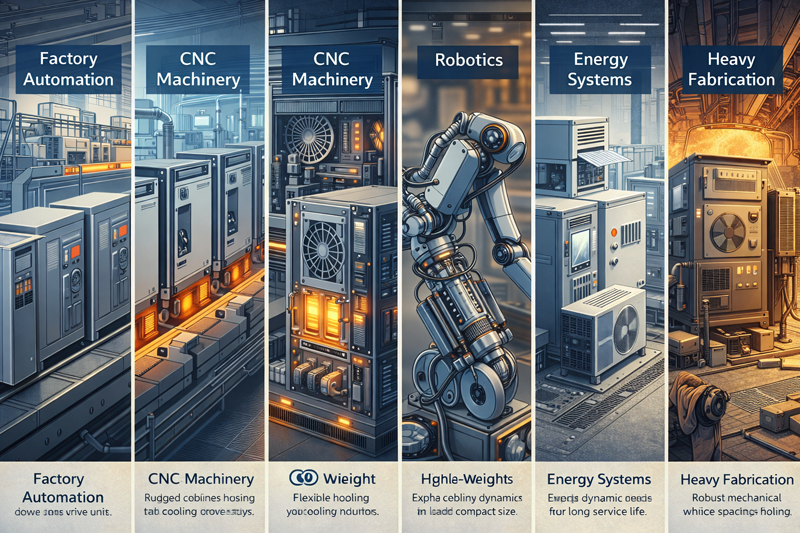
Figure 3: Industry-Specific Tradeoffs Between Power Density and Reliability. Different sectors prioritize compactness or durability based on application needs, from robotics and automation to energy and heavy fabrication
Where Engineers Draw the Line
The limit is defined as the point at which performance goals are met with sufficient margin to survive worst-case operating conditions. That point depends on the duty cycle, the environment, and downtime costs.
Compact designs may be acceptable for high-peak, low-average loads. Continuous high-load systems in hot enclosures usually justify larger frames or stronger cooling. Terms like servo controllers and servo controls represent real choices about protection behavior, thermal design, and fault handling, not just packaging.
Application-Specific Tradeoffs
Different industries balance density and reliability differently.
1. Factory automation favors compact drives with predictable protection
2. CNC machinery prioritizes stability and thermal consistency
3. Robotics values density but demands long life under dynamic loads
4. Energy systems favor conservative designs due to service cost
5. Heavy fabrication prioritizes robustness over compactness
Improving Reliability Without Sacrificing Density
Reliability can improve without sacrificing compactness by managing heat paths, intentionally derating, and validating against real-duty-cycle conditions.
Key steps include:
1. Define realistic mission profiles and environmental constraints
2. Improve heat extraction and minimize hot spots
3. Apply intentional derating for current, voltage, and temperature
4. Control switching behavior and EMI through layout and filtering
5. Validate with thermal soak, vibration, and cycling tests
Component Selection and Derating
Derating is one of the most effective reliability tools. Small reductions in temperature dramatically extend capacitor life and stabilize solder joints. Moderate current reductions often cut losses enough to prevent runaway hot spots.
Selecting components with realistic margins matters more than chasing peak specifications. Resources like servo drive applications help connect drive choices to actual machine behavior rather than abstract numbers.
Smarter Thermal Design
Effective thermal design reduces loss first, then improves heat paths. Lower switching loss, optimized magnetics, and reduced ripple shrink heat at the source. Improved interfaces, targeted airflow, and avoidance of recirculation stabilize dense layouts without excessive cooling hardware.
Common Design Mistakes
Reliability often fails due to hidden stress multipliers.
1. Assuming ideal airflow that does not exist in the field
2. Ignoring thermal cycling during validation
3. Allowing layout-induced ringing and overshoot
4. Designing for clean environments that never exist
5. Compressing service access and increasing repair risk
Looking Ahead
As power density rises, reliability will become the true differentiator. Downtime costs are increasing, and skilled maintenance resources are limited. Future designs will emphasize sensing, protection algorithms, and validation that mirrors real environments.
Compactness should be earned through engineering discipline, not declared through specifications. When density is paired with controlled stress, a predictable lifetime follows.
Conclusion
Power density packs more power into less space. Reliability ensures that power survives real industrial life. The balance depends on thermal design, electrical margin, realistic duty cycles, and validation quality.
Treat heat as a primary design variable, intentionally derate, and test under the worst believable conditions. Done well, compact systems can deliver high performance and long life. The goal is not choosing density or reliability but defining the boundary where both remain stable.