The hyperbolic increase in computing workloads driven by AI processing demands with higher than 50% CAGR expected by 2028, is fueling double-digit growth in power consumption into the hundreds of gigawatts
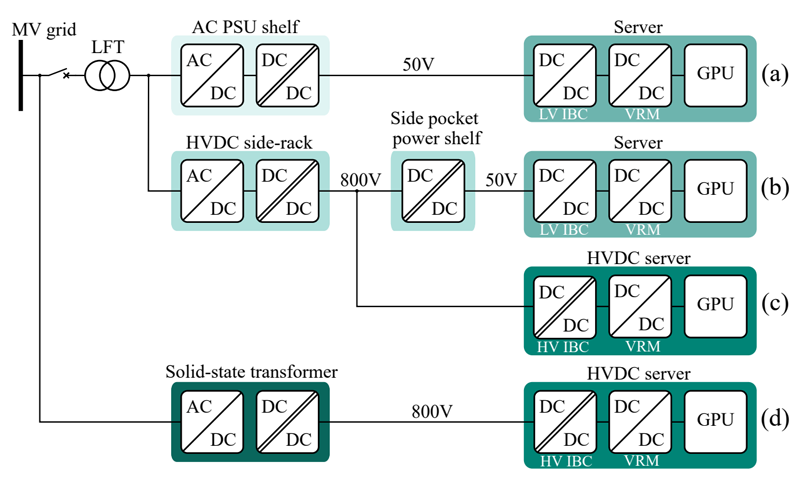
Figure 1: Next-generation Grid-to-Core Datacenter Architectures Minimize Energy Conversions
Source: NVIDIA
The expansion in AI processing demands is compelling huge capital investments in infrastructure and technology development with very fast cycles – releasing new server platforms in 12-15 months vs the more traditional 30 months. Power consumption at the AI SoC (xPU) is increasing dramatically, reaching multi-kW levels for the latest generation going into production in early 2026. This AI version of Moore’s Law driven by parallel processing is now calling for doubling power requirements every year, increasing by a factor of two or three the conventional increases in previous decades.
At the rack level, this increase determines the need for a different power distribution architecture capable of supporting the growing power levels. For example, consumption will increase from about 130kW in the current generation of NVIDIA Blackwell (NVL72) to about 300kW in the next generation. In addition, the number of Rubin GPUs per rack (NLV144) is expected to double, eventually topping 1MW with NVL576 in the various Rubin Ultra rack configurations. At these power levels, it becomes convenient to increase the distribution bus voltage to higher DC values to decrease the distribution losses. The 48V bus voltage standardized by the Open Compute Platform (OCP) is therefore moving to 800V which can be distributed with two wires or eventually three (+/-400V) in addition to the earth wire.
The increase of power in the computational (IT) rack containing the xPU and its proliferation makes it impossible to have the AC/DC conversion stage in the same rack. Therefore, to generate the 800V, another rack is being introduced – the side car – which is dedicated to the conversion from AC 415 Vac input to 800V. The 415Vac is today distributed inside the datacenter, starting from the power distribution unit (PDU) through the AC UPS, whose 480 Vac input is extracted from the main switch board connected to the medium voltage network (MVN, 13.8-35kVac) grid.
The entire market is moving to this new implementation, OEMs with their reference designs, Hyperscalers requesting ODM redesigns of racks in line with the new power architecture, as well as power vendors implementing the required new building blocks. Of course, in these evolving times, there are also examples of more conventional racks still using AC input and generating 800V for less GPU blade distribution, and surely, we will see hybrid implementations before the new architecture gets fully standardized (also with the full support of OCP) toward a common hardware able to optimize the cost and pace of datacenter expansions and new builds.
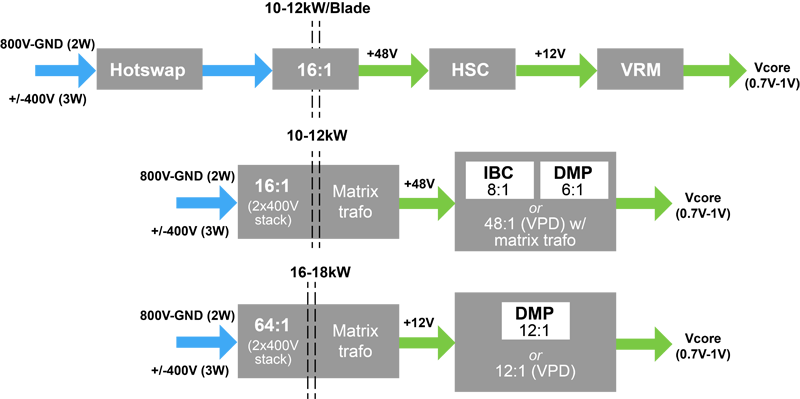
Inside the IT rack, which for the time being aims to reuse existing infrastructure, 48V will still be used. Therefore, the 800V needs to be converted down to that value, using high-efficiency, high-density converters. Renesas has participated in generating a reference design for a 12kW blade, based on 650V GaN FETs in TOLT packages and 80V MOSFETs in 5x6mm QFN packages driven by digital control, using DTX unregulated LLC topology switching higher than 700 kHz with peak efficiency higher than 98% and power density above 500W/in3. This onboard design, as with all Renesas PoCs, includes detailed information like schematics, layout, BOM and test reports available for customers and partners.
Click image to enlarge
Figure 2: New AI IT Rack Architecture Evolution Examples
The rest of the architecture at voltages lower than 48V remains unchanged for the time being. However, the increased SoC load, up to 4kA, requires delivering power to the load in ways other than laterally as has been used to date. Vertical power delivery (VPD) is needed and that can be implemented by very dense power stages or eventually integrating inductors as well, in greater phases and density. Renesas provides fully digital multi-phase controllers with multi-protocol and interface capabilities, up to 4 loops and best-in-class transients with TLVR support. Along with those are the Smart Power Stage (SPS) modules, which can deliver up to 100A pulse current per phase and can be combined in multi-unit packages for higher current density or be assembled with inductors up to 4 phases in advanced 3D packages to enable VPD and achieve high current density values (2A/mm2). These solutions are supported by end-to-end ecosystems which allow pre-PCB fabrication simulations and power delivery network (PDN) analysis, as well as testing tool hardware and interposer designs followed by tuning, measuring and bench validation phases. More complex modular approaches are under analysis and design to eventually integrate other conversion stages but still deliver VPD to the core. These will incorporate power density, efficiency and cost of encapsulation, using innovative IPs such as IVR for fast switching and high bandwidth implementation of final power delivery stage.
An interesting architectural topic at low voltage is the eventual change of the 12V rail which today is generated from 48V with a conventional IBC 4:1 converter. To enable better efficiency and current density of the final multi-phase stage to the xPU core leveraging lower voltage node technologies, that intermediate voltage may eventually be reduced. There, Renesas has been offering high-performance Hybrid Switch Cap (HSC) topology delivering efficiencies higher than 98%. The topology offers the possibility of scaling with 8 switches to an 8:1 ratio, delivering 6V output with peak efficiencies up to 97%, depending on unregulated/regulated or partial approaches. Renesas has also built reference designs to support this conversion. The same can be achieved with a multi-phase Buck, where usage of 100V GaN can increase the switching frequency and allows the use of much smaller converters. Renesas has built 48V reference design solutions up to 3kW with power density of almost 1kW/in3 and 8 phases down to 6V or 4 phases to 12V, leveraging digital control flexibility.
Eventually, further optimizations in the 800V distribution architecture will be possible. The 48V bus inside the xPU blade may be completely removed and a direct conversion to lower voltage can be implemented with a similar approach used today in the 16:1 converter from 800V downwards. Renesas has developed a reference design 800V to 12V (64:1) based on DTX topology and can achieve the potentially higher power level required by the following generation blade moving toward 20kW, based on xPU power increase.
GaN is again the key enabler of these high-density converters. This wide-bandgap technology is driving the growth of power content in datacenters at a faster pace and amplitude than SiC, especially where it may well replace Si MOSFETs (power device CAGR24-30 12%, courtesy of Yole). As soon as GaN technology evolution enables lower voltages at superior switching performance, the penetration of that technology close to the core will increase, enabling more density at reasonable efficiency.
In AC/DC side-car racks, where 1200V SiC content is dominating, an upcoming architectural element is the bi-directional 650V GaN switch. That four quadrant, almost ideal switch enables single-stage topologies and in front-end stages like T-type or Vienna rectifiers, generates significant density and cost optimizations replacing typical back-to-back structures.
High-voltage SiC (higher than 1.2kV) will also soon play a significant role in solid-state transformer (SST) input stages where the AC MVN grid will enter the power room in the datacenter and be converted to 800V, which will be distributed to the hall containing several rows (see figure 1, courtesy of NVIDIA). The SST will generate the 800V bus without the need for bulky line transformers, AC switchgears and PDUs. The use of 800V DC as main distribution inside datacenter will dramatically reduce the amount of copper required due to the ratio 1.5x of power that 800V cables can carry more than AC 415ac cables.
Another key architecture innovation is the energy storage architecture that one is moving inside the datacenter, from AC diesel generators toward an 800V DC storage. That portion of hardware based on super caps/high power capacitors will be located close to the compute racks for short duration needs and include extra power content (controllers/drivers/switches) for bi-directional DC/DC control of the energy flow (figure 2). On the premises of AI datacenters, energy generators for backup of the MVN utility will become an essential architectural element, together with MV battery energy storage in order to manage long-duration storage needs and enable continuous operation.