Author:
Christian Jonglas, Technical Support Manager at GAIA Converter
Date
12/24/2025
 PDF
PDF

Click image to enlarge
Drone warfare is changing military defense strategy. The ready availability of low-cost electronic hardware has made the drone a major threat not just in open warfare but in asymmetric conflicts and terrorism. Those factors have led to a wave of innovation in countermeasures against threats from a variety of armed drones, which often take the form of Remotely Piloted Aircraft Systems (RPAS).
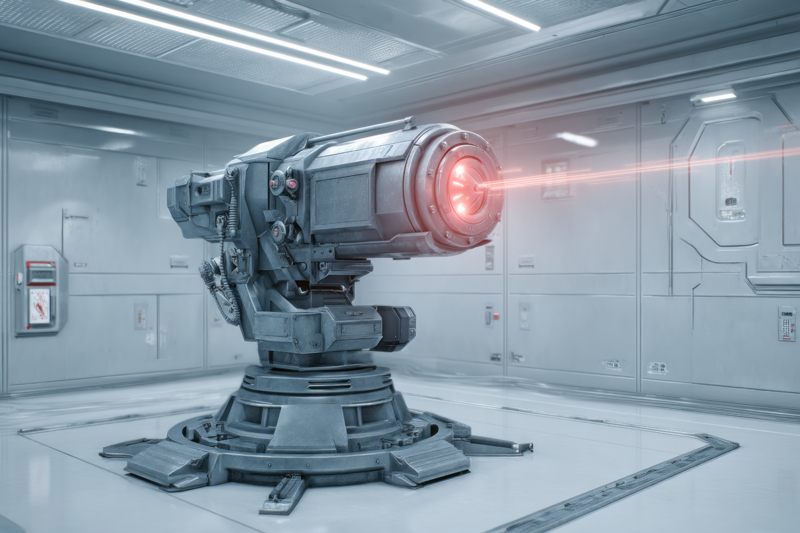
For countermeasures, military organisations are turning to directed-energy weapon (DEW) technology for the increased flexibility it can bring to defence, alongside conventional munitions. As they rely solely on a source of electrical power, they have no need for ammunition. This makes the DEW potentially far more cost-effective than kinetic weapons. The cost of energy for each shot can be just a few dollars, compared to the tens of hundreds of dollars often needed for precision-manufactured munitions. Additionally, DEWs do not suffer from the supply issues that might arise from the need to replenish the ammunition of systems used around a large perimeter.
Understanding directed-energy weapons
There are multiple ways in which directed energy can disable or neutralise the threat from incoming drones and missiles. High-energy lasers (HELs) can burn holes through the casing and sever cables and PCB traces on the electronic control board inside. Or the intense heat may weaken the support struts for the propellers enough to destabilize and bring down the drone. Other DEWs focus on the use of high-power microwave (HPM) pulses to disrupt the electronics inside the threat.
Operating with lower power levels, RF, infrared, and visible laser energy can jam or blind sensors enough to send a drone off course or cause it to crash. Others use RF jamming to disrupt communications between remote operators and drones. Some systems employ a combination of high- and low-power tactics. The HELMA-P counter-drone weapon developed by Cilas is an example of this. It is a system that can adjust power outputs to switch between attempting to blind a drone and physically disabling it. The system was deployed at the 2024 Paris Olympics to protect against possible attacks by terror groups armed with RPAS.
The uses for DEW technology extend beyond defense against direct attacks. Laser-based weapons launched into space may provide the means to reduce the quantity of unwanted debris in Earth orbit. Ablation of the surface of a satellite or rocket casing by a laser can push the objects into lower orbits. The increased atmospheric drag then quickly de-orbits the debris.

Click image to enlarge
Powering High-Precision Energy Weapons
With such a wide variety of technologies, there are inevitably wide ranges in the power demands they have. Some DEWs require tens of kilowatts of power to deliver the level of damage necessary to directly remove drone threats, which necessitates the use of large-scale electrical generation. Others that focus on sensor jamming or disruption can operate using just rechargeable battery packs. Some may use a combination of power sources to guarantee consistent power to the different subsystems. The drone will have built-in sensors that may include Lidar, radar, and camera units. High-precision motors will steer and stabilise the laser to ensure it remains on target. These functions will require power converters capable of delivering tens of watts. A separate power system can then be optimised to supply the intense bursts of energy needed for high-energy lasers.
The common factor in these systems lies in the need for clean and reliable power to supply the sophisticated electronics, sensor, and actuator subsystems that can direct the focused energy to precise locations on a fast-moving missile or drone. Despite the common requirements, the specific needs of each of these systems can differ radically. Each of the control and sensor subsystems may require independent supply rails, each with its own optimal voltage to support the regulators that supply each cluster of components and with galvanic isolation to prevent interference.
There will be cases where the sensor, computing, and actuator electronics need high levels of protection against conducted electromagnetic interference (EMI) from the high-power generators and subsystems that deliver the directed energy output. EMI filters in the inputs to the power converters can help protect sensitive electronics.
Modular Solutions for Reliable Power Delivery
Although the variety of designs may suggest that a custom design is the best approach to take advances in technology and design techniques make a modular architecture the most cost-effective and flexible option. The ability to select and match modules to the application provides an efficient way to optimize space, weight, and power (SWaP) for the specific use case.
A modular architecture provides the developer with the ability to add functions where needed. Designers may select modules for their ability to provide filtering to downstream circuits. Another front-end unit might be added to deliver more stringent filtering, which may be necessary to ensure that sensors and other devices are not affected by surges or spikes induced on the input rails.
By using modules with high power density in parallel, it is possible to achieve the kilowatt output levels required for situations where the design necessitates a unified power distribution architecture. Four of the modules in GAIA’s MGDM-500 / P series can support a 2kW laser. Synchronization support in the modules allows the designer to tune the switching frequency used by the converters to avoid interference with sensors and other electronics.
Click image to enlarge
It is essential to develop modular solutions that cater to the specific needs of military systems. In addition to supporting important standards on power quality, such as Mil-Std-461 and MIL-STD-1275, module designs should also consider less obvious requirements, including thermal and electrical efficiency.
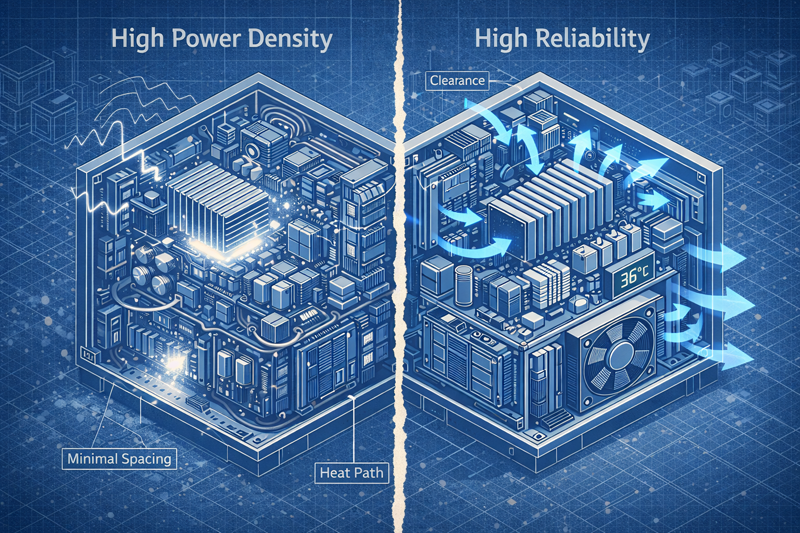
With high-power generators and energy weapons used in close proximity to other electronic subsystems in space-constrained enclosures, there may be limited opportunities for transferring heat away from the power systems. The use of potting, a technique that GAIA employs extensively in combination with baseplates of high thermal conductivity, helps address these environmental issues.
Long-term reliability is another key factor for systems that may be in place for years, but which need to react quickly to threats at any time. There are circuit-design decisions that make sense for industrial power converters. Those same decisions can be fatal to systems that must operate effectively at all times. A common choice for standard power converters with galvanic isolation between input and output is to use optocouplers to communicate across the isolation barriers. These optocouplers provide vital feedback to the pulsewidth-modulation control circuitry on changes in output voltage levels. This type of component is often considered a good choice because it is a relatively low-cost device with good linearity.
Unfortunately, the optocoupler’s transfer function drifts over time due to a gradual decline in the efficiency of the light-emitting diode (LED) that transmits voltage information across the isolation barrier. Ultimately, the drift is so great that the power converter fails. Using a magnetic coupler instead, which is an approach favoured by GAIA, overcomes this reliability problem. In GAIA’s converters, reliability can exceed one million hours, far higher than the several hundred hours of many designs that continue to use optocouplers.
Future developments, such as new transistor technologies, will enable more compact DEW systems. Wide-bandgap materials, such as silicon carbide (SiC) and gallium arsenide (GaN), offer several advantages over silicon devices, particularly at high power levels and in high-temperature environments, where they exhibit improved performance. SiC, in particular, can operate at higher ambient temperatures than competing materials. With GaN, lower switching losses result in less heat being generated during their operation.
Military systems will need to consider product lifetimes, making obsolescence management a critical part of the design. For this reason, using products targeted for high-volume applications that have similar requirements in terms of environmental performance and reliability, such as those made for automotive electronics, will be crucial in ensuring a viable source of components over the long term. Considerations like these are why it is important to employ power converters designed and fabricated by suppliers with a long history of experience in the military and defense sectors.