How Würth Elektronik helped Powered Orthotics improve hand function
Figure 1: Unlike previous solutions, MotionMate can also be actively opened
This case study looks at how Würth Elektronik helped Powered Orthotics develop a new product to help people with limited hand function.
Through a collaboration with Mannheim-based startup Powered Orthotics, Würth Elektronik is helping to drive innovation in the health tech sector: the smart MotionMate orthosis opens up new opportunities for independence for people with limited hand function. For the project, Würth Elektronik developed a custom transformer specifically for the affordable and user-friendly “orthosis to go.”
There are more than 100 million people worldwide are affected by limited mobility in their hands today. There are many reasons for this: accidents, strokes, or degenerative neurological diseases can sometimes cause everyday activities, such as raising a glass to your mouth or using a toothbrush, to become difficult or completely impossible overnight.
The limitations are as varied as the consequences of accidents and medical conditions. They range from partial loss of strength to complete paralysis. A system that supports hand function or restores it is therefore the key to greater independence in everyday life for those affected.
Requirements for a Hand Orthosis
In addition to the pure gripping function, the hand orthosis system also has a whole range of other development requirements. The drive system must offer the highest possible power and energy reserves, but at the same time be as light as possible, since the wearer always has limitations in terms of strength and movement.
In addition to these competing optimization goals, there is also the safety aspect. Since the orthosis is worn directly on the body, it must meet the highest safety standards. All components are required to meet the stringent safety and essential performance standards for medical electrical equipment as set forth in IEC 60601-1. This includes compliance with the 1 MOPP (Means of Patient Protection) safety measures mandated for medical power supplies.
Further requirements arise from user-friendliness, which is critical to the success in this area. The system must have control options that can be flexibly adapted to the user´s restriction. The orthosis must also be designed in such a way that the user can put it on without assistance.
Since the device must generally be financed by health insurance companies and is also intended for use in developing and emerging countries, it is also very important that the price be as low as possible.
MotionMate – the “Orthosis to go”
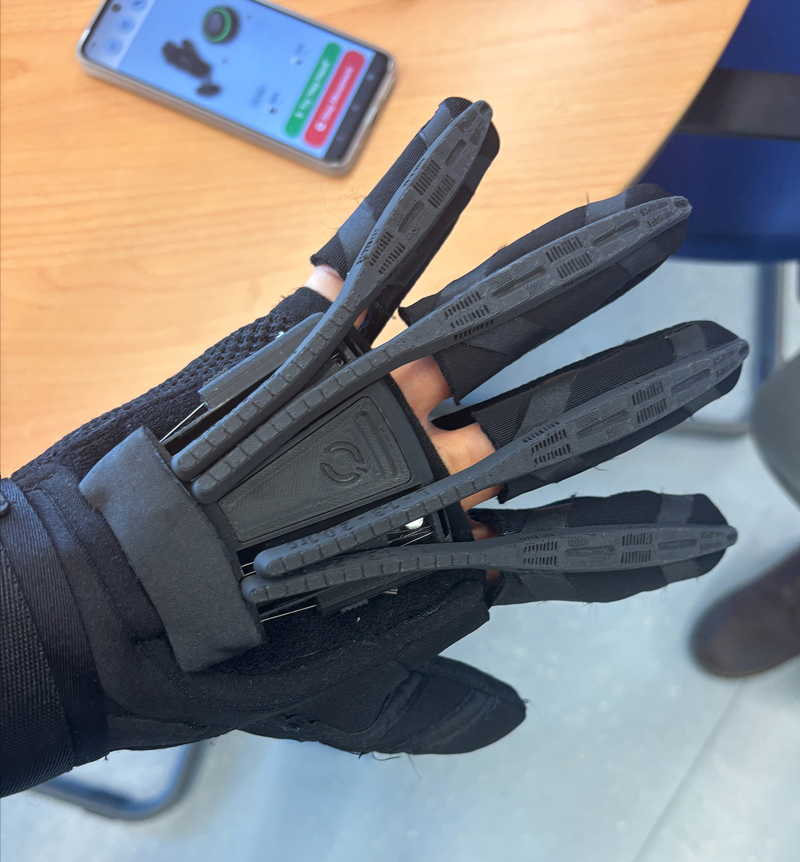
The MotionMate orthosis, developed by Mannheim-based startup Powered Orthotics, addresses the requirements described above. The system uses powerful electric motors, and cable pulls to close the fingers and, unlike previous solutions, also actively open it; similar to the tendons in the hand.
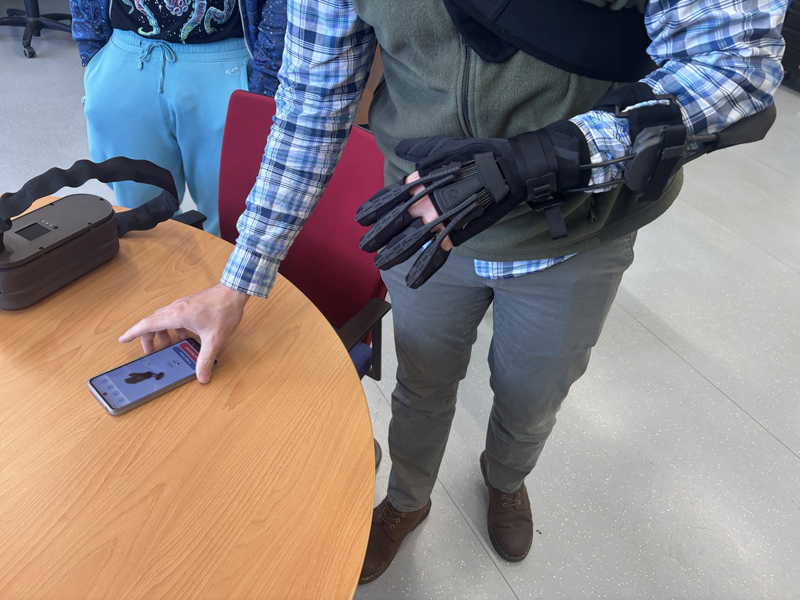
The orthosis is worn like a glove that is open at the palm, while a small cable guide unit is mounted on the forearm. The batteries and servomotors are housed in a separate belt pouch, keeping the orthosis itself pleasantly light. Depending on the degree of limitation, the system is controlled by movement signals, for example from the hand, arm, or shoulder. For this purpose, a control element, linked via Bluetooth, can be attached to various parts of the body. It can also be easily operated via a smartphone app and voice commands.
Click image to enlarge
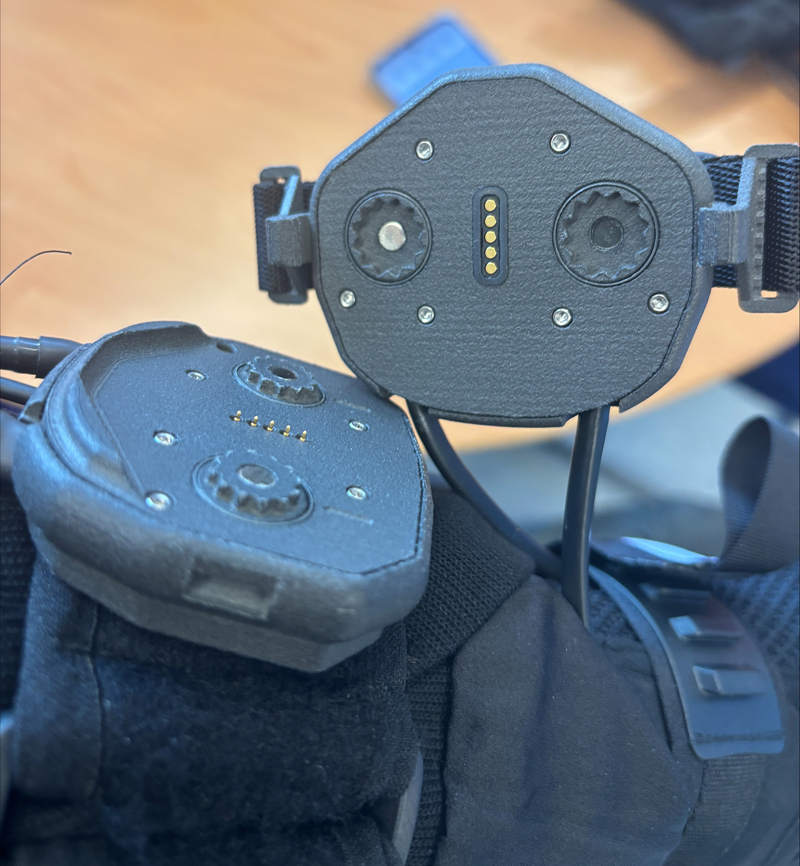
Figure 2: Deflection and coupling unit: The adapter worn on the forearm connects to the drive unit
MotionMate is not classified as a traditional medical device, but rather as an aid, which makes approval easier and cheaper. The sophisticated but relatively simple design ensures that the Powered Orthotics orthosis costs only about a quarter of what previous solutions have cost. Rational series production will also contribute to cost reduction, as the product is required in comparatively large quantities.
Click image to enlarge
Figure 3: The MotionMate orthosis can be put on by the user themselves and controlled via a smartphone app
Startup Support as a Success Factor
An important strategy for success at Würth Elektronik is its support for startups. The global manufacturer of passive components for the electronics industry helps new companies turn their ideas into products ready for series production. Guided by the idea of “Electronics for Positive Impact,” the company seeks cooperation partners whose projects contribute positively to society and the environment. From this perspective, Powered Orthotics is a strong match.
Alexander Gerfer, CTO, Würth Elektronik eiSos Group “Startups often face technical challenges alone, from power and safety to miniaturization and manufacturability. With our experience and custom solutions, we help turn the concept into a device that makes everyday tasks easier and supports users’ independence. MotionMate demonstrates what can be achieved when innovative startups and industry experts collaborate closely to solve challenges end-to-end.”
Custom Transformer
The specifications described above place the highest demands on the orthosis's power supply. It must be safe, efficient, and as compact as possible. A major obstacle in the development process was that no transformer on the market met all the requirements. A flyback transformer with an input of 12 to 15 V, an output of 12 V, and a rated current of 1.5 A.
This is where the specialists at Würth Elektronik stepped in: During internal research, they quickly determined that a new, customer-specific development was required that was not only small and powerful, but also complied with all safety regulations.
Guillermo Regidor, Design Engineer at Würth Elektronik and responsible for the project, “The power supply for an orthosis has to meet some pretty specific requirements. It needs to be compact, efficient, and also meet the strictest safety standards of protection classes IEC 60601-1 and 1 MOPP (Means of Patient Protection). After all, the device is worn directly on the body. What was required was a flyback transformer with an input of 12 to 15 V, an output of 12 V, and a power rating of 1.5 A. Our search for an off-the-shelf component quickly showed that none of the solutions exactly met our customers’ requirements. The safety regulations in particular were a critical factor. For this reason, we decided for a specially adapted new development."
Click image to enlarge
Figure 4: The new flyback transformer from Würth Elektronik was developed specifically for Powered Orthotics orthoses and has an efficiency of 98 %
The transformer developed by Würth Elektronik, specifically for this project, meets all safety requirements. Measuring at 21.5 × 29 × 12 mm, it achieves an efficiency of 98%, and thus also extends battery life. The component has already been consistently optimized for automated series production. In addition to this special development, standard components from Würth Elektronik are also used in the orthosis, including on the main control board, embedded-glove electronics, and the wireless control button.
From idea to product
Now that significant technical hurdles have been overcome, the next step is to produce 15 more units based on the initial prototype and have them tested in everyday use by people with the relevant disabilities. The findings will then be incorporated into series production, scheduled to 2026.
Würth Elektronik could also support the promising startup by conducting tests in its internal laboratories at its Waldenburg site; from resistance assessment to shocks, vibrations, and temperature changes.
The contract manufacturer, Elbe Electronic will be responsible for production of the new device.