Polymer capacitors provide improved performance, reliability and durability, making them a popular choice in modern electronics
Figure 1: Similarities and differences in the construction of polymer capacitors (Source: Kemet)
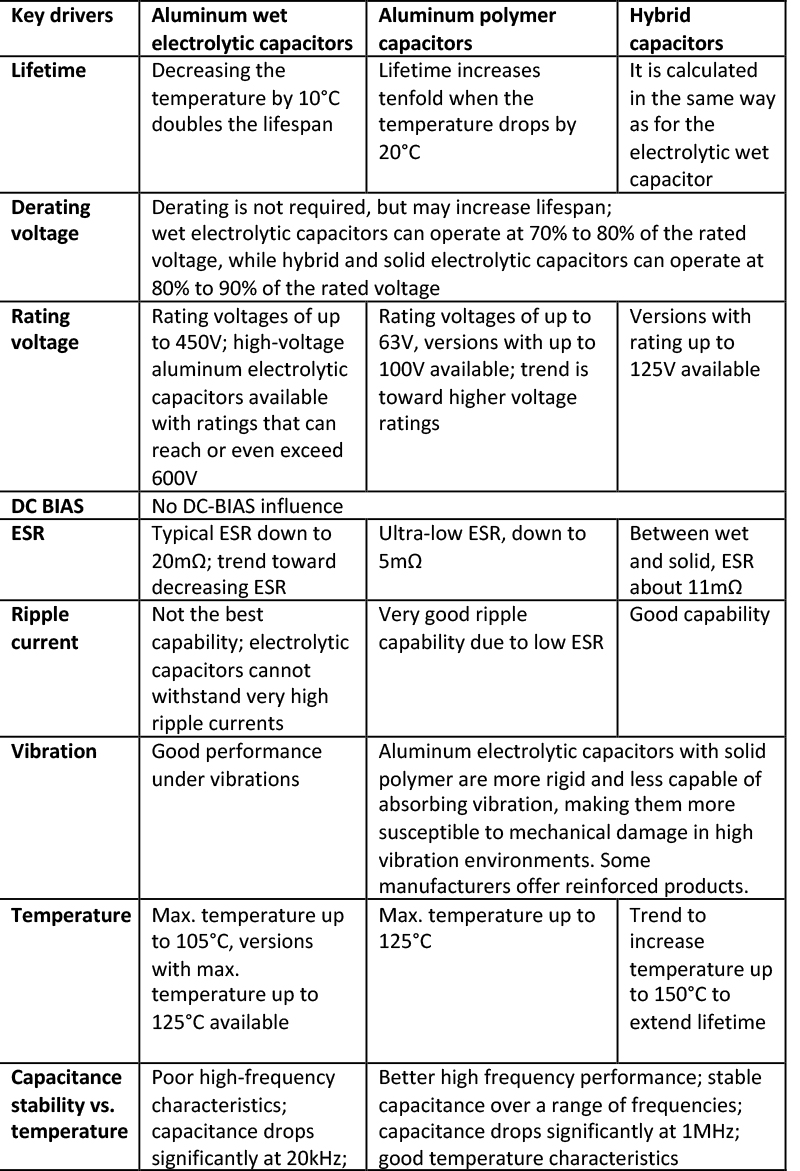
Aluminum electrolytic capacitors are polarized capacitors in which the anode and cathode are made of aluminum. They can have either a wet electrolyte, a solid conductive polymer, or a hybrid (wet and solid conductive polymer) electrolyte.
In aluminum electrolytic capacitors, both electrodes are made of aluminum. The aluminum anode is separated from the wet electrolyte by an oxide layer, which is a paper foil saturated with the wet electrolyte. Different types of electrolytes enhance oxidation, operate at higher temperature ranges, and absorb gases that may form internally. The other aluminum plate, which serves as the cathode, is also present. The robustness of the anode aluminum foil depends on whether the capacitor must withstand higher voltages.
The construction of the polymer capacitor is similar. It consists of an anode and a cathode, both made of aluminum foil. The dielectric is a layer of aluminum oxide (Al2O3) that acts as an insulator between the anode and the conductive polymer. A non-conductive layer (paper, film, or other insulating material) is placed between the conductive polymer, forming two layers of conductive polymer. Finally, a drying and aging process of up to 8 hours is performed.
Hybrid aluminum polymer capacitors combine the characteristics of both traditional aluminum electrolytic capacitors and polymer capacitors, taking advantage of each type. The dielectric is a mixture of liquid electrolyte and conductive polymers. The liquid electrolyte helps improve performance at lower frequencies and increases overall capacitance.
Self-Healing
Small defects such as pinholes, microcracks, or areas of dielectric breakdown can form in the Al oxide layer due to electrical stress, thermal cycling, or mechanical strain. These defects create pathways for leakage current that can degrade capacitor performance. When a defect causes an increase in leakage current, the localized area around the defect heats up. The conductive polymer layer reacts to this heat. The heat can cause the polymer to temporarily lose its conductivity in the localized area, effectively isolating the defect. The heat also promotes regeneration of the alumina dielectric layer at the defect site. This can occur by oxidation of the exposed aluminum at the defect site, where the aluminum reacts with oxygen (often from the polymer or the environment) to form new alumina. The combined effect of polymer reaction and oxide regeneration seals the defect and restores dielectric integrity. As the defect is sealed, the leakage current decreases and the capacitor resumes normal operation. In hybrid capacitors, the presence of the liquid electrolyte enhances the self-healing process by allowing the aluminum oxide layer to reform more efficiently. Both types of capacitors rely on these self-healing mechanisms to maintain performance and extend service life.
Click image to enlarge
Tantalum Electrolytic Capacitors
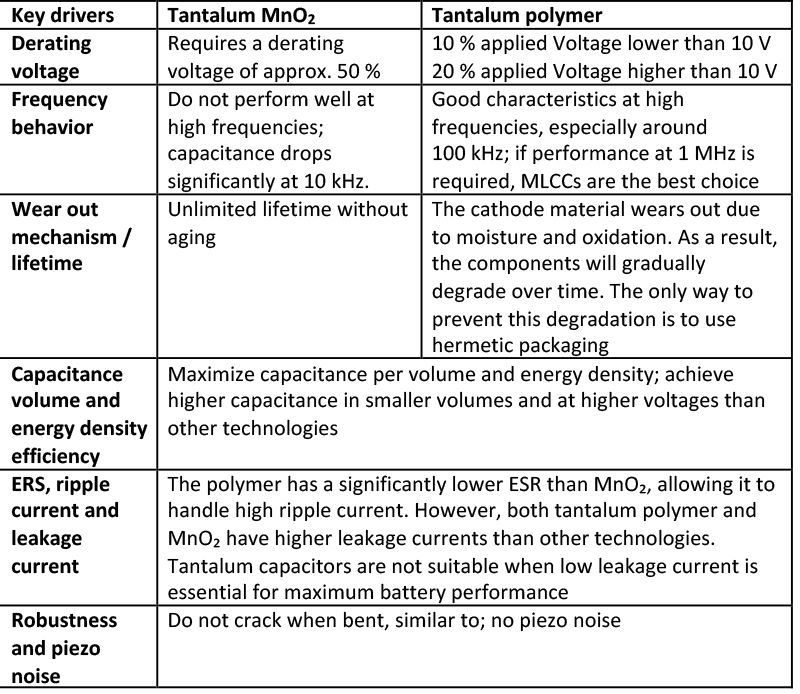
Tantalum capacitors are polarized capacitors that use a solid electrolyte such as manganese dioxide (MnO₂) or conductive polymer. However, care should be taken when applying reverse bias to this type of capacitor. The most notable properties of tantalum include high ductility, high corrosion resistance, high melting point (3,020°C), high heat and wear resistance, and high biocompatibility. Tantalum capacitors can replace MLCC capacitors in certain applications, subject to specific application criteria.
Solid Tantalum Capacitors
Solid tantalum capacitors use manganese dioxide as the cathode due to its self-healing properties. When defects occur in the dielectric, it becomes non-conductive. The tantalum is separated from the manganese dioxide by an oxide layer called tantalum pentoxide (Ta₂O₅). When this layer is reduced, the manganese dioxide oxidizes the tantalum, forming a new oxide layer. As a result, these capacitors exhibit exceptional reliability with virtually infinite life.
The self-healing process can potentially release oxygen, which in extreme cases can lead to combustion. Nevertheless, tantalum capacitors are well suited for applications that require operation at higher temperatures.
In these capacitors, the conductive surface area significantly affects the capacitance (directly proportional), while the dielectric thickness inversely affects the capacitance. Despite their thinness, tantalum capacitors are robust (dielectric breakdown: 470V/mm), allowing for relatively high voltage applications.
Tantalum Solid Conductive Polymer
Conductive polymers began replacing MnO₂ in tantalum capacitors in the mid-1990s due to the higher conductivity of these polymers, which results in a significantly lower equivalent series resistance (ESR). The transition from MnO₂ to conductive polymers offers several notable advantages, one of which is the self-healing mechanism.
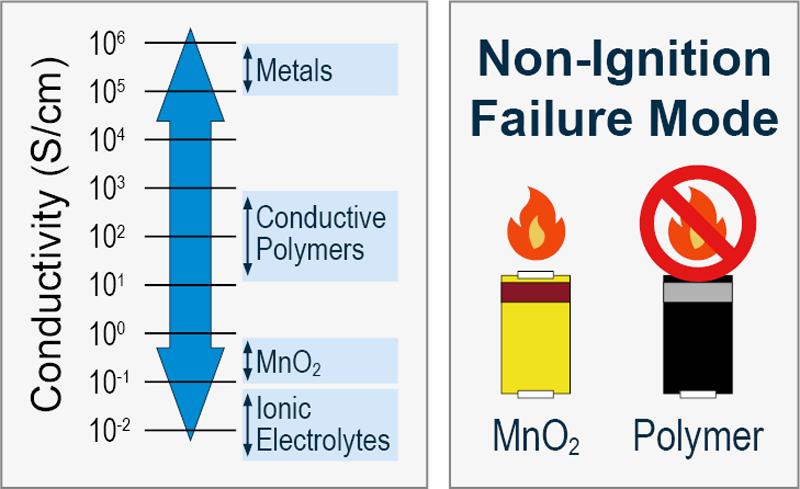
If a dielectric breakdown occurs during operation, the high current density at the defect site causes localized heating. This heat causes the conductive polymer to oxidize, rendering it non-conductive and effectively sealing the defect. This oxidation restores the insulating properties, preventing further failure and allowing the capacitor to continue operating. Notably, these capacitors are considered safer because their self-healing process does not generate oxygen, minimizing the risk of inflammation, as shown in Figure 2. The main applications are DC-DC voltage rail converters.
Click image to enlarge
Click image to enlarge
Weaknesses of tantalum polymer
Tantalum polymer capacitors offer several advantages over traditional electrolytic capacitors, making them desirable for various applications. However, they do have some drawbacks and cannot be used in all scenarios.
The use of polymer capacitors is not recommended for frequencies approaching or exceeding 1MHz, temperatures exceeding 150°C, or where maximum battery life depends on low leakage current.
Polymer capacitors are not suitable if the voltage is greater than 48V DC, the application requires ultra-low ESR (<< 4mΩ), low capacitance (< 0.68µF), or reverse bias.