Technical Features
December 2012

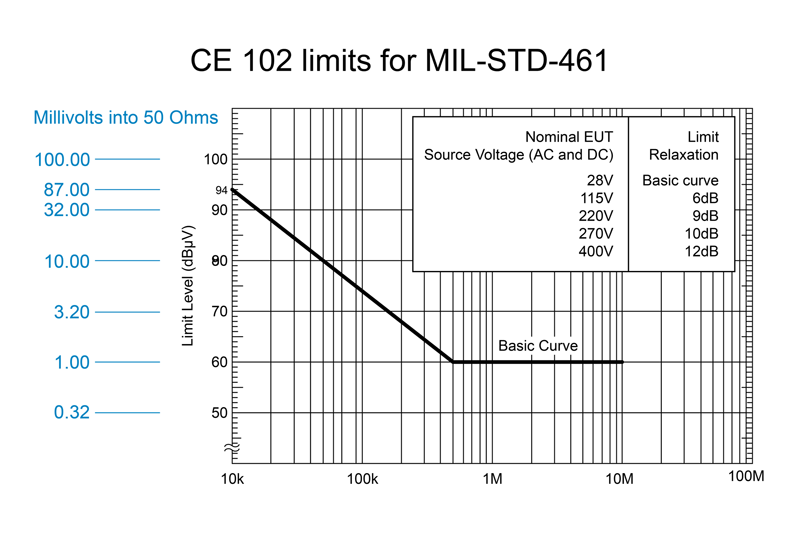
Figure 1: CE102 limits for MIL-STD-461. From the limits shown for 28V systems, we can see that at 500kHz and above, the limit is 1mV into 50Ω
Today's defense electronics need high-voltage-to-SELV conversion at unprecedented power levels and board densities. The specific challenge is converting 270V to a 28V or 48V bus while still meeting MIL-STD-461 conducted emissions limits (EMI), a requirement that is both a technical problem and a program schedule
. . . Learn More
Date:
10/28/2026
Click image to enlarge
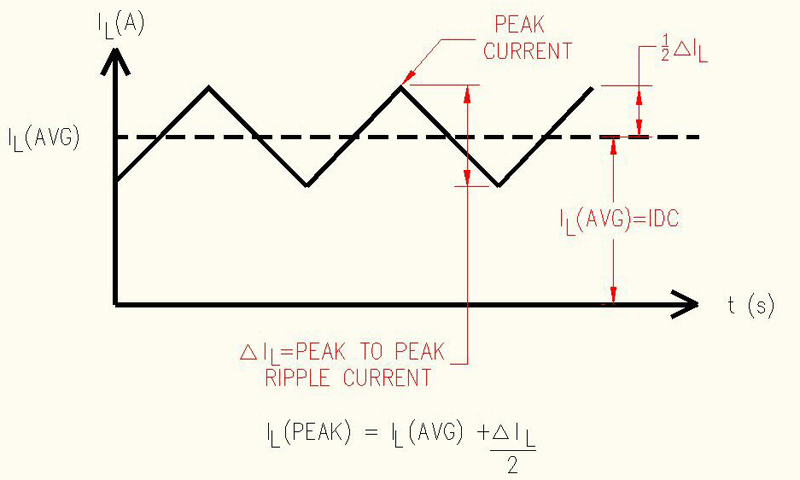
Figure 1: Inductor-current waveform
As high-tech electronic products and their power supplies continue to shrink in size, design engineers should look closely at the peak-current handling capability of power inductors.
Design engineers
. . . Learn More
Date:
12/23/2012

Click image to enlarge
Figure 1: SOA (a) and ZthJC (b) charts for the BSC014N04LS
Thermal challenges accompany almost all advances in power-electronic designs. Load cases not covered under a datasheet's parameters are often particularly problematic.
Each new MOSFET generation
. . . Learn More
Date:
12/19/2012

Click image to enlarge
Planners of photovoltaic power plants are no longer bound to string inverter concepts if multiple MMP(maximum power point)-trackers are required. Central inverter systems are, today, standard for
. . . Learn More
Date:
12/18/2012
Designers of solar power—photo-voltaic or PV—generating systems face some of the same problems as their counterparts in any other power-related technology: the need to constantly improve performance, reliability, longevity, and—above all—efficiency. As with any engineering endeavour, improved performance re
. . . Learn More
Date:
12/12/2012
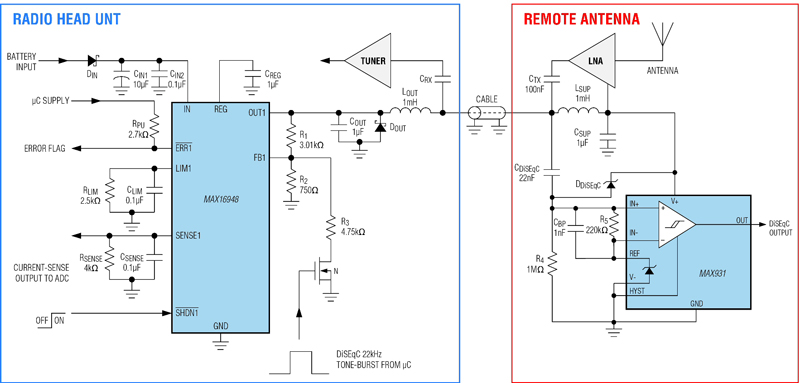
Click image to enlarge
Figure 1: The DiSEqC application circuit
The DiSEqC (digital satellite equipment control) standard is a communication protocol developed by Eutelsat used between a satellite receiver (decoder), defined as the master, and satellite peripheral
. . . Learn More
Date:
12/04/2012
Archive