Technical Features
February 2026

Click image to enlarge
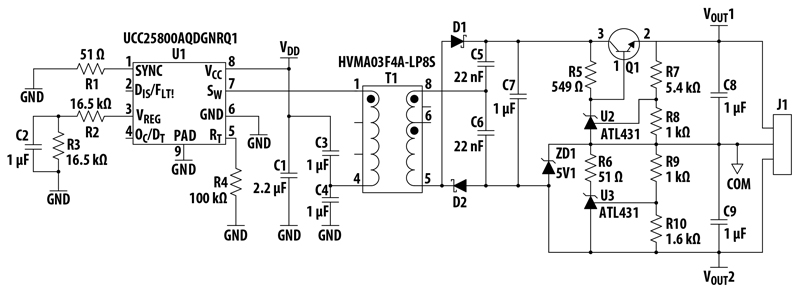
Figure 1: Gate driver circuit diagram with a Bourns transformer
While gate driver-based converters deliver improved efficiency, speed and signal integrity, their high frequency switching features can produce elevated levels of conducted electromagnetic interference (EMI), posing challenges to electromagnetic compatibility (EMC) and overall system reliability. To solve this
. . . Learn More
Date:
03/29/2026
Click image to enlarge
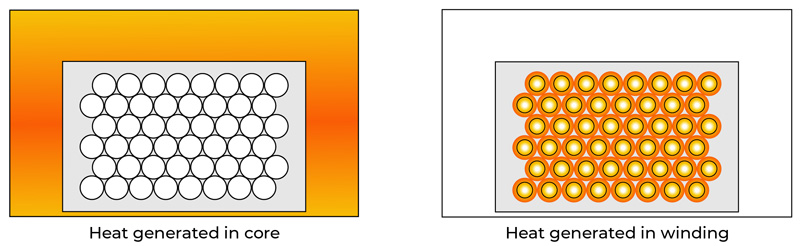
Figure1: Inductor Self-heating in the core vs the winding
The efficiency and the thermal properties of key components have very real implications for the success of any converter design. Switching FETs and inductors are generally the two most considered choices determining size and performance of any converter. Though made of vastly different materials of course, and with dif
. . . Learn More
Date:
02/28/2026

Click image to enlarge
Figure 1: The LTC7891 step-down (buck) converter schematic
Gallium nitride field-effect transistors (GaN FETs) offer faster switching speeds, smaller packages, and lower power losses than silicon FETs. These features allow power converters to run at higher frequencies, reducing overall solution size while maintaining high efficiency. While the basic DC-to-DC converter de
. . . Learn More
Date:
02/01/2026

Click image to enlarge
Figure 1: Stability versus Current
- Low current condition (Vds=200V)
- High current condition (Vds=200V)
Engineers working with Silicon Carbide (SiC) MOSFETs encounter this firsthand when parallel devices begin exhibiting unexpected oscillations. What starts as a subtle waveform irregularity on an oscilloscope trace can quickly reveal deeper design sensitivities in high-speed switching environments.
Parallel-connected SiC MOSFE
. . . Learn More
Date:
02/01/2026

Click image to enlarge
Figure 1: Software defined vehicle
Emerging SerDes standards such as OpenGMSL, MIPI A-PHY, and ASA are designed to support high-bandwidth, asymmetric data links between sensors and central processing units. These standards are crucial for managing the growing volume of sensor data, supporting zonal architecture, and ensuring functional safety in
. . . Learn More
Date:
02/01/2026

Click image to enlarge
Figure 1: Side-by-side comparison of cloud-based vision processing vs the instant result of an Edge AI camera
Since the global mainstreaming of generative AI in late 2022, AI now curates TikTok and Instagram, personalizes shopping on Amazon, helps us navigate in Google Maps, powers real-time translation, enables biometric authentication, and flags fraud in financial systems. AI is a daily utility, silently shaping our ch
. . . Learn More
Date:
02/01/2026
Archive