Notable & Newsworthy
    November 2016
    NYU Nanoscale breakthrough promises atomic-scale electronics

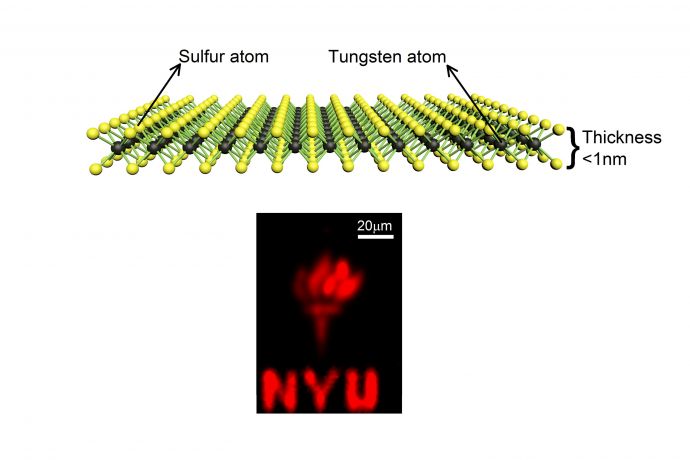
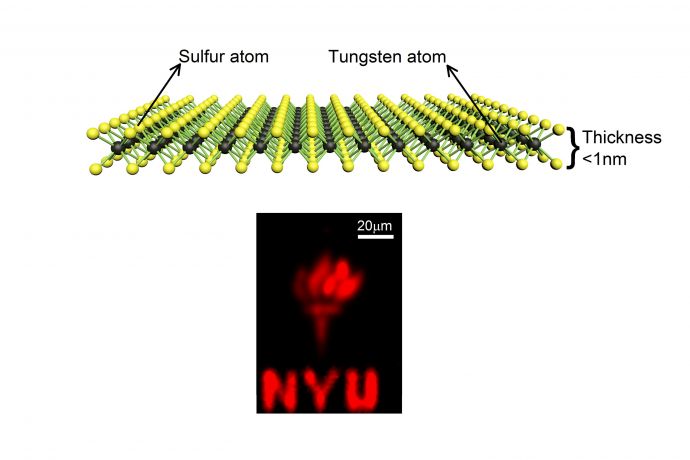
    At just one atom thick, tungsten disulfide allows energy to switch off and on, but it also absorbs and emits light, which could find applications in optoelectronics, sensing, and flexible electronics. The NYU logo shows the monolayer material emitting light
    Researchers at the NYU Tandon School of Engineering have pioneered a method for growing an atomic scale electronic material at the highest quality ever reported. In a paper published in Applied Physics Letters, Assistant Professor of Electrical and Computer Engineering Davood Shahrjerdi and doctoral student Ab
    . . . Learn More
    Date:
    11/29/2016
    Glow-in-the-dark dye could fuel liquid-based batteries

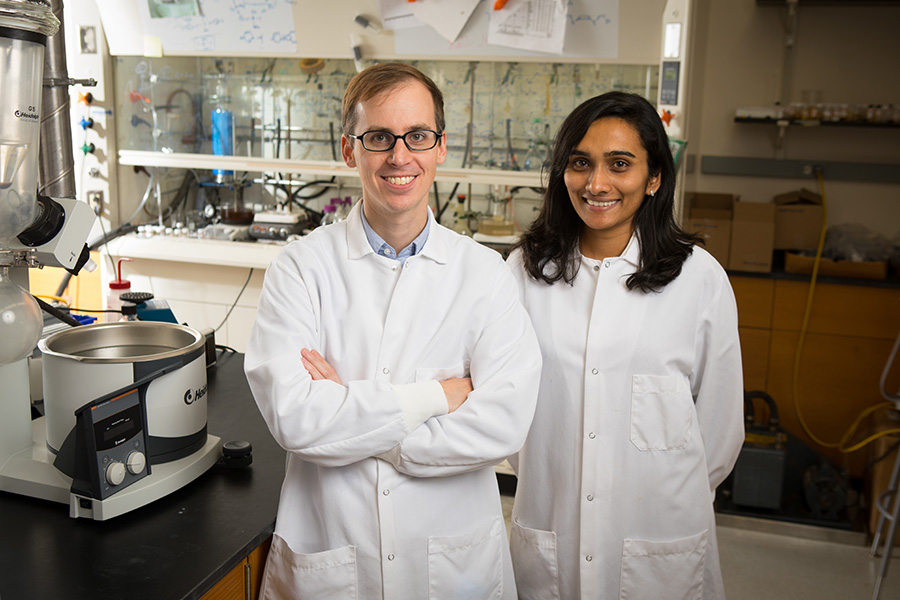
    The research team includes Timothy Cook, assistant professor of chemistry, and first author Anjula M. Kosswattaarachchi, a PhD student in chemistry
    Could a glow-in-the-dark dye be the next advancement in energy storage technology? UB scientists think so. They have identified a fluorescent dye called BODIPY as an ideal material for stockpiling energy in rechargeable, liquid-based batteries that could one day power cars and homes. BODIPY — short for boron-dip
    . . . Learn More
    Date:
    11/29/2016

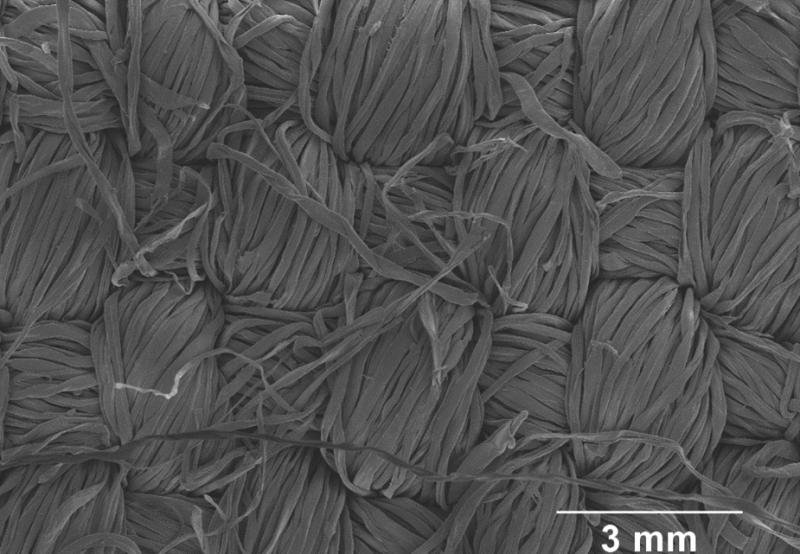
    Electron microscopy image of a conductive graphene/cotton fabric

    A new method for producing conductive cotton fabrics using graphene-based inks opens up new possibilities for flexible and wearable electronics, without the use of expensive and toxic processing steps. Wearable, textiles-based electronics present new possibilities for flexible circuits, healthcare and envir
    . . . Learn More
    Date:
    11/29/2016
    NMSU energy harvester to power pacemakers

    Abdessattar Abdelkefi, mechanical and aerospace engineering assistant professor, second from left, is pictured with three of his New Mexico State University Ph.D. students. From left, Rashid Naseer, Hichem Abdelmoula and Mostafa Hassanalian assist Abdelkefi with projects including an energy harvester for pacemakers.
    About 200,000 Americans have pacemakers implanted each year, and a College of Engineering professor at New Mexico State University is working on a mechanism to increase the longevity of the devices. Abdessattar Abdelkefi, mechanical and aerospace engineering assistant professor, is leading a project that designs br
    . . . Learn More
    Date:
    11/25/2016
    'Back to the Future' inspires nanotech-powered clothing

    Associate Professor Jayan Thomas

    MMarty McFly’s self-lacing Nikes in Back to the Future Part II inspired a UCF scientist who has developed filaments that harvest and store the sun’s energy — and can be woven into textiles. The breakthrough would essentially turn jackets and other clothing into wearable, solar-powered batteries that neve
    . . . Learn More
    Date:
    11/21/2016
    Novel Supercapacitor can be charged by body heat

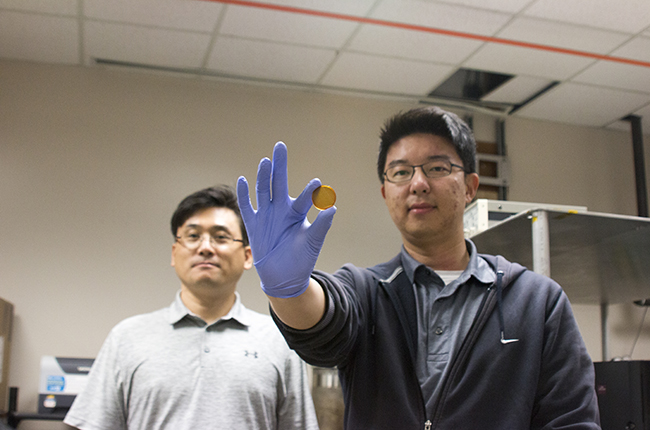
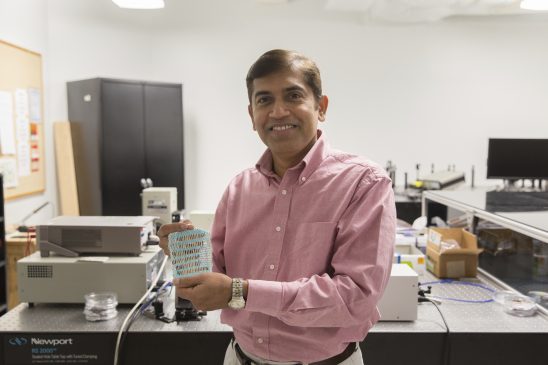
    From left: Dr. Choongho Yu and Ph.D. student, Suk Lae Kim.
    Dr. Choongho Yu, Gulf Oil/Thomas A. Dietz Career Development Professor II in the Department of Mechanical Engineering at Texas A&M University, and his graduate student group has developed a new concept of electrical energy storage: Thermally Chargeable Solid-state Supercapacitor. This innovative supercapac
    . . . Learn More
    Date:
    11/18/2016
    Nanoscale tech breakthrough at NYU promises atomic-scale electronics

    At just one atom thick, tungsten disulfide allows energy to switch off and on, but it also absorbs and emits light, which could find applications in optoelectronics, sensing, and flexible electronics. The NYU logo shows the monolayer material emitting light.
    Researchers at the NYU Tandon School of Engineering have pioneered a method for growing an atomic scale electronic material at the highest quality ever reported. In a paper published in Applied Physics Letters, Assistant Professor of Electrical and Computer Engineering Davood Shahrjerdi and doctoral student Ab
    . . . Learn More
    Date:
    11/18/2016
    Samsung Electronics announced an $8 billion deal to buy Harman International Industries, marking a major push into the auto electronics market and the biggest overseas acquisition ever by a South Korean firm. The electronics giant previously shunned big acquisitions, and the latest deal underscores a strategic sh
    . . . Learn More
    Date:
    11/14/2016
    Siemens is further building its Vision 2020 to shape Digital Industrial Enterprise by expanding its unique portfolio for industrial software. Siemens and Mentor Graphics announced that they have entered into a merger agreement under which Siemens will acquire Mentor for $37.25 per share in cash, which represents an
    . . . Learn More
    Date:
    11/14/2016
    Programmable-chip maker Lattice Semiconductor Corp said it is being bought by Canyon Bridge Capital Partners, a newly formed private equity firm backed by Chinese funding for $1.3 billion, the latest deal in the consolidating chip sector. Portland, Oregon-based Lattice makes programmable chips used in fast-g
    . . . Learn More
    Date:
    11/05/2016
    Self-healing printed electronics empower wearables

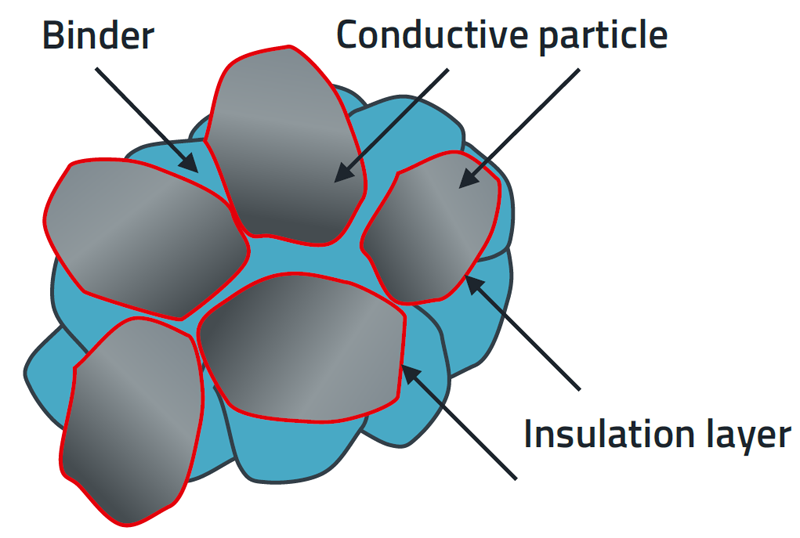
    Self-healing printed electronics

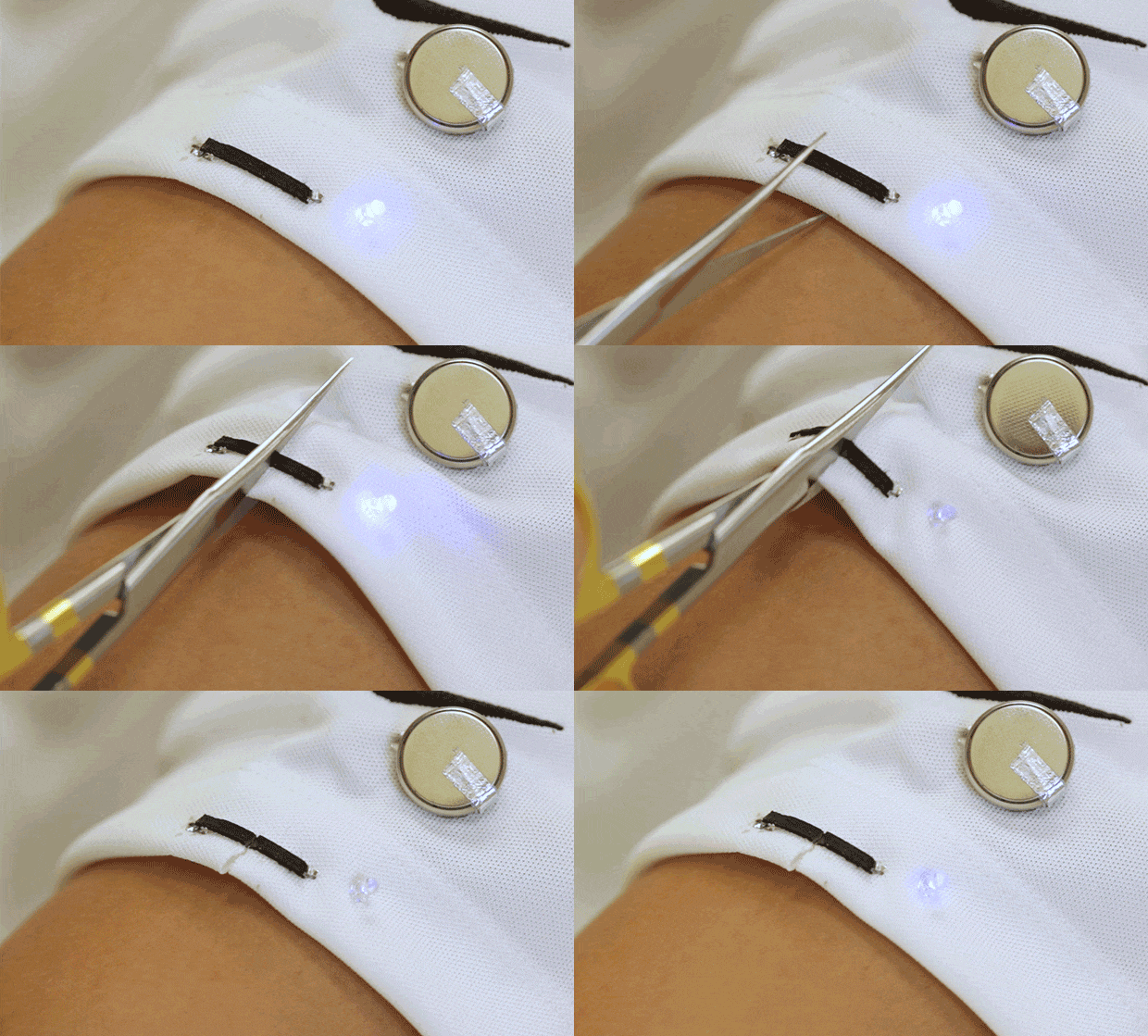
    A team of engineers at the University of California San Diego has developed a magnetic ink that can be used to make self-healing batteries, electrochemical sensors and wearable, textile-based electrical circuits. The key ingredient for the ink is microparticles oriented in a certain configuration by a magn
    . . . Learn More
    Date:
    11/04/2016
    Fraunhofer to unveil mini OLED for low-power eyewear at electronica

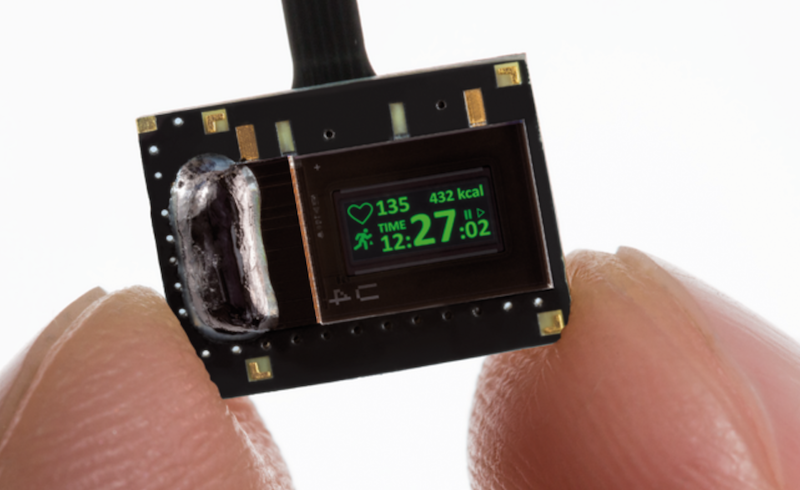
    Fraunhofer advanced microdisplay

    Data glasses mirror information to the eye without interfering with the wearer‘s vision. However, the battery runs down quickly, because the electronics consume a great amount of electricity while playing back the images. Fraunhofer researchers have developed an energy-saving display that reduces the power co
    . . . Learn More
    Date:
    11/04/2016
    Archive

    Power Systems Design

    146 Charles Street
    Annapolis, Maryland 21401 USA

    Power Systems Design

    Power Systems Design is a leading global media platform serving the power electronics design engineering community. It delivers in-depth technical content, industry news, and product insights to engineers and decision-makers developing advanced power systems and technologies.

    Published 12× per year across North America and Europe, Power Systems Design is distributed through online and fully digital editions, complemented by eNewsletters, webinars, and multimedia content. The platform covers key areas including power conversion, semiconductors, renewable energy, automotive electrification, AI power systems, and industrial applications—supporting innovation across the global electronics industry.