Technical Features

    October 2012
    Gate Driver Choices for High Power Density Intermediate Bus Converters in AI Servers

    Click image to enlarge

    Figure 1: Two-stage 48 V power architecture for an AI server, showing IBC and downstream point-of-load regulation
    ­1. AI server power delivery raises the density challenge AI accelerators concentrate more computing, and therefore more electrical power, within limited rack and board space. Supplying these loads is not simply a matter of increasing converter output. Every power‑delivery stage must balance conversion ef
    Date:
    08/31/2026
    Enhancing medical-product usability with IEC 62366

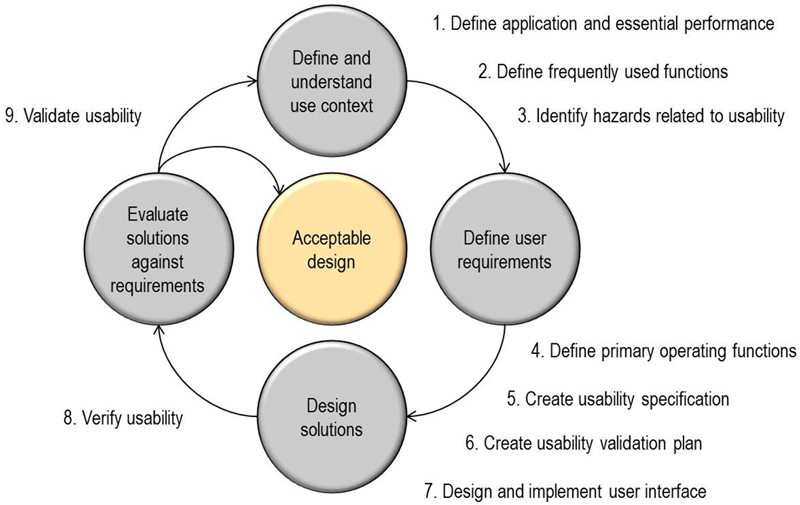
    Click image to enlarge

    Figure 1: General usability-engineering design cycle
    Manufacturers are required by the 3rd edition of IEC 60601-1 to avert the poor usability risks involved in identification, marking, and documents, which can be achieved by an "application of usability
    . . . Learn More
    Date:
    10/30/2012
    Power management of an artificial hand

    Click image to enlarge

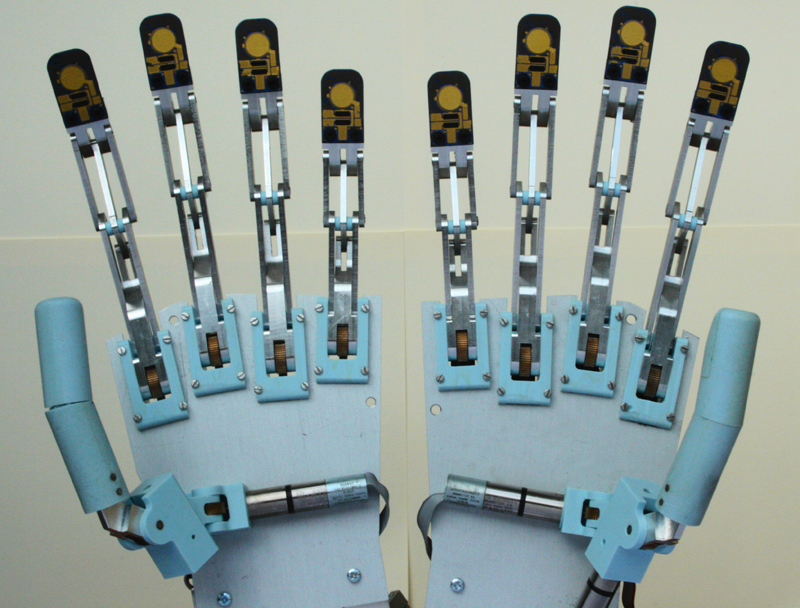
    Figure 1: Southampton hands. Across each palm can be seen a dc motor with a worm and wheel to rotate the thumb. Five other motors flex and extend the fingers and thumb. The fingertips have touch (force), slip/texture, and temperature sensors.
    For an upper extremity amputee, mass is a main factor when choosing an artificial hand. A hand should be lightweight so that high pressure points do not develop inside the plastic socket that attaches
    . . . Learn More
    Date:
    10/25/2012
    Optimize data rates in isolated SPI buses

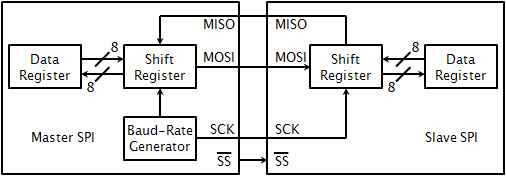
    Figure 1: The 8-bit data registers in the SPI Master and Slave devices link through the MISO and MOSI signals to form a 16-bit control register. (Click image to enlarge.)
    The simple SPI (Serial Peripheral Interface) bus is a popular serial interface commonly employed in automotive, industrial-control, and communication applications. To provide isolation and minimize
    . . . Learn More
    Date:
    10/21/2012
    Reliability of copper wire bonding for power devices

    Click image to enlarge

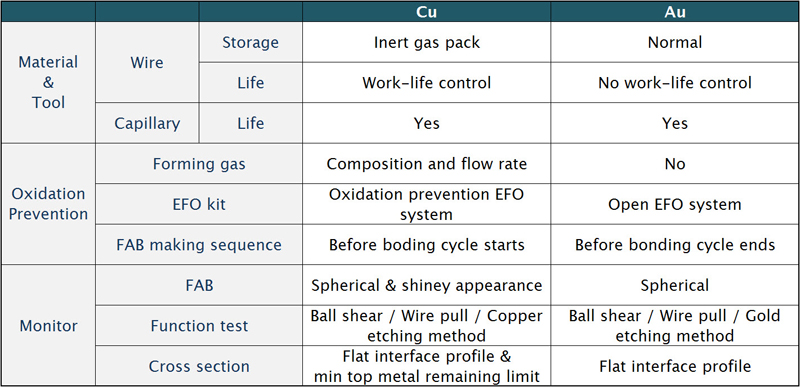
    Table 1: Process-control measures
    Though copper wire bonding developed nearly 30 years ago, it has only recently gained in popularity due to the rapid increase in the price of gold, which is now about 7,000 times that of copper (Reference
    . . . Learn More
    Date:
    10/19/2012
    The 60-W TV

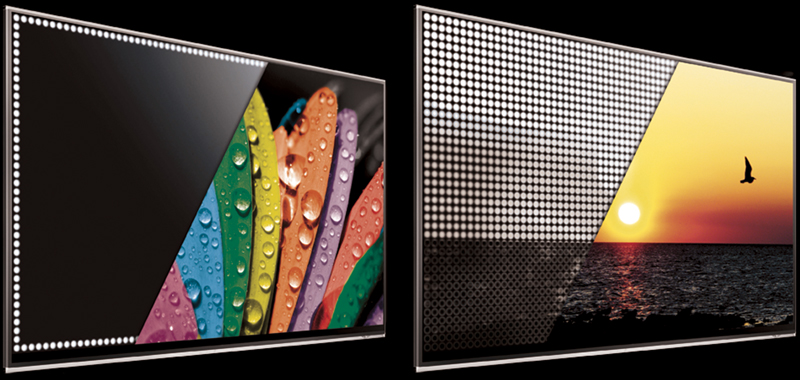
    Figure 1: The local-dimming function saves 10 to 20% of power on edge-lit systems (left) and 20 to 30% of power on direct back-lit TVs (right).
    TVs in households are regular companions for many people around the world. It is common that people have the TV on in a living room while preparing a meal in the kitchen. In many cases, the TV is
    . . . Learn More
    Date:
    10/18/2012
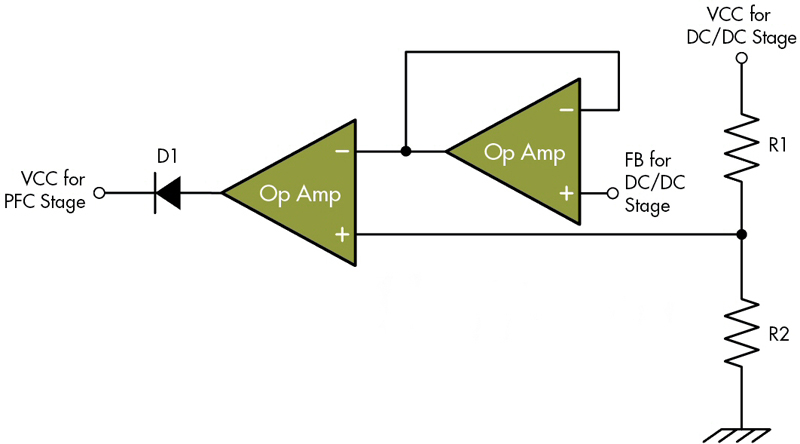
    Reducing standby power consumption for LED Lighting
    LEDs provide high-efficiency, environment-friendly characteristics, and a long life compared to conventional lighting sources. Therefore, they are becoming a primary light-source choice to reduce
    . . . Learn More
    Date:
    10/16/2012
    Archive

    Gate Driver Choices for High Power Density Intermediate Bus Converters in AI Servers

    Aug 31,2026
    Jeffrey Cumabig, Product Application Engineer, and Lei Song, Product Definition Engineer, both for gate drivers at Infineon Technologies AG

    Silicon Carbide Semiconductors: Gaining Widespread Adoption

    Jul 30,2026
    Jens Baringhaus, Chief Expert for Wideband Gap Technology and responsible for Bosch's SiC technology roadmap

    Innovation through Lean AI

    Jun 1,2026

    Crystal Chen, Product Marketing & Product Management, Infineon HiRel

    Molded Power Inductors

    May 29,2026
    Efrain Bernal-Alzate, Design Engineer, Würth Elektronik eiSos

    Power Systems Design

    146 Charles Street
    Annapolis, Maryland 21401 USA

    Power Systems Design

    Power Systems Design is a leading global media platform serving the power electronics design engineering community. It delivers in-depth technical content, industry news, and product insights to engineers and decision-makers developing advanced power systems and technologies.

    Published 12× per year across North America and Europe, Power Systems Design is distributed through online and fully digital editions, complemented by eNewsletters, webinars, and multimedia content. The platform covers key areas including power conversion, semiconductors, renewable energy, automotive electrification, AI power systems, and industrial applications—supporting innovation across the global electronics industry.