Technical Features

    November 2024
    Transformer Design Comparisons for Mitigating EMI in Gate Driver Circuits

    Click image to enlarge

    Figure 1: Gate driver circuit diagram with a Bourns transformer

    While gate driver-based converters deliver improved efficiency, speed and signal integrity, their high frequency switching features can produce elevated levels of conducted electromagnetic interference (EMI), posing challenges to electromagnetic compatibility (EMC) and overall system reliability. To solve this
    Date:
    03/29/2026
    QSPICE: A Mission to Get SPICE Right

    Click image to enlarge

    Figure 1: MOSFET channel punch-through showing outputs from previous SPICE simulators vs. QSPICE
    Qorvo’s QSPICE™ simulator for analog and mixed-signal simulation provides power designers with the tools to confidently evaluate their designs. Free to use, QSPICE improves SPICE basics, supports large amounts of digital logic without performance penalties, and delivers the speed and accuracy needed for rel
    . . . Learn More
    Date:
    11/29/2024
    Maximize SiC MOSFET Performance with Optimized Gate Drivers

    Click image to enlarge

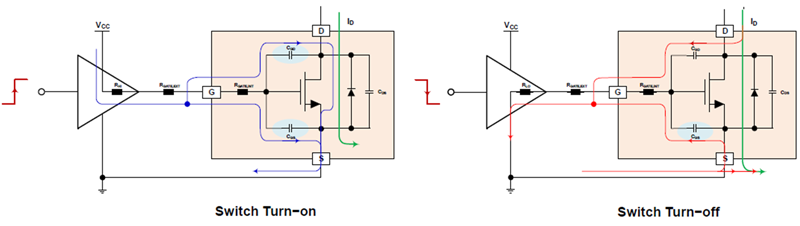
    Figure 1: Gate driver’s MOSFET driving for turn-on/off operation and current path. The MOSFET model includes parasitic capacitances such as CGD and CGS, which must be charged and discharged

    ­Silicon MOSFETs and IGBTs have traditionally dominated the market for power electronic applications such as uninterruptible power supplies, industrial drives and pumps and electric vehicles (EVs). Market demand for smaller form-factors however, along with various pressures on designers to improve power efficiencies, ha
    . . . Learn More
    Date:
    11/01/2024
    High-Current, High-Performance Buck-Boost Regulator

    Click image to enlarge

    Figure 1: The LTM4607 power stage schematic

    ­There are many applications with wide input and/or output voltage ranges, such as a battery-powered system. The power supply needs to regulate its output voltage while the input voltage can be lower or higher than the output voltage. A four-switch buck-boost topology can offer the highest efficiency and power den
    . . . Learn More
    Date:
    11/01/2024
    The Future of Powering the World

    Click image to enlarge

    Figure 1a: Edison
    ­For those who have watched the TV series “The Big Bang Theory,” you may recall Sheldon’s character talking about the rivalry between Thomas Edison and Nikola Tesla. Their feud became known as the “War of Currents,” which occurred in the 1880s. Back then, as electricity was emerging as an essential se
    . . . Learn More
    Date:
    11/01/2024
    More Than Simply Volts and Amps

    Click image to enlarge

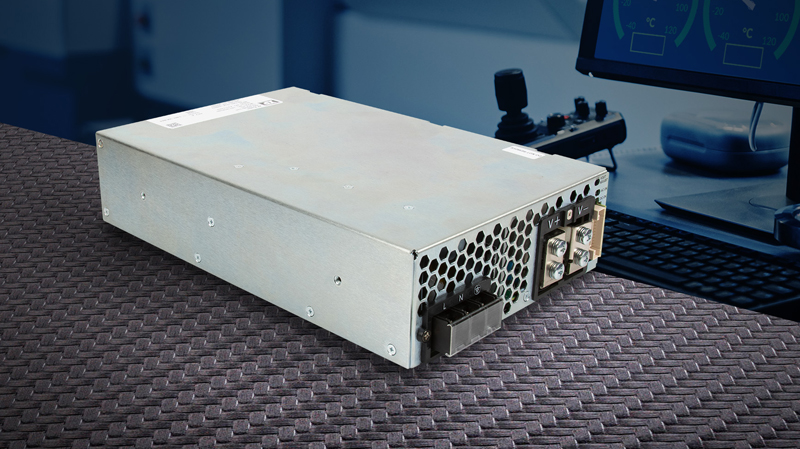
    Figure 1: XP Power’s recently launched HPF3K0 delivers up to 3kW of power from a universal single-phase input with configurable single output voltages ranging from 24 to 60V

    ­Over the years, increasing amounts of functionality and features have helped enhance the safety, performance, and reliability of power supplies. This article looks beyond the volts and amps to discuss how digital control and its programmability can benefit semiconductor manufacturing equipment designers. The semicondu
    . . . Learn More
    Date:
    11/01/2024
    Navigating Security Standards for Safer Product Design

    Click image to enlarge

    ­In the ever-evolving landscape of data security, electronics engineers face the daunting task of designing systems that not only stop sophisticated cyber threats but also comply with stringent legislative and regulatory frameworks. This challenging requirement stems from a highly dynamic cyber threat landscape, wi
    . . . Learn More
    Date:
    11/01/2024
    Addressing Power Quality and EMC Together

    Click image to enlarge

    Figure 1: Unwanted harmonics can disrupt electrical systems, causing overheating, equipment damage and inefficiencies in energy transmission and consumption

    ­When designers are working on developing new electronic products or components, they often struggle to consider the issue of electromagnetic compatibility (EMC) and what that means in terms of electromagnetic interference (EMI). The best way of tackling this problem is, of course, to incorporate filters into th
    . . . Learn More
    Date:
    11/01/2024
    Power Delivery Considerations for HPC/AI Devices

    Click image to enlarge

    Figure 1: HPC devices for AI application demand a significant amount of power

    ­With the insatiable need for more power, high-performance computing (HPC) products create challenges for test cells in delivering and managing high power during manufacturing test.  According to data from Market.us, the global computing power market is forecasted to grow from $45.7 billion in 2023 to $8
    . . . Learn More
    Date:
    11/01/2024
    Optimizing EV On-Board Charger Protection: A Superior Solution

    Click image to enlarge

    ­Traditional solutions, like NTC thermistors and standalone MOVs, often need more response time and reliability. This article explores how the SIDACtor+MOV combination offers a superior, cost-effective solution for safeguarding EV on-board chargers, providing faster response, lower clamping voltage, and enhanced du
    . . . Learn More
    Date:
    11/01/2024
    Archive

    Transformer Design Comparisons for Mitigating EMI in Gate Driver Circuits

    Mar 29,2026
    Matthew Russell, Master’s student at University College Cork, and a student engineer at Bourns Electronics Ireland

    1250 V/1700 V GaN HEMTs for NVIDIA 800 VDC Architecture

    Jan 31,2026
    Kamal Varadarajan & Chris Lee, Power Integrations

    Future-Proof Automotive High-Voltage-to-SELV Conversion

    Dec 30,2025
    Greg Green, Director of Automotive Marketing, Vicor

    Power Systems Design

    146 Charles Street
    Annapolis, Maryland 21401 USA

    Power Systems Design

    Power Systems Design is a leading global media platform serving the power electronics design engineering community. It delivers in-depth technical content, industry news, and product insights to engineers and decision-makers developing advanced power systems and technologies.

    Published 12× per year across North America and Europe, Power Systems Design is distributed through online and fully digital editions, complemented by eNewsletters, webinars, and multimedia content. The platform covers key areas including power conversion, semiconductors, renewable energy, automotive electrification, AI power systems, and industrial applications—supporting innovation across the global electronics industry.