Technical Features

    October 2025
    Transformer Design Comparisons for Mitigating EMI in Gate Driver Circuits

    Click image to enlarge

    Figure 1: Gate driver circuit diagram with a Bourns transformer

    While gate driver-based converters deliver improved efficiency, speed and signal integrity, their high frequency switching features can produce elevated levels of conducted electromagnetic interference (EMI), posing challenges to electromagnetic compatibility (EMC) and overall system reliability. To solve this
    Date:
    03/29/2026
    Current Multipliers: The Obvious Choice for Powering AI Processors and Other Demanding Applications

    Click image to enlarge

    Figure 1: Conventional Intermediate Bus Architectures use a fixed-ratio isolated bus converter (IBC) to step down 48V to a 12V intermediate rail, which then feeds niPOL converters
    AI processors can draw up to thousands of amps while operating at voltages well below 1V. This current demand is unprecedented and has turned the power delivery network (PDN) into a major system bottleneck. With every amp pushed through PCB or substrate copper power planes, conductive losses and, thermal m
    . . . Learn More
    Date:
    10/31/2025
    How Modern ATEX Design Enables Intelligent Control at the Edge

    Click image to enlarge

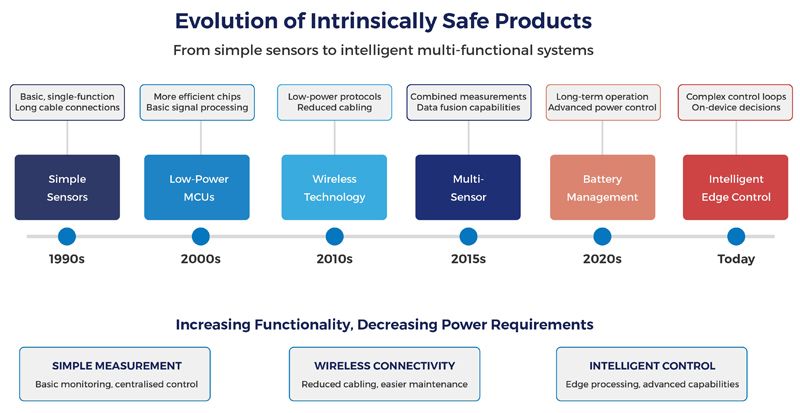
    Figure 1: Evolution of Intrinsically Safe Products

    ­Manufacturers are under continual pressure to create advanced electronic systems for hazardous environments. In the past, intrinsically safe (IS) designs were limited to basic sensors that transmitted data to distant control rooms. Now, modern low-power electronics have opened up new possibilities for intri
    . . . Learn More
    Date:
    10/01/2025
    Enabling Digital Transformation in Industrial Environments

    Click image to enlarge

    Figure 1: Bird’s-eye view of an FPGA architecture showing an array of programmable logic blocks interconnected by configurable routing.

    ­Whether in the pursuit of greater efficiency, data-driven insights, artificial intelligence (AI) applications, or beyond, businesses across sectors are continuing to pursue digital transformation. In fact, the International Data Corporation (IDC) projects worldwide spending on digital transformation efforts wi
    . . . Learn More
    Date:
    10/01/2025
    How IoT is Driving Sustainability Across Industries in 2025

    Click image to enlarge

    Figure 1: An area driving sustainable manufacturing innovation is automated robotic systems that improve warehouse efficiency, reduce labor costs, lower the risk of errors and minimize the environmental impact of transportation

    ­In 2025, IoT is expected to emerge as a powerful force in advancing sustainability initiatives across industries, helping organizations reduce their environmental impact while improving operational efficiency. IoT is not just a product, but the architecture around a product, using sensors, connectivity and oth
    . . . Learn More
    Date:
    10/01/2025
    Floating Ground Non-isolated Half-Bridge Gate Drivers

    Click image to enlarge

    Figure 1: A step-down power converter with remote load

    ­Power conversion is a core function of virtually every electronics design today. Ideally, any conversion from one DC voltage, say 9 V, to a different level, for example, 24 V, should be as efficient as possible, with minimal losses. To accommodate different voltages, current requirements, and power density, se
    . . . Learn More
    Date:
    10/01/2025
    Unlocking the Full Potential of Virtual Prototyping

    Click image to enlarge

    Figure 1: Virtual prototypes and virtual testing accelerate the development process and time to market at a lower cost versus transitional approaches (courtesy of ESI Group)

    ­In roughly 80 years of computer simulation, we’ve seen its benefits span across industries and domains. From modeling gravitational waves to designing a circuit board, the intent remains unchanged: to represent the physical world as accurately as possible. In the last several years, multi-domain integrati
    . . . Learn More
    Date:
    10/01/2025
    Solving Multiphase Power Challenges in Compact, High-Efficiency Systems with Coupled Inductors

    Click image to enlarge

    Figure 1: Simplified equivalent circuit for simulation

    ­Whether in data centers, electric vehicles, or industrial automation, engineers face increasing demands to deliver higher power with less space while minimizing losses all while managing thermal loads without complex cooling infrastructure. A central trend in these applications is the adoption of 48-volt p
    . . . Learn More
    Date:
    10/01/2025
    A Deep Dive into High-Efficient LED Drivers for Low-Profile Display Applications

    Click image to enlarge

    Figure 1: Conventional LED boost architecture simplified circuit diagram

    ­Laptop battery drain has a significant impact on the battery run-time of the laptop system. In this article, we explore the efficiency and performance of the LED driver and introduce a novel, 2-stage architecture that consists of a synchronous boost followed by a charge pump multiplier. We compare the 2-stage ar
    . . . Learn More
    Date:
    10/01/2025
    Archive

    Transformer Design Comparisons for Mitigating EMI in Gate Driver Circuits

    Mar 29,2026
    Matthew Russell, Master’s student at University College Cork, and a student engineer at Bourns Electronics Ireland

    1250 V/1700 V GaN HEMTs for NVIDIA 800 VDC Architecture

    Jan 31,2026
    Kamal Varadarajan & Chris Lee, Power Integrations

    Future-Proof Automotive High-Voltage-to-SELV Conversion

    Dec 30,2025
    Greg Green, Director of Automotive Marketing, Vicor

    Power Systems Design

    146 Charles Street
    Annapolis, Maryland 21401 USA

    Power Systems Design

    Power Systems Design is a leading global media platform serving the power electronics design engineering community. It delivers in-depth technical content, industry news, and product insights to engineers and decision-makers developing advanced power systems and technologies.

    Published 12× per year across North America and Europe, Power Systems Design is distributed through online and fully digital editions, complemented by eNewsletters, webinars, and multimedia content. The platform covers key areas including power conversion, semiconductors, renewable energy, automotive electrification, AI power systems, and industrial applications—supporting innovation across the global electronics industry.
