Technical Features

    October 2021
    Transformer Design Comparisons for Mitigating EMI in Gate Driver Circuits

    Click image to enlarge

    Figure 1: Gate driver circuit diagram with a Bourns transformer

    While gate driver-based converters deliver improved efficiency, speed and signal integrity, their high frequency switching features can produce elevated levels of conducted electromagnetic interference (EMI), posing challenges to electromagnetic compatibility (EMC) and overall system reliability. To solve this
    Date:
    03/29/2026
    Powering Clustered AI Processors

    Click image to enlarge

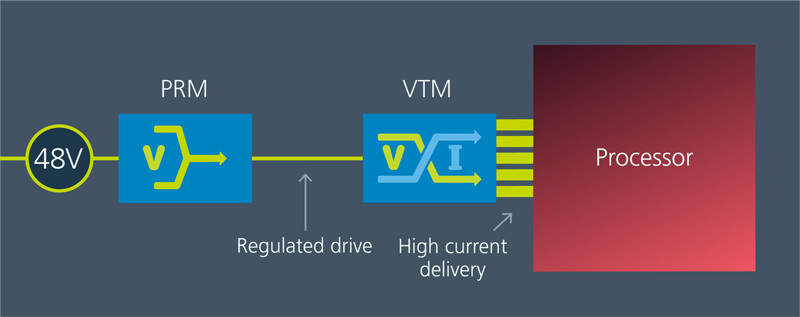
    Figure 1: PRM™ and VTM™ are the building blocks of FPA. PRMs are selected based on the system input voltage range and power requirements; VTMs are selected based on the output voltage range and current requirements. The PRM can be mounted anywhere in the system where convenient; the VTM should be mounted as close to the processor core as possible

    The recent introduction of new clustered AI ASIC processor based supercomputers are pushing the boundaries of power delivery networks to levels that were never imagined just a few years ago. With current levels approaching 100 kiloamps/ASIC cluster, innovation is needed across power system architectures, topologies, con
    . . . Learn More
    Date:
    10/27/2021
    Delivering a Complete Active Power Factor Correction Solution in a Single Package: Part 2 of 4

    Click image to enlarge

    HiperPFS-4 with Integrated 600 V Qspeed Diode Application

    Two of the main issues for modern power supply designers are the elimination of unwanted line harmonic currents and ensuring a power factor that is as close to unity as possible. Unwanted harmonics can cause transmission equipment to overheat and pose interference challenges that must be addressed later; both a
    . . . Learn More
    Date:
    10/26/2021
    A Quicker, More Efficient Way to Market for BLDC Designs: Part 1 of 4

    Click image to enlarge

    BridgeSwitch Application

    Electric motors are currently the largest consumers of electricity in the world by a large margin. The Energy Research Centre of the Netherlands (ECN) estimates that 45% of all electricity generated globally is consumed by electric motors. Therefore, as part of the push towards higher efficiency, legislation is
    . . . Learn More
    Date:
    10/26/2021
    Don’t Stress with Nomophobia: Part 4 of 4

    Click image to enlarge

    InnoSwitch3-PD

    If we didn’t know it before Covid-19, we do now: always being connected via your smart mobile device is essential. Track and Trace – scan the QR code, order online, pay without cash, watch an instructional video, send a selfie, use an app to summon a taxi, or count your steps as part of a fitness program. He
    . . . Learn More
    Date:
    10/25/2021
    Enhance AC Line Switching Efficiency and Reliability in HBA and Smart Home Applications by Using Lossless Zero-Cross Detection: Part 3 of 4

    Click image to enlarge

    LinkSwitch-TNZ

    Optimizing the performance of devices that turn AC line power on and off is an important consideration in a growing variety of applications, including home/building automation (HBA), Internet of Things (IoT)-enabled appliances, smart switches and plugs, dimmers, and occupancy sensors, and especially in designs tha
    . . . Learn More
    Date:
    10/25/2021
    Powering IoT Modules w/ Supercapacitors, Solar Panels, and Power Management ICs

    Click image to enlarge

    Figure 1: A schematic view of Analog Devices’ LTC31102A, bidirectional, buck-boost DC/DC regulator and charger/balancer

    To further improve IoT modules, many manufacturers are developing set-and-forget IoT modules designed to either eliminate batteries or extend battery life so significantly that end-users rarely to never have to concern themselves with powering their IoT modules. In pursuit of this goal, IoT module manufactu
    . . . Learn More
    Date:
    10/12/2021
    Would You Like to Have a Little More? The Power Supply in the Industrial Interface Sector

    Click image to enlarge

    Figure 1: Schematic diagram of a sensor transmission line in an industrial environment
    Summary This article shows the challenges an extended IoT system can pose in terms of EMC and thus also functionally. Potential leakage currents, inductively and capacitively coupled interference can disrupt data transmissions from wired sensors. To reduce these influences, decoupled, i.e., galvanically isolated
    . . . Learn More
    Date:
    10/04/2021
    The BYLink Power Management Concept

    Click image to enlarge

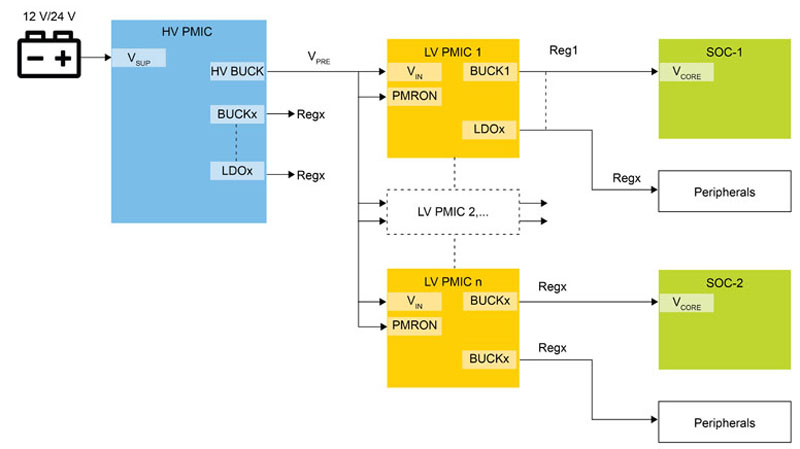
    Figure 1: General concept of high and low-voltage PMICs connected together

    In automotive systems, the 12 V and 24 V supply from the battery is used and derived in multiple supply rails to satisfy the system power demand. NXP’s portfolio of safety PMICs with embedded system features can be classified in two main categories: the high-voltage PMICs (HV PMIC) and low-voltage PMICs (LV PM
    . . . Learn More
    Date:
    10/01/2021
    Understanding the Factors Affecting Heat Loss

    Click image to enlarge

    Figure 1: Measuring heat loss

    Troubleshooting any inefficiencies and reducing heat loss can improve the efficiency of heating systems and save costs. Here, it breaks down the factors related to heat loss and explains how to calculate predicted heat loss for your application. Heat loss is the intentional or unintentional movement of heat f
    . . . Learn More
    Date:
    10/01/2021
    Haptic Devices Add Positive Feedback to the Automotive Experience

    Click image to enlarge

    Figure 1. Haptic use within a car
    Our five senses keep us alive: we instinctively draw back from things that are too hot or loud that cause pain. Our environment has defined how these reactions developed over time. Non-language communication that takes advantage of innate perception Our sense of balance and other innate mechanisms have
    . . . Learn More
    Date:
    10/01/2021
    Negative Resistance: Selecting the Optimal Capacitor for Your DC-DC Converter

    Click image to enlarge

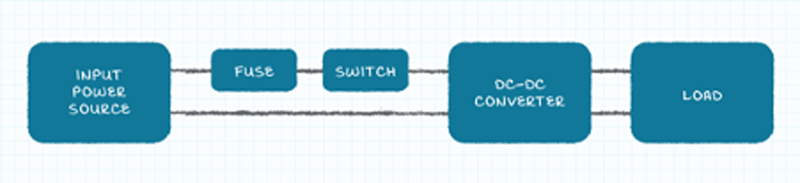
    Figure 1: An example of a standard dc-dc converter application
    If your DC-DC converter doesn’t work, you might check all the obvious causes that it could stem from - such as it not being plugged in correctly, not turned on, the input fuse having blown, etc. - none of which appear to be the issue.  So you are completely perplexed as to why it won’t play ball. But, ha
    . . . Learn More
    Date:
    10/01/2021
    Digital Power Supply Control Adds Value to IoT Applications

    Click image to enlarge

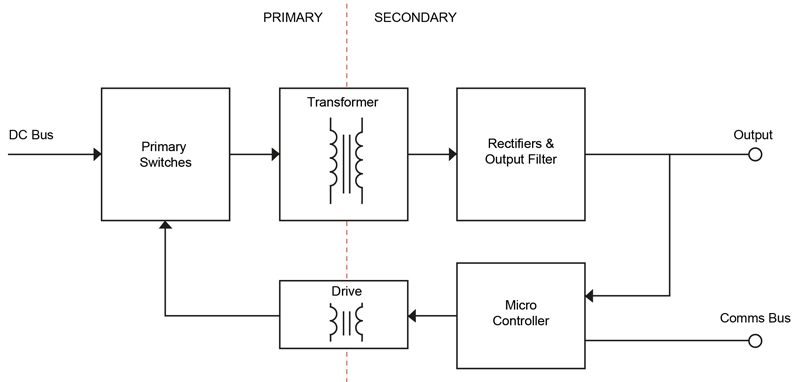
    Figure 1 - Analogue power supply with simple digital interface
    Digital control in power supplies can mean different things ranging from simple digital signalling of status/alarms and on/off control of a traditional analogue controller, through addition of more sophisticated functions with a simple microcontroller, all the way through to full implementation of feedback loop comp
    . . . Learn More
    Date:
    10/01/2021
    Accelerating Innovation at the Edge

    Click image to enlarge

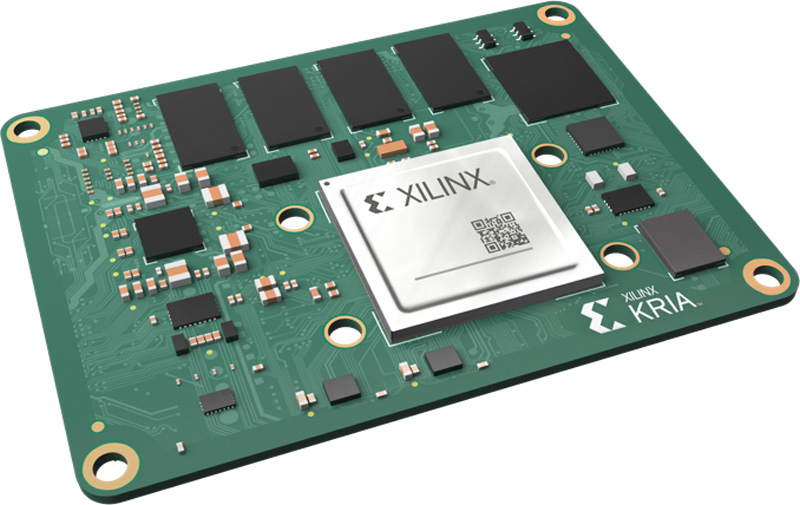
    Figure 1: Kria K26 SOM

    When deploying a system at the edge, power consumption, footprint, and cost are all limiting factors. Increasing processing demands, within the limitations of edge processing, mean that providing the required performance level is challenging. While CPUs have experienced improvements at the edge, the gains have sl
    . . . Learn More
    Date:
    10/01/2021
    Enabling Efficient Power Consumption in IIoT Applications

    Click image to enlarge

    Figure 1: Industrial Internet of Things is being integrated into many modern manufacturing processes

    Offering a wide range of benefits, including greater reliability, enhanced safety, minimal downtime, enhanced productivity, and cost-effectiveness, IIoT is becoming critical to the manufacturing industry. However, power consumption is a key concern in IIoT systems. For example, remote monitoring and real-time da
    . . . Learn More
    Date:
    10/01/2021
    Backup Power Considerations for the Digital Transformation

    Click image to enlarge

    Figure 1. The acceleration of the digital transformation should force engineers to rethink their approach to backup power to ensure systems are adequately protected

    Advancements such as the Internet of Things, automation and cloud infrastructure have gone from competitive advantages to business necessities to accommodate remote work, reductions in staffing and other critical challenges brought on by the pandemic. This acceleration should force engineers to rethink their app
    . . . Learn More
    Date:
    10/01/2021
    Powering Industrial Innovation with Next-Gen Connectivity

    Click image to enlarge

    Figure 1. The skilled manufacturing worker of the future will have IoT expertise in a hybrid environment where employees and robots work together

    IoT-enabled devices share vast amounts of data via wired or wireless networks to provide real-time information about the state of “the thing” that is being monitored. Furthermore, connected devices have been advancing business operations and completely revolutionizing the way information is collected and proce
    . . . Learn More
    Date:
    10/01/2021
    Archive

    Transformer Design Comparisons for Mitigating EMI in Gate Driver Circuits

    Mar 29,2026
    Matthew Russell, Master’s student at University College Cork, and a student engineer at Bourns Electronics Ireland

    1250 V/1700 V GaN HEMTs for NVIDIA 800 VDC Architecture

    Jan 31,2026
    Kamal Varadarajan & Chris Lee, Power Integrations

    Future-Proof Automotive High-Voltage-to-SELV Conversion

    Dec 30,2025
    Greg Green, Director of Automotive Marketing, Vicor

    Power Systems Design

    146 Charles Street
    Annapolis, Maryland 21401 USA

    Power Systems Design

    Power Systems Design is a leading global media platform serving the power electronics design engineering community. It delivers in-depth technical content, industry news, and product insights to engineers and decision-makers developing advanced power systems and technologies.

    Published 12× per year across North America and Europe, Power Systems Design is distributed through online and fully digital editions, complemented by eNewsletters, webinars, and multimedia content. The platform covers key areas including power conversion, semiconductors, renewable energy, automotive electrification, AI power systems, and industrial applications—supporting innovation across the global electronics industry.